
Variational Review & Trading Guide
DEXVariational Omni is an invite-only perpetuals venue on Arbitrum with no maker or taker fees, quoting crypto, stock and commodity markets by RFQ.
We may earn a commission if you sign up.How we choose
Key facts
- Type
- Decentralized exchange (DEX)
- Custody
- Self-custody (you hold your keys)
- KYC
- Not required
- Products
- Perpetuals
- Perps fees
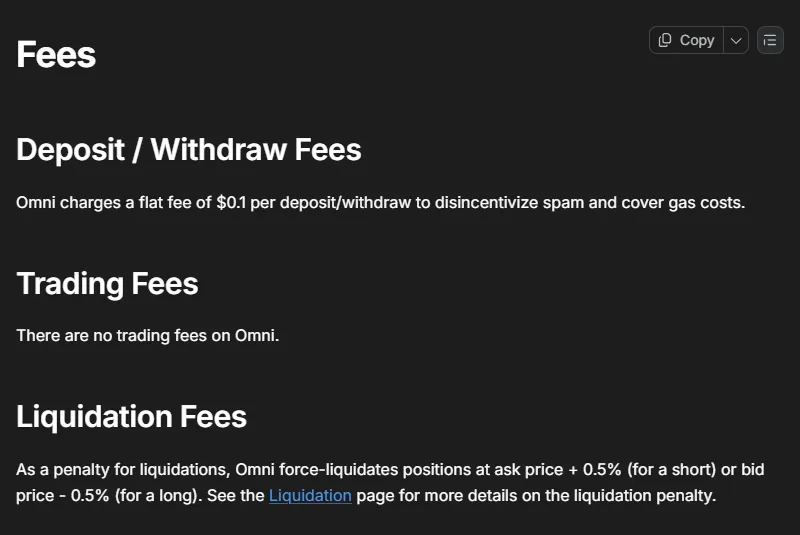
- No maker or taker fee. The cost is the bid-ask spread quoted by the Omni Liquidity Provider. Flat $0.10 per deposit or withdrawal. 0.5% liquidation penalty.
- Max leverage
- Up to 50x
- Chains
- Arbitrum
- Points program
- LiveLaunched December 17, 2025, with points distributed every Friday; the docs say weekly distributions end no later than the end of Q4 2026.
- Restricted regions
- United States, Canada, Taiwan, Cuba, Iran, North Korea and 10 more
What is Variational?
Variational is a derivatives protocol on Arbitrum. Its trading app, Omni, is a perpetuals venue with no maker or taker fees, aimed at traders who want crypto, stock and commodity markets in one wallet-based account. Omni is in private beta, so you need an access code to open an account.
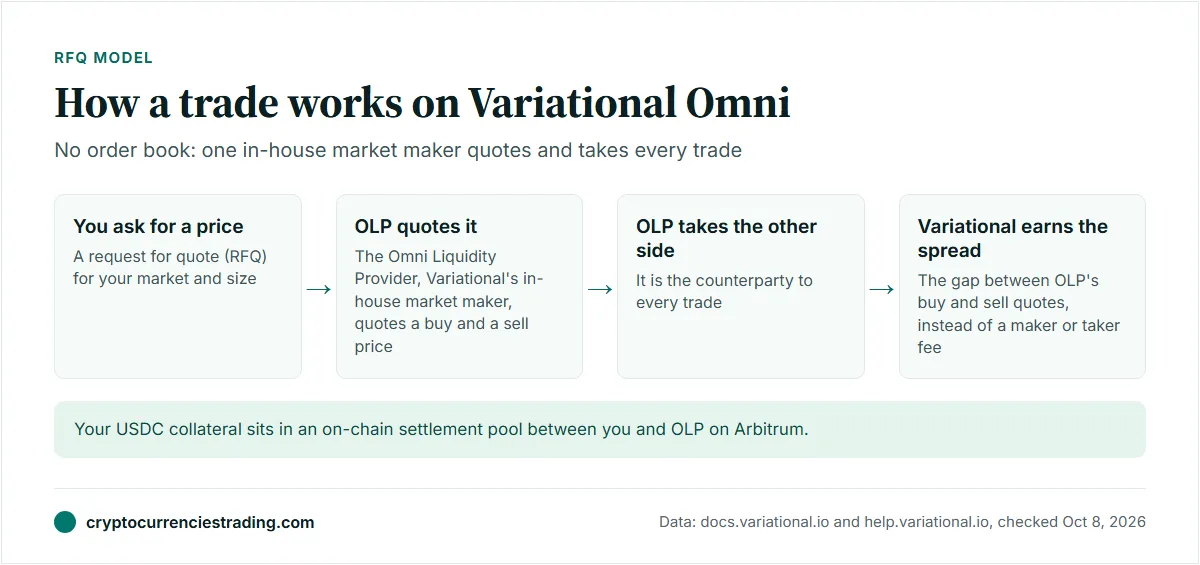
Omni has no order book. It uses a request-for-quote (RFQ) model: you ask for a price, and one in-house market maker, the Omni Liquidity Provider (OLP), quotes it and takes the other side of every trade. Variational earns the spread between OLP’s buy and sell quotes instead of a fee.
The account is self-custody. You connect your own EVM wallet and deposit USDC on Arbitrum, and your collateral sits in an on-chain settlement pool between you and OLP. The help center says Variational never holds your keys or funds.
On October 31, 2026 the official stats API listed 581 markets, 563 perpetuals and 18 swaps, which the docs group as crypto, equity, commodity, FX, index and pre-IPO. DefiLlama showed about $1.10 billion of open interest on Variational on October 8, 2026.
Perpetuals on Variational
Every market on Omni is a derivative settled in USDC; there is no spot trading. Most listings are perpetual futures on crypto, stocks, ETFs, indices, commodities and pre-IPO companies. Omni also lists swaps on indices, FX and commodities, a separate instrument with daily funding that, for now, trades in set hours with isolated margin only.
Leverage runs from 1x to 50x, though the help center says some newer TradFi markets are capped at 20x. Margin can be cross or, on supported markets, isolated.
Order types are market, limit, trigger, and take profit or stop loss. A limit order fills only when OLP’s quote crosses your price, and it is all-or-nothing.
Perp funding is charged over a window of 1 to 8 hours and is normally capped at 2% per hour. Pre-IPO perps use a fixed 0.005% every 8 hours.
Liquidation starts when maintenance margin usage reaches 100%. Omni closes only as much of the position as it needs to, at a 0.5% penalty. Because OLP is the only counterparty, the reverse can happen too: if OLP cannot hold its own margin in extreme volatility, your position can be closed early, and you receive the penalty.
Leverage magnifies losses as well as gains. A small move against a 50x position can liquidate it, and you can lose all the margin behind it.
Variational fees
| Market | Maker | Taker | Notes |
|---|---|---|---|
| Perpetuals | n/a | n/a | No maker or taker fee. The cost is the bid-ask spread quoted by the Omni Liquidity Provider. Flat $0.10 per deposit or withdrawal. 0.5% liquidation penalty. |
Omni charges no maker or taker fee at any trade size. The costs sit elsewhere:
- Spread. You buy at OLP’s ask and sell at its bid. The order form shows the spread before you confirm.
- Transfers. A flat $0.10 comes out of each deposit and withdrawal. There is no gas to pay, so you do not need ETH.
- Liquidation. A 0.5% penalty applies if a position is force-closed.
- Funding. Paid or received while a position is open.
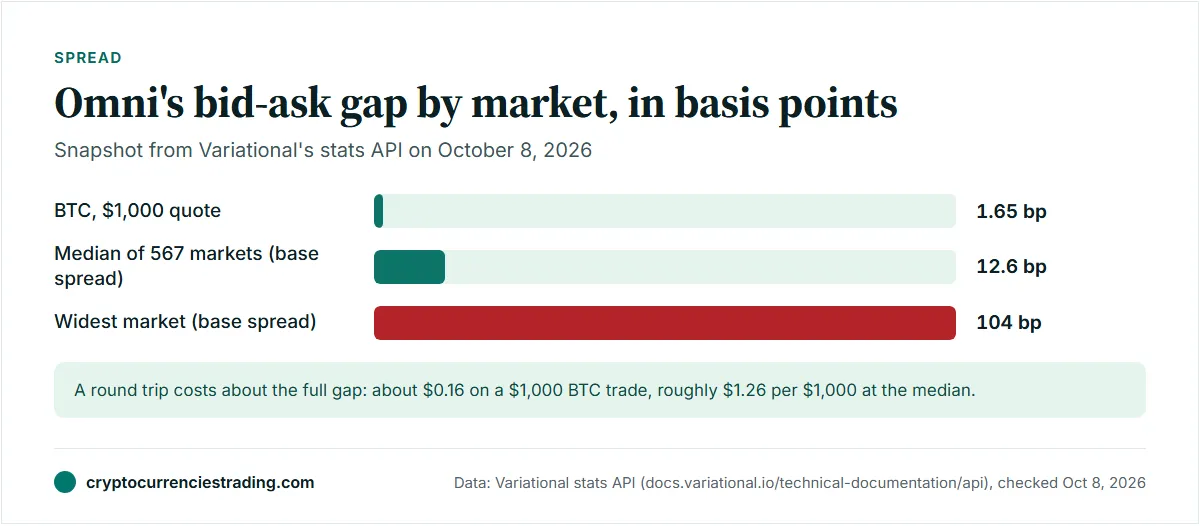
A worked example: deposit $1,000 and $999.90 reaches your account after the $0.10 fee. Open and later close a $1,000 BTC position and the fee is $0. What you pay is the spread. On October 8, 2026 the official stats API quoted BTC at $83,050.69 bid and $83,064.38 ask for $1,000 of size. That gap is about 1.65 basis points, so the round trip cost about $0.16.
Spreads differ a lot between markets. In the same snapshot the median base spread across the 567 markets listed then was about 12.6 basis points, roughly $1.26 per $1,000 round trip, and the widest was about 104 basis points. Spreads move, so read the quote every time.
Where Variational is available
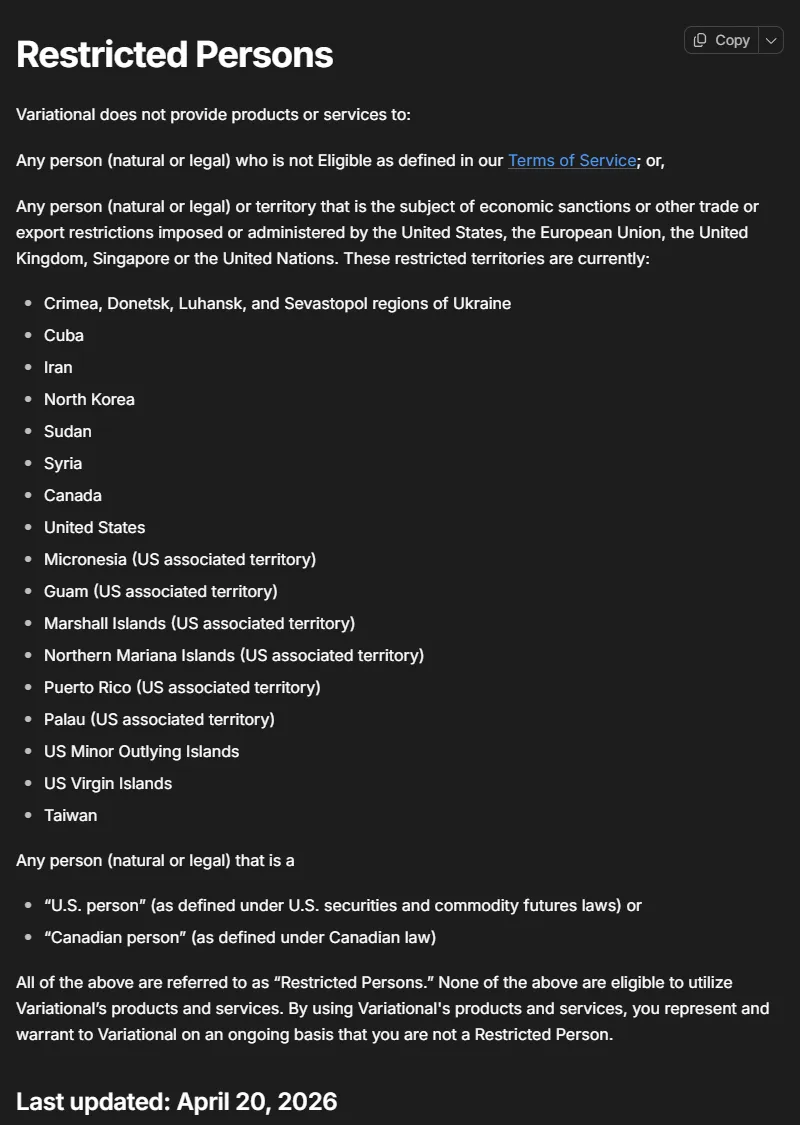
Not available in: United States, Canada, Taiwan, Cuba, Iran, North Korea, Sudan, Syria, Micronesia, Guam, Marshall Islands, Northern Mariana Islands, Puerto Rico, Palau, U.S. Outlying Islands, U.S. Virgin Islands.
Also excluded: the Crimea, Donetsk, Luhansk and Sevastopol regions of Ukraine, and U.S. persons and Canadian persons wherever they are. Omni is in private beta, so a new account needs an access code.
Omni is not open to everyone. Variational’s Restricted Persons policy, last updated April 20, 2026, excludes the United States and the U.S.-associated territories it lists, Canada, Taiwan, Cuba, Iran, North Korea, Sudan and Syria, plus the Crimea, Donetsk, Luhansk and Sevastopol regions of Ukraine. It also excludes U.S. persons and Canadian persons wherever they are.
The Terms of Use add that the company may geo-block restricted locations and refuse customers from any other country.
Sign-up also needs an access code while Omni is in private beta. Opening an account takes no identity check, but the terms allow source-of-funds checks, and Variational asks for KYC before it pays competition prizes or campaign referral rewards of $4,000 or more.
Is Variational safe?
Audits
- December 16, 2024Zellic
- March 9, 2025Spearbit (Cantina)
Incidents
- October 7, 2025A risk limit that had not been updated for Omni's growth was triggered and interrupted trading for about 11 minutes. Variational published a postmortem, reviewed its risk limits and asked affected users to open support tickets. (t.me)
Nothing here is a guarantee. These are the facts we could source.
Custody. Each user has a separate on-chain settlement pool with OLP on Arbitrum. The OLP docs say OLP never moves traders’ funds to outside venues and hedges with its own capital.
Counterparty risk. OLP is the counterparty to every trade and is funded by the Variational team for now. The docs state that OLP can lose money and that, if it became insolvent, profit owed to you from then on would be bad debt that could not be paid. The docs we read describe no insurance fund.
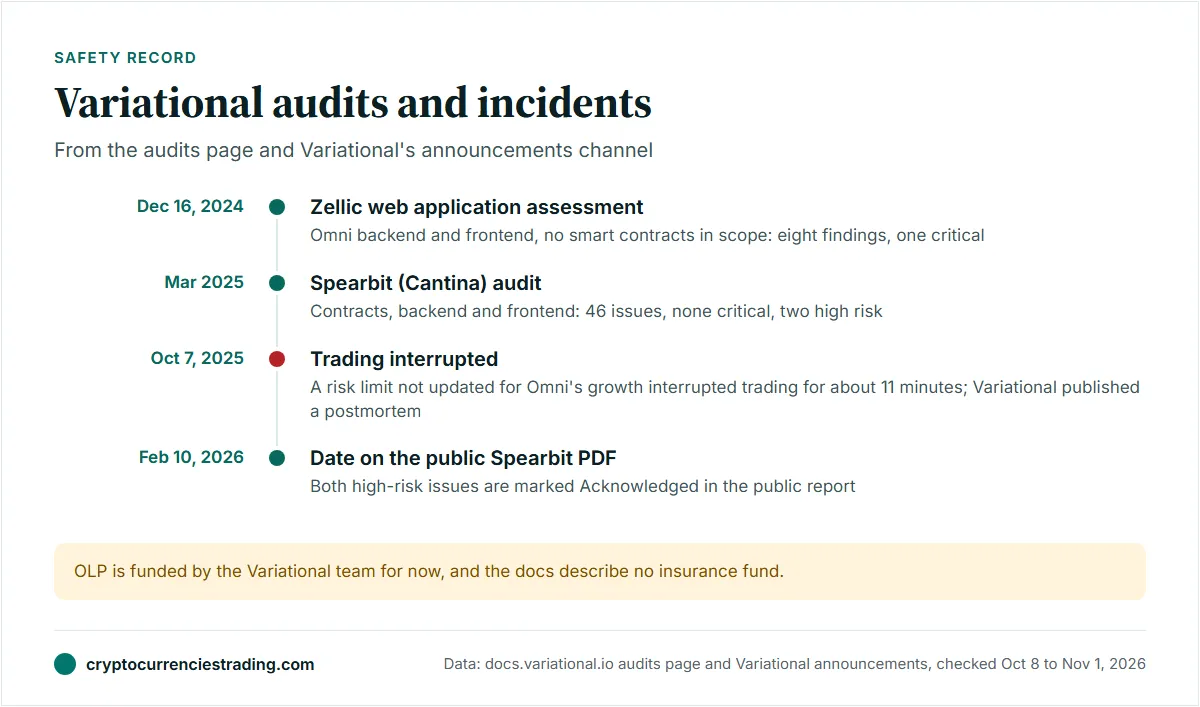
Audits. Two reports are on the audits page. Zellic’s, dated December 16, 2024, is a web application assessment of the Omni backend and frontend; its scope lists no smart contracts. It counts eight findings, one of them critical, with details redacted because the code is private. Spearbit (Cantina) reviewed the contracts, backend and frontend and counted 46 issues, none critical and two high risk, both marked “Acknowledged” in the public report. The docs date that audit to March 2025; the public PDF is dated February 10, 2026.
Other controls. Variational runs a bug bounty with Immunefi. Admins can disable trading across the platform.
Incidents. Variational’s announcements channel, which relays its Discord announcements, carries one postmortem. On October 7, 2025 a risk limit that had not been updated for Omni’s growth was triggered and interrupted trading for about 11 minutes. Variational said it reviewed its risk limits and asked affected users to open support tickets. We found no exploit or bad-debt report in that channel, the docs or the help center.
How to start on Variational
-
Set up an EVM wallet (the help center lists Rabby, MetaMask and WalletConnect) and hold USDC on Arbitrum One in it. You do not need ETH.
-
Open omni.variational.io and click Connect Wallet. If you see Access Restricted, stop here.
-
Enter an access code. The docs say codes are shared in the Variational Discord and on X.
-
Accept the Terms of Use, then click Authenticate and sign the message.
-
Click Deposit, enter a USDC amount and sign the gasless approval. The $0.10 fee comes out of the amount.
-
Pick a market, set leverage and margin mode, choose an order type and enter the size. Check the quoted price, spread and estimated liquidation price before you confirm.
-
To cash out, open the Withdraw tab. Funds can go only to the wallet connected to the account.
There is no app to download. Omni runs in a mobile browser.
Variational referral program and points
Referrers earn a flat 5% of the spread their referrals pay, in USDC, plus 1 point for every 10 points those referrals earn. A first referral code unlocks after $1 million of trading volume. The referral docs state no bonus for the person who signs up.
The points program has been live since December 17, 2025. Points go out every Friday, and the docs say weekly distributions end no later than the end of Q4 2026.
The docs also say a $VAR token is planned for Q4 2026, with 32% of supply going to points holders. The roadmap still listed the launch as not done when we checked. Points do not guarantee a token or its value: Variational’s own campaign terms say points carry no right to any token.
Loss refunds have been discontinued, according to Variational’s API docs, and the stats API’s loss refund fields now always read 0. Its biweekly updates also list loss refunds as sunset. The Terms of Use, updated September 11, 2026, still list loss refunds as an incentive Variational may grant at its discretion.
Variational pros and cons
Pros
- No maker or taker fees, no gas, and a flat $0.10 per transfer
- 581 crypto and traditional markets from one USDC account
- Self-custody, with a separate settlement pool per user
- Two published audit reports and an Immunefi bug bounty
Cons
- Private beta: you need an access code
- Closed to the United States, Canada, Taiwan and other listed places
- One counterparty for every trade, with stated bad-debt risk if OLP fails
- The real cost is the spread, which varies widely by market
- No spot trading, no copy trading and no native mobile app
Variational FAQ
Does Variational charge trading fees?
No maker or taker fee. You pay the bid-ask spread on each trade, a flat $0.10 per deposit or withdrawal, funding, and a 0.5% penalty if you are liquidated.
Can I use Variational in the United States?
No. The Restricted Persons policy excludes the United States and U.S. persons anywhere. Canada and Taiwan are excluded too.
Do I need KYC to trade on Variational?
Not to open an account: you connect a wallet, enter an access code and accept the terms. Some reward payouts require KYC.
Does Variational have a mobile app?
No native app. Omni runs in a mobile browser and can be added to your home screen.
Does Variational have a token?
Not yet. The docs say a $VAR token is planned for Q4 2026. Points do not guarantee a token or its value.
Featured in
- Best Perp DEXs (#6)
Alternatives: Lighter, Aster, Hyperliquid
Compare side by side: Variational vs Lighter, Variational vs Aster, Variational vs Hyperliquid
Sources
Every figure on this page comes from the pages below, checked on the date shown.
- variational.ioOfficial website. Checked October 8, 2026.
- docs.variational.io/omni/about-omniProducts. Checked October 8, 2026.
- docs.variational.io/omni/trading/swapsProducts. Checked October 8, 2026.
- docs.variational.io/getting-started/roadmapProducts. Checked October 8, 2026.
- help.variational.io/en/articles/15029306-how-do-i-trade-on-mobileProducts. Checked October 8, 2026.
- help.variational.io/en/articles/16034102-which-wallets-are-supportedCustody. Checked October 8, 2026.
- docs.variational.io/omni/the-omni-liquidity-provider-olpCustody. Checked October 8, 2026.
- help.variational.io/en/articles/14765696-creating-an-accountKYC. Checked October 8, 2026.
- docs.variational.io/legal/terms-of-useKYC, Points program, Availability. Checked November 1, 2026.
- docs.variational.io/omni/getting-started-with-omniChains, Max leverage, Availability. Checked October 8, 2026.
- docs.variational.io/omni/trading/feesPerps fees. Checked October 8, 2026.
- docs.variational.io/omni/trading/funding-ratesPerps fees. Checked November 1, 2026.
- docs.variational.io/technical-documentation/apiPerps fees, Points program. Checked November 1, 2026.
- omni-client-api.prod.ap-northeast-1.variational.io/metadata/v2/statsPerps fees. Checked October 31, 2026.
- help.variational.io/en/articles/16035018-what-is-the-maximum-leverage-on-omniMax leverage. Checked October 8, 2026.
- docs.variational.io/omni/rewards/pointsPoints program. Checked October 8, 2026.
- t.me/s/variational_io/446Points program. Checked November 1, 2026.
- docs.variational.io/legal/restricted-personsAvailability. Checked October 8, 2026.
- docs.variational.io/technical-documentation/auditsAudits. Checked October 8, 2026.
- t.me/s/variational_io/221Incidents. Checked November 1, 2026.
- docs.variational.io/getting-started/official-linksIncidents. Checked November 1, 2026.
