A maker order adds liquidity to an exchange’s order book: it is a limit order that doesn’t fill straight away and waits for someone else to trade against it. A taker order removes liquidity: it fills immediately against orders already on the book, such as a market order. Exchanges charge takers more than makers, because makers are what make a market tradable. On the venues we review, the gap ranges from nothing at all to several times the maker rate.
Understanding the difference is one of the easiest ways to cut your trading costs, especially if you trade often or with leverage. This guide shows how each order type is classified, what real venues charge, how fees add up over a year and how to pay less.
This is not financial advice. Crypto trading carries risk, and leveraged products can lose all the money you put in.
The order book in two minutes
Most exchanges, and order-book perp DEXs, match buyers and sellers on an order book. It has two sides:
- Bids: orders to buy at a stated price or lower.
- Asks (or offers): orders to sell at a stated price or higher.
The highest bid and the lowest ask are the best prices available. The gap between them is the spread.
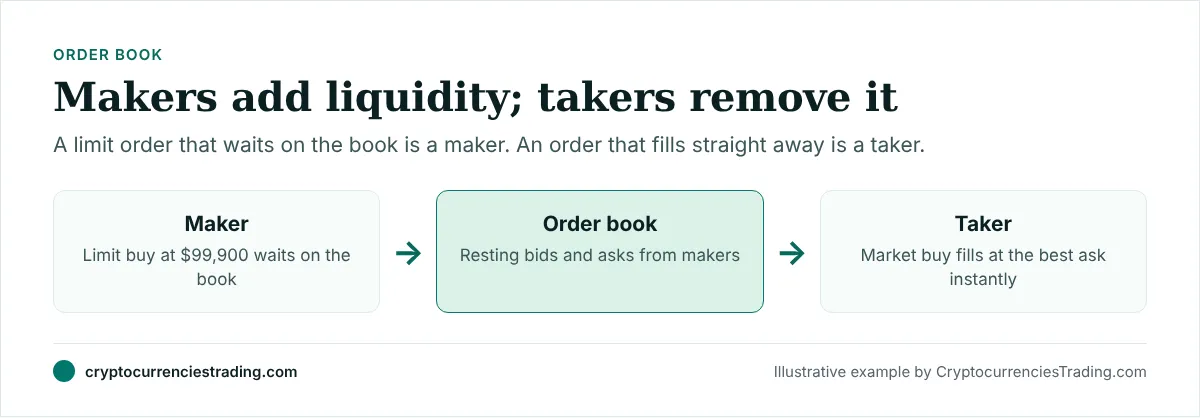
When you place an order, it either:
- Matches immediately against an existing order on the other side. You are the taker.
- Doesn’t match yet and rests on the book until someone trades against it. You are the maker.
What makes an order a maker or a taker
The label depends on what your order does, not which button you click.
- Market orders are always takers. They take the best available prices immediately.
- Limit orders are makers only if they don’t fill on arrival. A limit buy priced below the current best ask rests on the book and is a maker. A limit buy priced at or above the best ask fills immediately and is charged as a taker.
- Stop orders usually become market orders when triggered, so they pay the taker fee. Stop-limit orders become limit orders, which may or may not fill at once.
- Partially filled orders can be both: the part that filled on arrival pays taker, and the part that rested and filled later pays maker.
Many venues offer a post-only option. A post-only limit order is cancelled instead of filling as a taker, which guarantees you either get the maker rate or don’t trade.
Real fees at venues we review
Here is what the same $10,000 trade costs at entry-level rates on several venues we review. The first figure is the maker cost; the second is the taker cost.
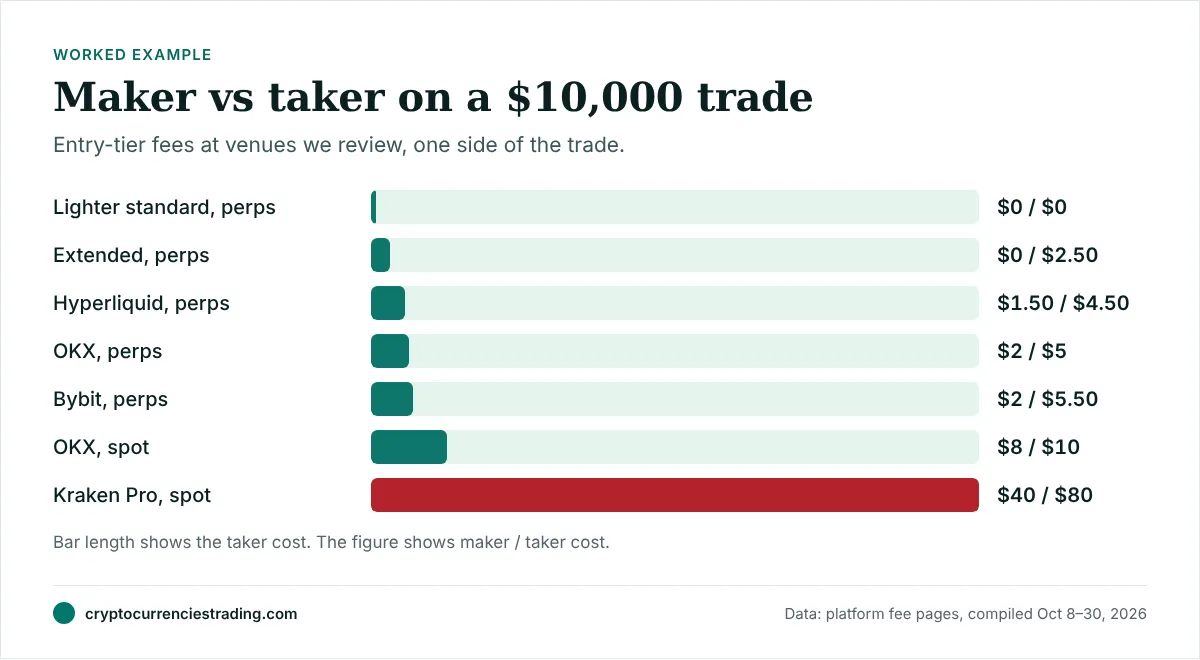
A few patterns stand out:
- Perps are cheaper than spot on the same exchange. OKX’s regular-user rates are 0.02% maker and 0.05% taker on perps, against 0.08% and 0.10% on spot.
- Some perp DEXs charge makers nothing. Extended charges 0% maker and 0.025% taker on crypto markets, and Lighter’s standard account charges 0% on both sides.
- Convenience costs more. Kraken Pro’s entry tier is 0.40% maker and 0.80% taker on spot, and simple “buy” screens on many apps cost more than the pro trading screen.
- The gap varies. At Hyperliquid’s base tier, taker (0.045%) is three times maker (0.015%). At Bitget, futures taker (0.06%) is three times maker (0.02%). At OKX spot, taker is only a quarter more than maker.
How fees are charged
Fees are a percentage of the trade value. For spot, that is the amount you buy or sell. For perps, it is the full position size, not your margin. A $1,000 margin at 10x opens a $10,000 position, and you pay fees on $10,000.
You pay twice per trade: once to open and once to close. A perp round trip at OKX’s 0.05% taker rate costs 0.10% of the position. At 10x leverage, that is 1% of your margin, before any price move. At 50x, it is 5% of your margin. That is why high-leverage traders who trade often see their accounts shrink even when they are right about direction half the time.
How fees add up over a year
Small differences become real money for active traders.
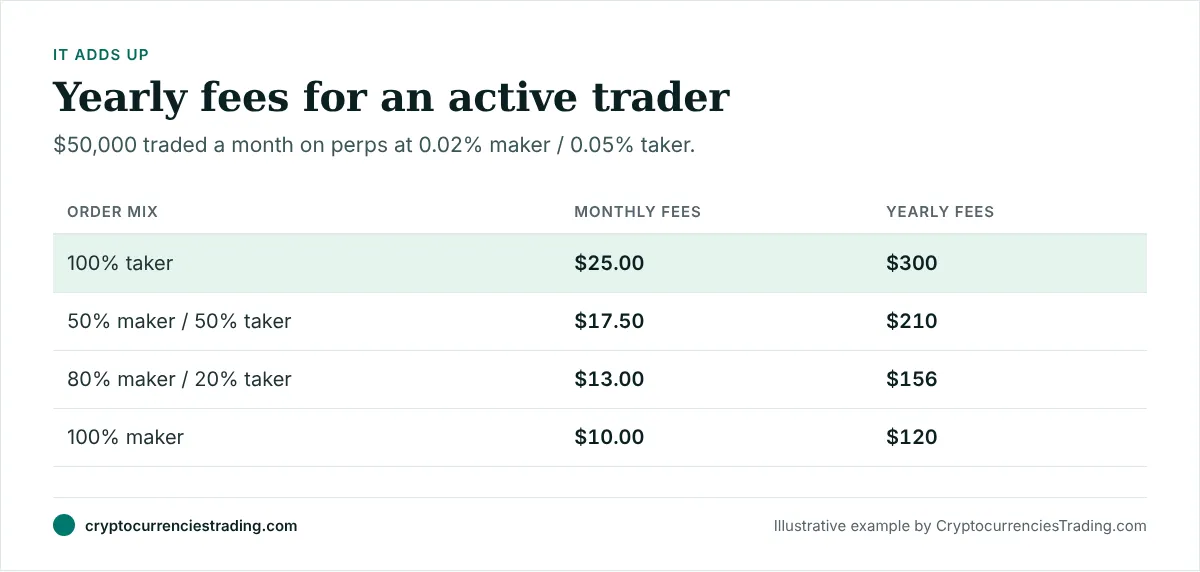
Someone trading $50,000 a month in perps at 0.02% maker and 0.05% taker pays $300 a year using only market orders, and $120 a year using only limit orders that rest on the book. Most people land somewhere in between.
Rebates and negative maker fees
On some venues, the maker fee can be negative. That means the exchange pays you for adding liquidity. It is usually reserved for very high-volume traders and market makers:
- OKX’s lowest VIP tier lists a maker fee of -0.005%, a small rebate.
- Extended pays makers with at least 0.5% of total maker volume over 30 days a rebate of 0.002% to 0.010%, paid daily once it reaches $10.
For most retail traders, rebates are out of reach. The realistic goal is to pay the maker rate more often, not to earn rebates.
VIP tiers and token discounts
Most centralized exchanges lower fees as your 30-day trading volume or the assets you hold rise. These ladders are called VIP tiers. Some also cut fees if you pay them in the exchange’s own token:
- Bitget takes 20% off spot fees paid in BGB.
- Bybit takes 25% off spot fees and 10% off USDT and USDC perpetual fees paid in MNT.
Token discounts are only worth it if you already hold the token or trade a lot. Buying a volatile exchange token to save a fraction of a percent per trade can easily cost more than it saves if the token’s price falls.
Other costs that look like fees
The maker-taker rate is only part of the cost of a trade:
- Spread. If the best bid is $99,990 and the best ask is $100,010, a market buy followed by an immediate market sell loses $20 per bitcoin to the spread alone, before fees.
- Slippage. A large market order can eat through several price levels on the book, filling at progressively worse prices.
- Funding on perps, paid between traders while you hold a position. See our funding rates guide.
- Network fees for withdrawals and for every on-chain action on a DEX.
- Pool fees on AMM-style DEXs, which replace maker-taker with a fixed fee per swap paid to liquidity providers.
Some venues have no maker-taker fee at all and build the cost into the price instead. Variational, for example, charges no maker or taker fee; the cost is the spread in the quote you accept.
A worked example: one trade, two ways
Say you want to buy $5,000 of ETH on a perp at a venue charging 0.02% maker and 0.05% taker, hold it for a few days, and sell.
The hurried way. You click market buy, then later click market sell. Both sides are taker: $2.50 to open and $2.50 to close, $5.00 in fees. You also cross the spread twice, which on a liquid ETH market might cost another dollar or two.
The patient way. ETH trades at $4,000. You place a post-only limit buy at $3,996, just under the market, and it fills within the hour as the price dips. Later you place a post-only limit sell a little above the market, and it fills on the next uptick. Both sides are maker: $1.00 to open and $1.00 to close, $2.00 in fees, and you earned the spread instead of paying it.
The saving on one trade is small. Over hundreds of trades a year, it is the difference between the yearly figures in the table above.
The patient way has a cost too: sometimes your limit order never fills and the price runs away without you. That is the trade-off makers accept.
Common fee mistakes
- Assuming a limit order is always cheaper. A limit order priced through the market fills as a taker.
- Judging a venue only by its maker fee. If you mostly use market orders, the taker rate is the one you pay.
- Forgetting the round trip. Every position is opened and closed, so the real cost is double the one-way fee.
- Calculating fees on margin instead of position size. On a 20x perp, the fee is twenty times larger than it looks if you think in margin.
- Ignoring spread on “zero-fee” products. No fee does not mean no cost; the cost moves into the price.
- Paying high convenience fees for large purchases. Simple buy buttons and card payments are fine for $50, but expensive for $5,000.
Reading a fee schedule
Fee pages can be dense. Look for these items:
- The tier you are in. New accounts start at the lowest tier: VIP 0, Regular, Tier 1 or Non-VIP, depending on the exchange.
- Separate rows for spot and derivatives, and sometimes for special groups of markets, such as new listings, fiat pairs or tokenized stocks, which often cost more.
- Regional differences. The same brand can charge different rates in different countries. OKX’s US service, for example, lists 0.20% maker and 0.35% taker for regular spot users, against 0.08% and 0.10% on the global site.
- Discount conditions, such as paying in the exchange’s token or holding a minimum balance.
How to pay less
- Use limit orders when you are not in a hurry. Place them slightly away from the current price so they rest on the book.
- Turn on post-only if your venue offers it, so a limit order never fills as a taker by accident.
- Trade less often. Fewer round trips matter more than any fee tier.
- Use the pro trading screen instead of simple buy buttons, which usually price in a wider spread.
- Compare total costs, including spread and funding, not just the headline rate.
- Use token discounts only if you already hold the token.
- Check your fee tier after a few months; you may qualify for a lower one.
A word of caution: chasing the maker rate is not worth missing a stop-loss. When you need to exit, use the order type that gets you out, and accept the taker fee.
Frequently asked questions
Is a limit order always a maker order?
No. A limit order that can fill immediately against the book is charged as a taker. Only the part that rests on the book and fills later pays the maker rate.
Why do makers pay less?
Because they provide the liquidity that lets everyone else trade. Lower maker fees encourage traders to post orders, which tightens spreads.
Are maker-taker fees charged on margin or position size?
On position size, or trade value for spot. A $1,000 margin at 10x pays fees on $10,000.
What is a post-only order?
A limit order that is cancelled if it would fill immediately, so it can only ever pay the maker rate.
Which matters more for beginners, maker or taker fees?
The taker fee, because beginners mostly use market orders. When you compare venues, look at the taker rate first, then check whether you would realistically use limit orders often enough for the maker rate to matter.
Do maker and taker fees change with leverage?
The percentage doesn’t change, but the dollar amount does, because fees are charged on the larger position that leverage opens. Higher leverage means the same fee eats a bigger share of your margin.
Can I see which fee I paid?
Yes. Your trade history on every major venue shows the fee for each fill, and usually whether it was charged at the maker or taker rate. Checking it after your first few trades is the quickest way to learn how your orders are classified.
Do DEXs have maker and taker fees?
Order-book perp DEXs usually do. AMM-style spot DEXs charge a pool fee per swap instead, plus network gas.
