A funding rate is a regular payment between traders who hold long and short positions in a perpetual future. When the rate is positive, longs pay shorts; when it is negative, shorts pay longs. It exists to keep the perp’s price close to the coin’s spot price, because perps never expire. Funding is not a fee to the exchange, but it is a real cost or income for as long as you hold a position, and on a trade held for days it can cost more than the trading fees.
This guide explains why funding exists, how to read the number on your screen, how to turn it into a daily or yearly cost, and how to use it in your decisions. If perps are new to you, start with what perpetual futures are.
This is not financial advice. Perps involve leverage and liquidation risk.
Why perps need funding
A traditional futures contract has an expiry date. On that date it settles at the spot price, so as expiry approaches the future’s price is forced toward spot. Traders can rely on that.
A perpetual has no expiry. Without something to tie it to spot, a perp’s price could drift far away whenever traders were mostly bullish or mostly bearish. Funding is that tie. It makes the crowded side pay the other side, which nudges traders to take the less popular side until the prices line up again.
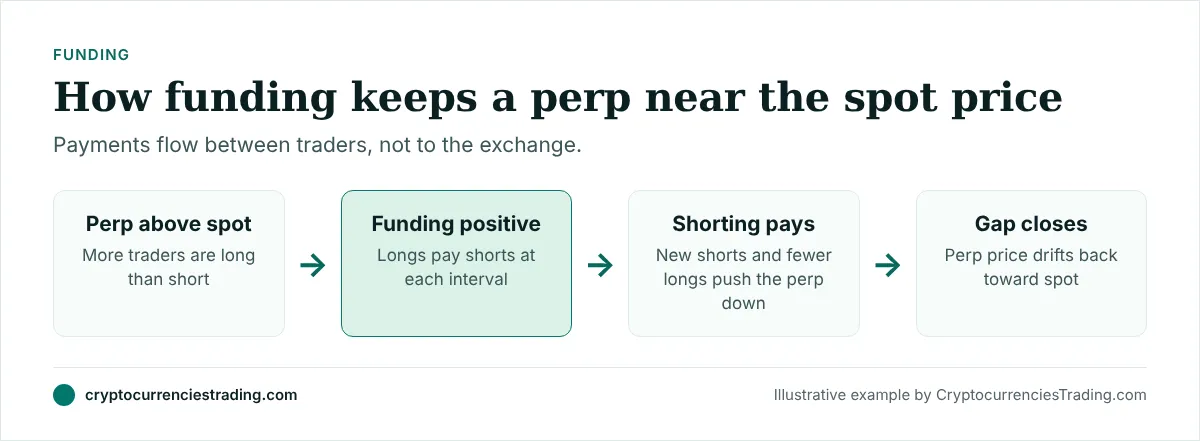
Who pays whom
- Positive funding: the perp trades above the index (spot) price. Longs pay shorts. This usually happens in rising, optimistic markets where many traders use leverage to go long.
- Negative funding: the perp trades below the index price. Shorts pay longs. This often happens after sharp falls, when many traders are short or hedging.
- Near zero: the perp is close to spot, or the venue’s baseline interest component is all that remains.
The payment is calculated on your position size, not your margin. A $10,000 position at a 0.01% rate pays or receives $1 per funding period, whether you used 1x or 20x leverage to open it.
The exchange does not keep funding. It moves from one group of traders to the other. The exchange earns trading fees, not funding.
How the rate is calculated
Exact formulas differ by venue, but most follow the same idea:
- A premium measures how far the perp price is from the index price over the period, averaged so that brief spikes don’t dominate.
- An interest component reflects the difference in borrowing costs between the two assets in the pair. On many venues it is a small fixed figure.
- A cap and floor limit how extreme funding can get in one period.
You don’t need to compute it yourself. Venues show the current or predicted rate next to the market, along with a countdown to the next payment. What you need to know is how to read it.
Reading a funding rate
Every rate has two parts: a percentage and an interval. “0.01%” means nothing until you know whether it is paid every hour or every eight hours.
Intervals vary. Many centralized exchanges settle funding every eight hours on their main markets, while several perp DEXs settle hourly. Hyperliquid, Arcus and Extended all pay funding every hour. Some venues shorten the interval on volatile markets. Always check the interval on the market you are trading.
To compare venues, convert every rate to the same period. The cleanest way is to annualize it:
Annualized rate = rate per period × number of periods per year.
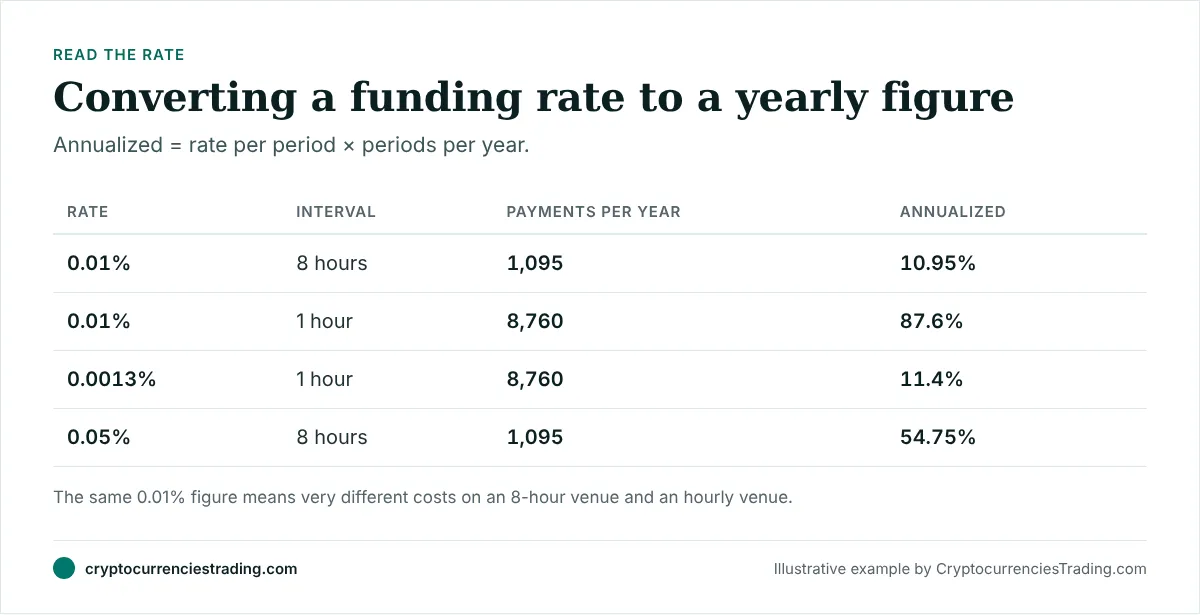
A rate of 0.01% every eight hours is about 11% a year. The same 0.01% paid every hour is almost 88% a year. That is a big difference hidden behind identical-looking numbers.
Worked examples: what funding costs you
Take a $10,000 long held for seven days at a steady positive rate paid every eight hours, which means 21 payments.
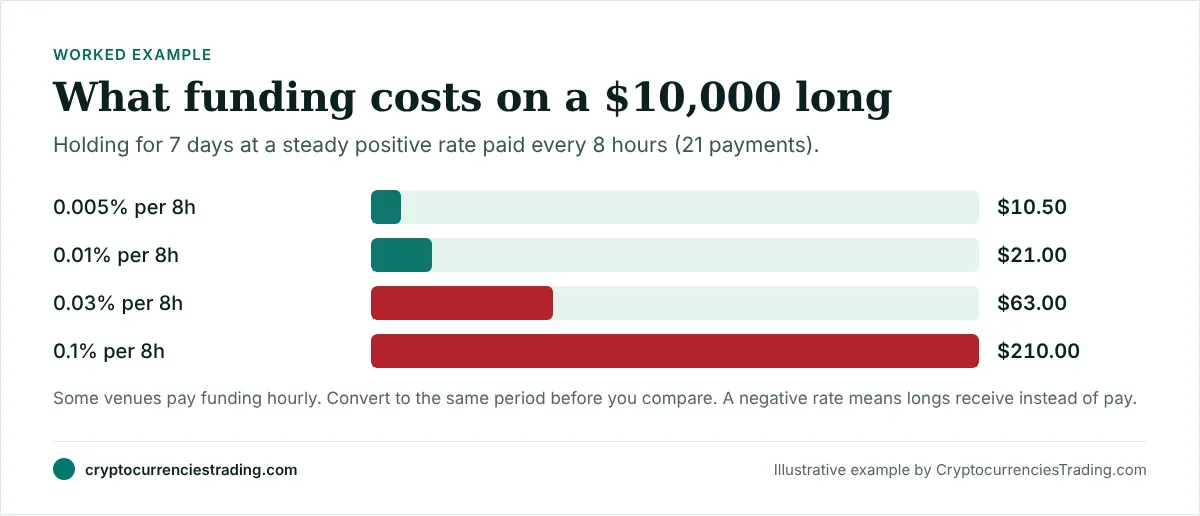
Compare that with trading fees. Opening and closing the same $10,000 position at a 0.05% taker fee costs $10. At a moderate 0.01% funding rate, a week of funding costs twice that. In a heated market at 0.1% per eight hours, a week costs $210, more than 2% of the position. If you used 10x leverage, that is over 20% of your $1,000 margin.
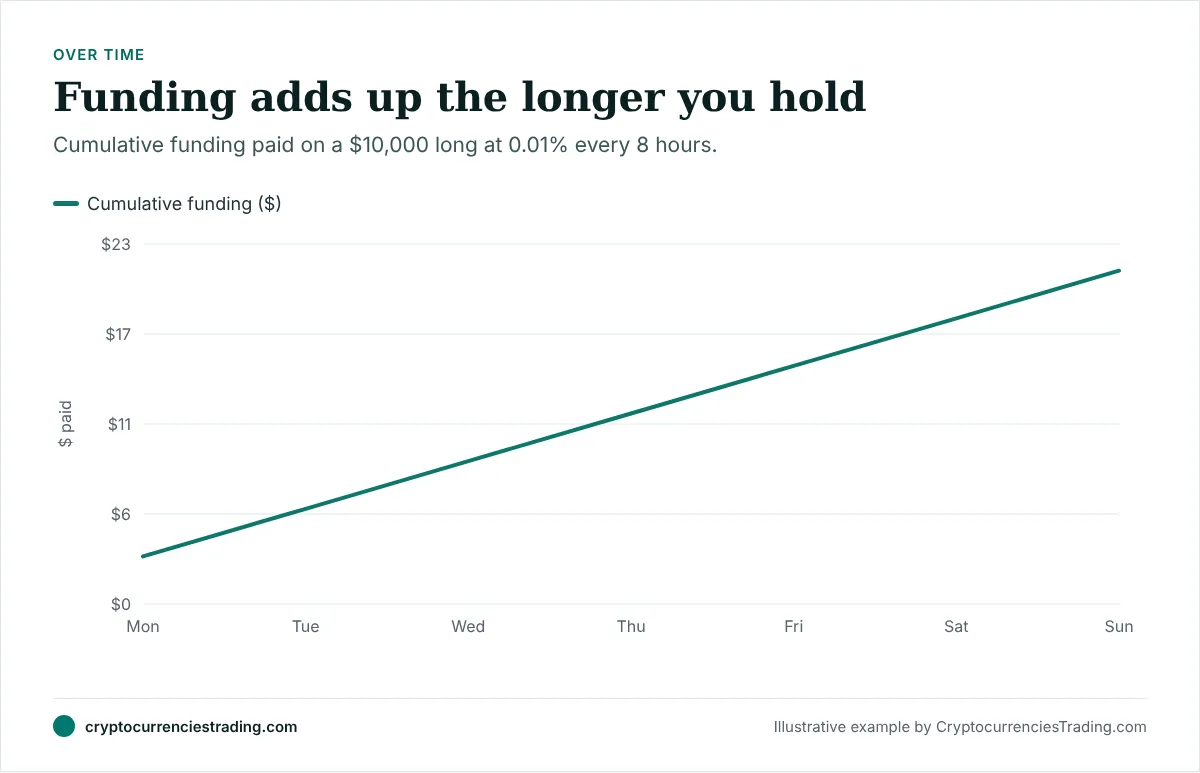
Funding also reduces your equity directly. On an isolated position, each payment comes out of the margin, which moves your liquidation price closer. A long held through days of strong positive funding can drift toward liquidation even if the price never moves. Our leverage and liquidation guide covers this.
Rates are not steady in real markets. They change every period, and they can flip from positive to negative quickly. The examples use constant rates only to show the scale.
What funding tells you about the market
Funding is also information. Because it reflects how crowded each side is, traders watch it as a sentiment gauge.
- Persistently high positive funding means many traders are paying to stay long, often with leverage. That can precede sharp drops, because a small dip can trigger a cascade of long liquidations.
- Deeply negative funding means shorts are crowded. Short squeezes, where rising prices force shorts to buy back, become more likely.
- Funding diverging between venues can show where leverage is concentrated.
Treat it as one signal among many. Funding can stay high for weeks in a strong uptrend while the price keeps rising.
How traders use funding
Directional traders check funding before opening a position they plan to hold. A long you plan to keep for a month during 0.03% eight-hourly funding has a built-in cost of roughly 2.7% a month, before fees. The trade needs to beat that.
Basis or “cash-and-carry” traders try to collect funding while staying neutral on price. They buy the coin on spot and short the same amount on a perp. If funding is positive, the short receives payments while the spot holding cancels out the price risk. This is lower risk than directional trading, but not risk-free: funding can turn negative, the venue holding either leg can fail, and a sharp price move can liquidate the short leg if it uses too much leverage.
Hedgers who short perps to protect coins they hold should know that positive funding pays them, while negative funding costs them.
A worked basis trade, with numbers
Here is how a simple cash-and-carry trade looks on paper, and where it can go wrong. The numbers are illustrative.
You buy 0.1 BTC on spot at $100,000, costing $10,000. At the same time you short a $10,000 BTC perp, posting $5,000 of margin (2x). Your price exposure is now roughly zero: if BTC rises 10%, the spot coin gains $1,000 and the short loses $1,000; if it falls 10%, the reverse.
Suppose funding stays at 0.01% every eight hours for 30 days. The short receives $1 per period, three times a day, so about $90 over the month. Trading fees to open and close both legs might cost around $20 to $30, depending on venue and order type. The net result is around $60 to $70 on $15,000 of capital tied up, or about 0.4% to 0.5% for the month.
What can go wrong:
- Funding flips negative. Your short then pays instead of receiving, and the trade loses money every period until you close.
- The short leg is liquidated. If BTC jumps sharply, the short’s margin can run out even though the spot leg has gained. At 2x a rise of nearly 50% would be needed, but traders who push leverage higher to “boost the yield” shorten that distance a lot.
- Venue risk. If the exchange holding either leg fails or freezes withdrawals, the hedge breaks.
- Execution. The two legs rarely fill at exactly the same price, and spreads eat into a small edge.
Basis trading is how a lot of professional money earns from funding. It is not free money, and the margin for error is thin.
Common mistakes with funding
- Comparing rates with different intervals. 0.01% hourly is eight times the cost of 0.01% every eight hours.
- Ignoring funding on “swing” trades. A position held for two weeks can pay more in funding than in fees, especially in strong trends.
- Chasing negative funding blindly. Getting paid to be long is nice until the price keeps falling. Funding is rarely large enough to make up for a bad directional trade.
- Opening just before a big payment. If funding is strongly against your side and the next payment is minutes away, waiting until after it can save a period’s cost, provided you are not chasing a fast-moving price.
- Forgetting that funding moves the liquidation price. On a high-leverage isolated position, a few days of funding can shift the liquidation price noticeably.
Where to see funding rates
Every perp venue shows the current or next funding rate on its trading screen, usually above the chart along with a countdown. Most also publish a history page for each market. Look at the history before you open a position you plan to hold: a market that has paid high positive funding for a month is telling you something about how crowded it is.
Rates for the same coin often differ between venues. That is normal, because each venue has its own traders and its own premium. Large gaps tend to close as arbitrage traders take the cheaper side on one venue and the opposite side on another.
Funding vs other holding costs
Not every venue uses classic funding. Some perp DEXs work differently:
- Veranta charges a combined “net rate” of funding plus a borrow fee while a position is open, and the lighter side of a market can receive funding.
- Papertrade charges no funding at all; instead it takes a share of winning trades.
- Some venues price trades through a market maker’s spread rather than a separate funding payment.
When you compare venues, compare the total cost of holding a position for your expected time, not just the headline trading fee.
Practical checklist
Before you open a perp you might hold for more than a few hours:
- Check the current funding rate and its interval.
- Annualize it or convert it to a daily cost on your position size.
- Compare it with your expected gain. If the trade only makes sense over weeks, funding can decide whether it is worth it.
- Watch how fast it is changing. A rate that doubled in the last day may keep rising.
- Remember it hits margin. Leave room between your liquidation price and the current price for funding to accumulate.
Frequently asked questions
Does the exchange earn funding?
No. Funding moves between traders holding opposite positions. The exchange earns trading fees.
Is funding charged if I close before the payment time?
Generally no. On most venues, funding is paid only to positions open at the funding timestamp. Check your venue’s rules, since some accrue continuously.
Is funding charged on my margin or my position?
On your position size. A $10,000 position pays the same funding at 2x or at 20x leverage.
Can funding be negative?
Yes. When the perp trades below spot, shorts pay longs, so a long position receives payments.
Why do funding rates differ between exchanges?
Each venue has its own traders, its own premium and its own formula and interval. When one venue’s longs are more crowded than another’s, its funding runs higher. Arbitrage traders narrow the gap, but rarely close it completely.
Does spot trading have funding?
No. Funding exists only on perpetual futures. If you buy and hold a coin on a spot market, there is nothing to pay while you hold it.
What is a “normal” funding rate?
It varies by venue, market and conditions. A baseline around 0.01% every eight hours, roughly 11% a year, is common on many centralized exchanges in calm markets, but rates swing widely. Always read the live figure.
