Leverage lets you open a position larger than the money you put up. Liquidation is what happens when that position loses enough that your remaining money no longer covers the exchange’s minimum: the position is closed automatically and you lose the margin behind it. The higher the leverage, the smaller the price move needed. At 10x, a drop of roughly 9.5% liquidates a long; at 100x, about 0.5% is enough.
This guide shows how the numbers work, with worked examples at every common leverage level, then explains margin modes and the habits that keep you away from the liquidation price. If you are new to perps, read what perpetual futures are first.
This is not financial advice. Leveraged trading carries a high risk of losing all the money you put in.
Leverage in one sentence
Leverage is position size divided by margin. A $10,000 position backed by $1,000 of margin is 10x leverage.
The important part is what leverage does not change. A 5% move on a $10,000 position is a $500 gain or loss whether you used 2x or 50x. Leverage changes how much of your own money stands behind that position, so it changes what fraction of your margin a given move eats. At 2x, a $500 loss is a tenth of your $5,000 margin. At 50x, the same $500 loss is more than double your $200 margin, which means you would have been liquidated long before.
So the right way to think about leverage is as a measure of how little room you leave yourself.
What liquidation is
Every venue sets a maintenance margin: the minimum equity a position must keep, as a percentage of its size. If losses push your equity below that line, the venue’s risk engine closes the position, usually at market. You lose the margin on that position, and many venues charge a liquidation fee or pass the remaining margin to an insurance fund.
Three details are worth knowing:
- Liquidation happens before your margin reaches zero. The maintenance margin is a buffer that lets the venue close you out without a loss to anyone else.
- It usually follows the mark price, not the last traded price. The mark price is based on an index of spot prices, so a single wild trade on one venue is less likely to liquidate you. A sustained move still will.
- Large positions have higher maintenance margins. Most venues use risk tiers: the bigger the position, the higher the requirement and the lower the maximum leverage.
The liquidation price formula
For a simple isolated-margin position on a linear (USDT or USDC margined) contract, ignoring fees and funding, the liquidation price is approximately:
- Long: liquidation price = entry × (1 − 1/leverage) / (1 − maintenance margin rate)
- Short: liquidation price = entry × (1 + 1/leverage) / (1 + maintenance margin rate)
With a maintenance margin rate of 0.5%, a long on BTC at $100,000 with 10x leverage is liquidated at about $100,000 × 0.9 / 0.995 = $90,452, a drop of about 9.5%.
Real venues add details: tiered maintenance margins, fees deducted from margin, funding that changes your equity over time, and different contract types. Use the formula to understand the shape of the risk, and always read the liquidation price the venue shows on its order ticket before you confirm.
Worked examples from 2x to 100x
Here is the same $10,000 BTC long at $100,000, opened with different leverage.
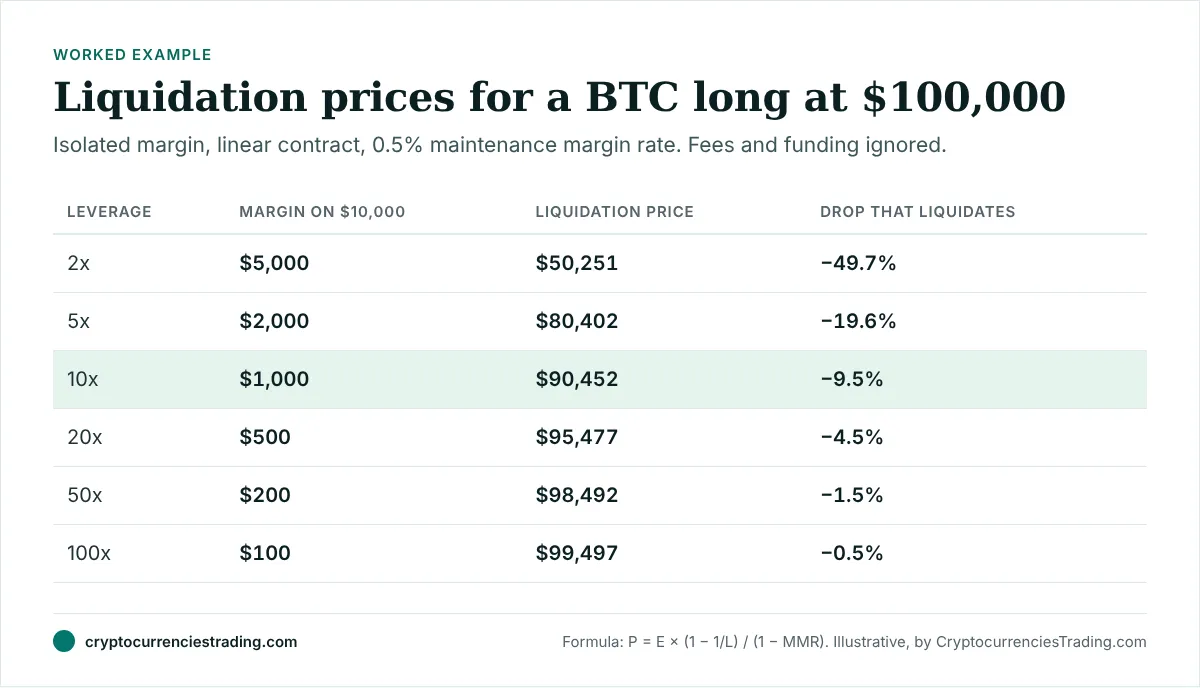
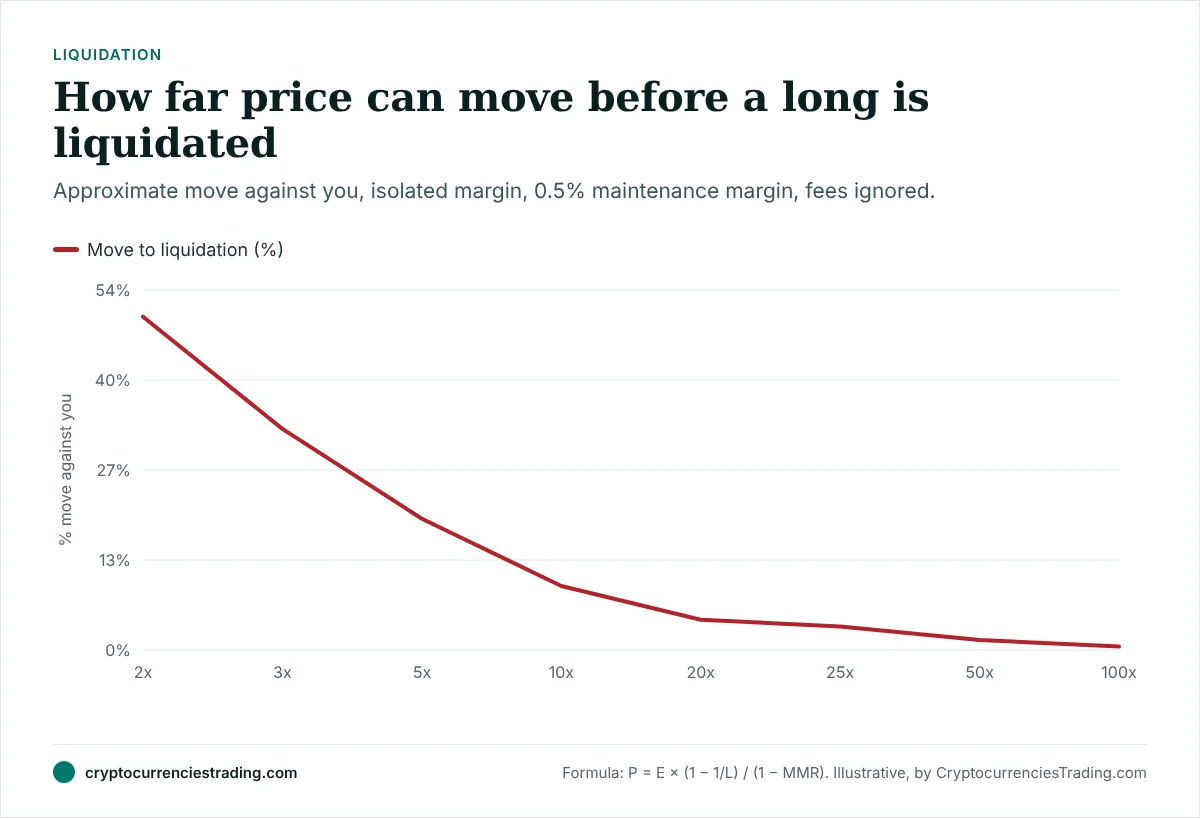
Look at the right-hand column. At 2x, bitcoin has to roughly halve before you are liquidated. At 20x, a 4.5% dip does it. At 100x, half a percent.
How often does bitcoin move that much? Moves of a few percent in a day are common, and moves of 0.5% in an hour are routine. That is why traders using 50x or 100x get liquidated so often, even when they are eventually right about the direction: the price only has to wobble against them once.
Shorts work the same way, upside down
A short is liquidated when the price rises. Using the short formula with 10x leverage and a 0.5% maintenance margin, a BTC short at $100,000 is liquidated at about $100,000 × 1.1 / 1.005 = $109,453, a rise of about 9.5%.
There is one extra danger with shorts: a price can only fall 100%, but it can rise far more than that. Short squeezes, where a rising price forces shorts to buy back, can push a small coin up 50% in minutes. Be especially careful shorting thin, newly listed coins.
Cross margin vs isolated margin
How much of your money a liquidation can take depends on the margin mode.
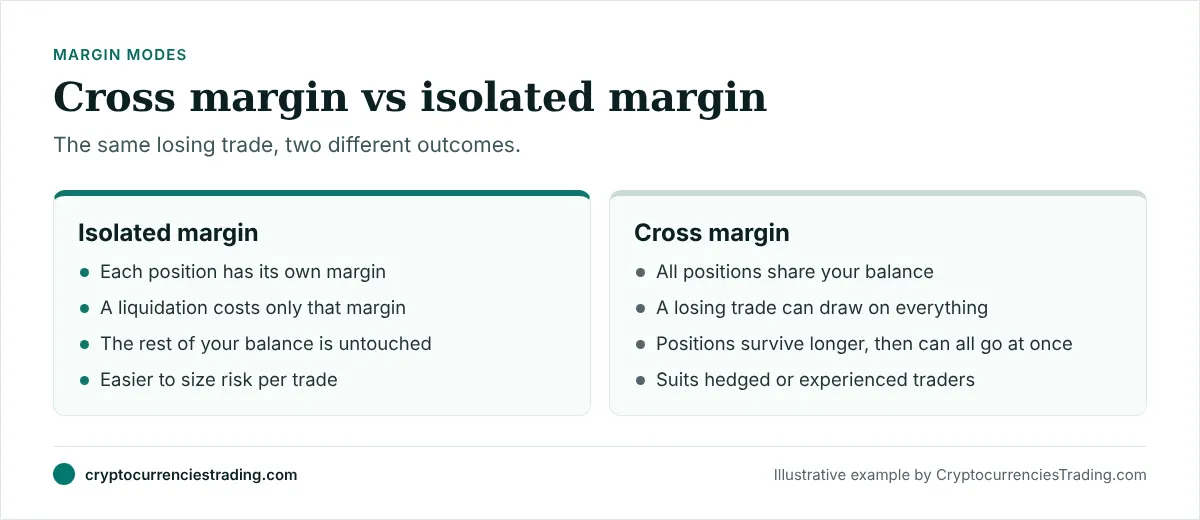
Isolated margin assigns a fixed amount to each position. If that position is liquidated, you lose that amount and nothing else. It is the easiest mode to reason about and the safest default for beginners.
Cross margin uses your entire account balance as shared collateral. A losing position can keep drawing on free balance, so it survives longer than it would in isolated mode. That sounds safer, but the cost is that when it does go, it can take much more of your account with it, and several positions can be liquidated together. Cross margin suits traders running hedged positions who understand their total exposure.
A common beginner mistake is to open a “small” 50x trade in cross mode on an account holding all their savings. The trade is small; the potential loss is not.
What actually happens in a liquidation
When the mark price crosses your liquidation price:
- The risk engine takes over your position and closes it, usually with a market order.
- If it closes at a better price than the bankruptcy price (where equity would be zero), the leftover usually goes to the venue’s insurance fund, and a liquidation fee may apply.
- If the market is moving too fast and the position closes at a worse price, the insurance fund covers the shortfall. If the fund cannot, some venues use auto-deleveraging (ADL), which reduces profitable opposite positions to balance the books.
From your side, the result is simple: the position is gone and so is its margin. On most venues you cannot lose more than the margin on an isolated position, but you will lose all of it.
Some venues work differently. On Papertrade, for example, a liquidation is a “hard bust” that forfeits the full isolated margin as soon as the price crosses a displayed level, and on Veranta a position is liquidated once it has lost about 85% of its collateral. Always read the venue’s own liquidation rules.
Fees and funding move your liquidation price
The formula above ignores two things that matter in practice:
- Fees are usually taken from your margin when you open. A large taker fee on a high-leverage position reduces your margin and moves the liquidation price closer.
- Funding paid while you hold a position reduces your equity. A long held for a week during strongly positive funding can drift meaningfully closer to liquidation even if the price stays flat. See our funding rates guide.
Adding margin to an isolated position moves the liquidation price away, but it also means you are putting more money behind a trade that is going against you. Decide in advance whether you ever do that.
Liquidation cascades
Liquidations do not happen one at a time. When many traders use high leverage in the same direction, their liquidation prices cluster at similar levels. If the price reaches the first cluster, the forced market sells from those liquidations push the price lower, which reaches the next cluster, which triggers more forced selling. Traders call this a cascade, or a long squeeze (for shorts, a short squeeze).
Cascades explain the sudden, deep wicks you sometimes see on a chart: a 5% drop in minutes that partly recovers soon after. If your liquidation price sat inside that wick, you were closed out at the bottom, and the recovery does not help you.
Two practical lessons follow. First, avoid placing your liquidation price at obvious round numbers or just below recent lows, where everyone else’s sits. Second, low leverage keeps your liquidation price far below where most of the crowd is, so a cascade that clears them may not reach you.
Gaps and closed markets
Crypto trades 24/7, but some perp venues now list stock, index and commodity perps whose underlying markets close at night and on weekends. When the underlying reopens, the price can jump straight past your stop-loss or liquidation price. That is a gap, and stops cannot protect you from it.
Venues handle this differently. Arcus raises the initial margin requirement outside market hours, and Veranta lowers its leverage limits around weekends and major economic releases. If you trade non-crypto perps, use even lower leverage than you would on BTC, and avoid holding high-leverage positions over a weekend.
Leverage, risk per trade and account size
It helps to separate three numbers that beginners often blur together:
- Account size: all the money you have set aside for trading.
- Risk per trade: how much of the account you accept losing if the trade hits your stop. Many experienced traders keep this at 1% to 2%.
- Leverage: a by-product of position size and margin, which only matters for where the liquidation price sits.
With a $5,000 account and 1% risk per trade, you accept losing $50. If your stop is 5% from entry, your position is $1,000. You could post that with $1,000 of margin at 1x, or $200 at 5x. The second choice keeps more cash free, but it brings the liquidation price closer, so the stop must sit comfortably inside it.
How to avoid being liquidated
Most liquidations are avoidable. These habits handle the large majority of cases.
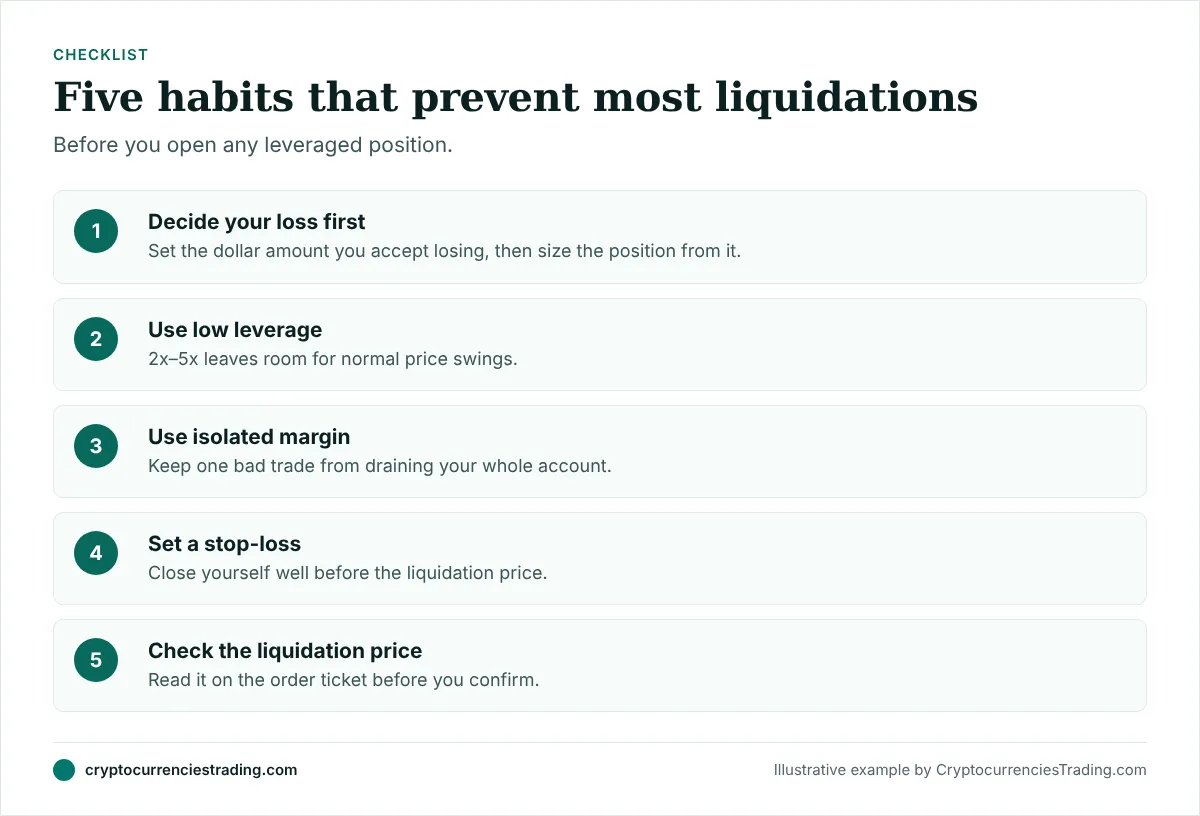
- Start from the loss, not the leverage. Decide how many dollars you accept losing on this trade. Then choose your stop-loss level from the chart, and size the position so that hitting the stop loses exactly that amount. Leverage becomes an output of this calculation, not an input.
- Keep leverage low. For most retail traders, 2x to 5x is plenty. If your plan only works at 50x, the plan is the problem.
- Use isolated margin unless you have a specific reason not to.
- Always set a stop-loss that triggers well before the liquidation price. Being stopped out at a small loss is a normal part of trading. Being liquidated is a failure of risk management.
- Read the liquidation price on the ticket every time, and check the funding rate if you plan to hold.
A worked example of point 1: you have $1,000 and accept losing $20 (2%) on a BTC long at $100,000. You place your stop at $98,000, 2% below entry. A 2% move on the position should cost $20, so the position size is $1,000. You can open that at 1x with $1,000 of margin or at 5x with $200, and the stop limits the loss to roughly $20 either way, as long as it fills near its price. Notice that the leverage did not change the risk; the stop and the position size did.
Frequently asked questions
What leverage is safe?
None is completely safe, but lower is safer. At 2x to 3x, normal market swings rarely reach your liquidation price. Above 20x, ordinary volatility can liquidate you within hours.
Can I lose more than I deposited?
On most centralized exchanges and perp DEXs, an isolated position’s loss is capped at its margin, with insurance funds absorbing any shortfall. With cross margin, a losing position can consume your whole account balance.
Why was I liquidated when the chart never reached my price?
Usually because liquidation follows the mark price, while the chart shows the last price on one venue, or because fees and funding had moved your liquidation price since you opened. Large positions may also have higher maintenance margins than you expected.
Does a stop-loss guarantee I won’t be liquidated?
No. In a very fast market, a stop-loss can fill at a worse price than you set, a gap called slippage. Placing the stop well away from the liquidation price gives you a safety margin.
Is 100x leverage ever a good idea?
For almost every retail trader, no. A move of about half a percent liquidates a 100x position, and bitcoin regularly moves that much within an hour.
