A perpetual future, or “perp”, is a contract that tracks the price of a coin and never expires. You don’t buy the coin. You agree to gain or lose the price difference between when you open and when you close, and you can bet on the price going up (a long) or down (a short), usually with leverage. A regular payment between traders, called funding, keeps the contract’s price close to the real coin’s price.
Perps are the most traded product in crypto. They are useful, flexible and cheap to trade, and they are also the fastest way to lose money in crypto, because leverage and liquidation work against beginners. This guide explains how they work, what they cost and what to check before you open your first position.
By the end you should be able to read a perp order ticket and understand every number on it: position size, margin, leverage, liquidation price, fee and funding rate. If any of those is unclear when you are about to trade, stop and come back to the matching section here. Most expensive mistakes with perps come from one of those six numbers.
This is not financial advice. Perpetual futures involve liquidation risk, and you can lose all the money you put into a position.
Perps vs buying the coin
When you buy bitcoin on a spot market, you own bitcoin. You can hold it for ten years, send it to a friend or move it to your own wallet. If the price halves, you still have the same amount of bitcoin; you have only lost value on paper.
A perp is different. You hold a contract whose value moves with bitcoin’s price. You put up collateral, called margin, and the contract settles your profit or loss in that collateral, usually USDT or USDC. You never touch bitcoin itself.
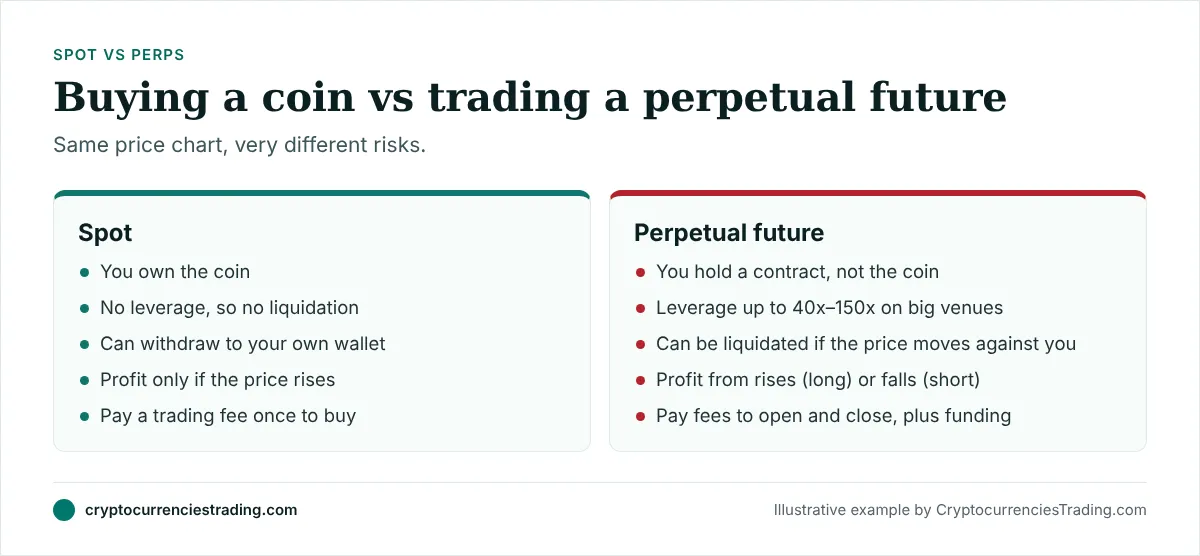
That difference brings three things spot can’t do:
- Shorting. You can profit when the price falls.
- Leverage. You can control a larger position than your margin.
- Capital efficiency. You don’t need the full position’s value in your account.
And three risks spot doesn’t have:
- Liquidation. If the price moves far enough against you, the exchange closes your position and you lose the margin.
- Funding. You pay or receive funding while the position is open.
- Counterparty and venue risk. Your profit depends on the exchange or protocol being able to pay it.
Why “perpetual”?
Traditional futures have an expiry date. A December bitcoin future settles in December, and you have to close it or roll it into the next contract. A perpetual has no expiry. You can hold it for a minute or a year.
Without expiry, something else must keep the perp’s price close to the spot price. That is the job of funding, covered below and in our full funding rates guide.
Long and short
Opening a long means you profit if the price rises. Opening a short means you profit if it falls. Your profit or loss is the price change multiplied by your position size.
Take a $10,000 BTC perp opened at $100,000:
- BTC rises to $105,000, a 5% gain. A long makes $500; a short loses $500.
- BTC falls to $95,000, a 5% loss. A long loses $500; a short makes $500.
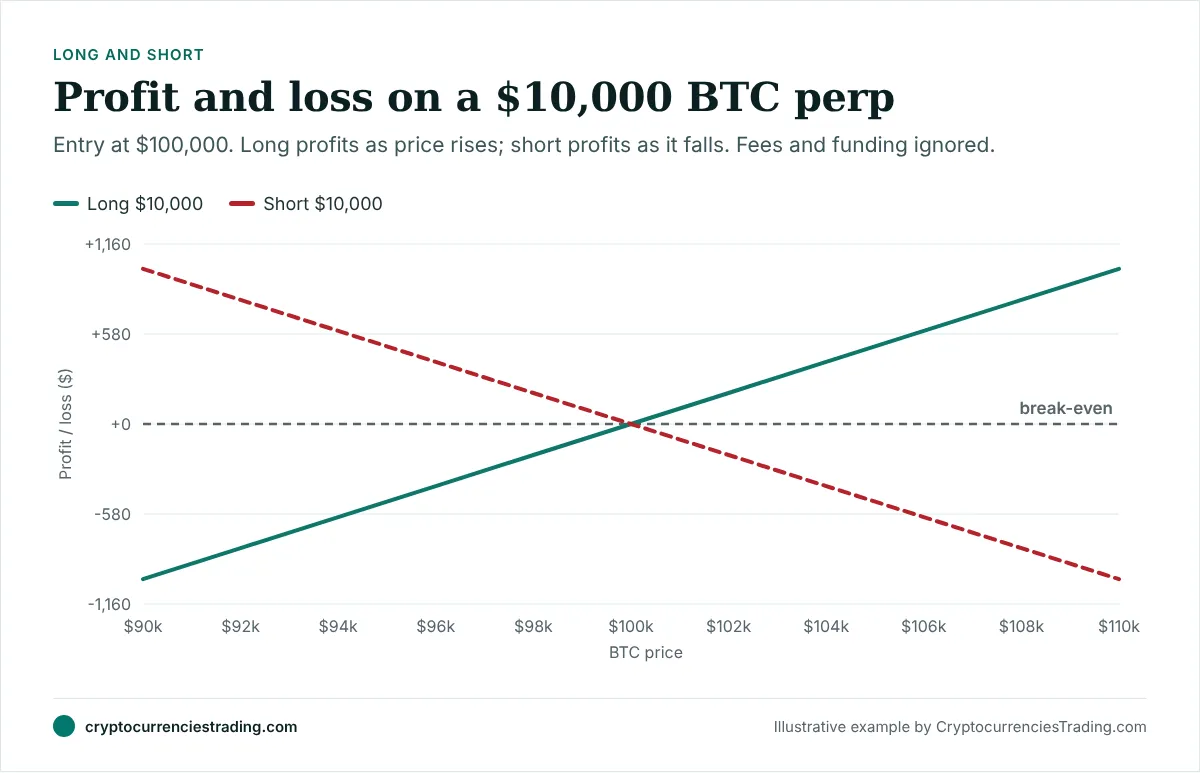
Fees and funding come off the result. Notice that the profit and loss depend on position size, not on your margin. That is where leverage comes in.
Margin and leverage
Margin is the collateral you put up. Leverage is how many times larger your position is than your margin.
- $1,000 of margin at 1x opens a $1,000 position.
- $1,000 of margin at 10x opens a $10,000 position.
- $1,000 of margin at 100x opens a $100,000 position.
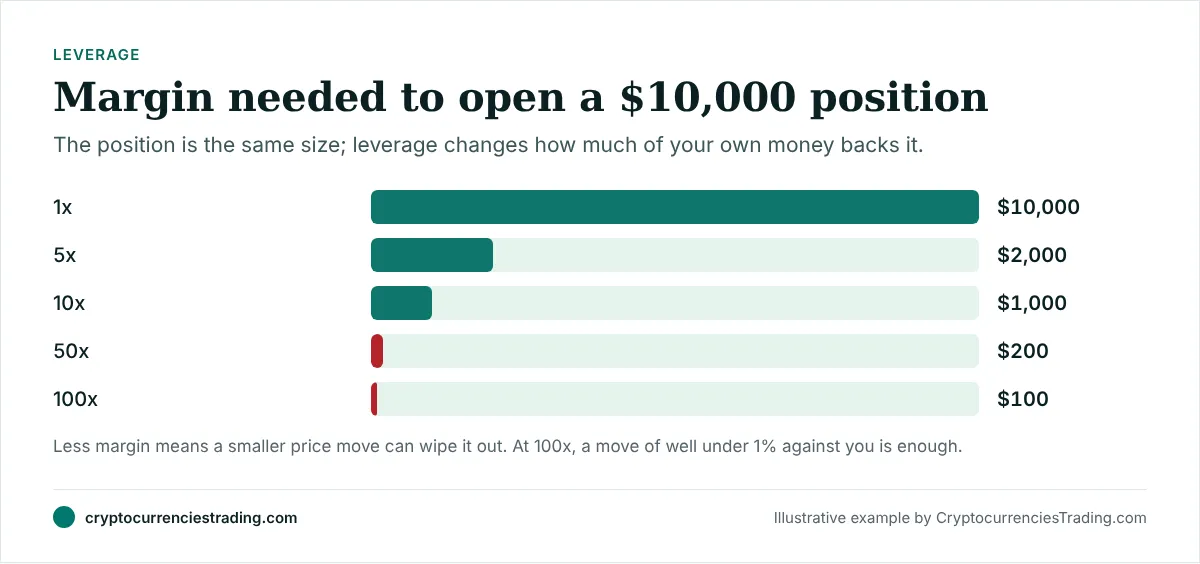
Leverage does not change how much a price move earns or loses on a given position size. It changes how much of your own money is at stake for that size, and therefore how small a move it takes to wipe the margin out. A 10% move on a $10,000 position is $1,000 either way. At 1x that is a tenth of your margin. At 10x it is all of it.
Most venues let you choose between isolated margin, where only the margin assigned to one position is at risk, and cross margin, where your whole account backs every position. Beginners are usually safer with isolated margin.
Liquidation
If a position loses so much that the remaining margin falls below a minimum, called the maintenance margin, the exchange closes it automatically. That is a liquidation. You lose the margin on that position, and some venues charge a liquidation fee on top.
As a rough guide, a long at 10x is liquidated after a drop of a little under 10%, and at 100x after a drop of well under 1%. Bitcoin moves 1% within an hour on many ordinary days. That is why high leverage loses money for most people who use it.
Our leverage and liquidation guide shows the formula, worked examples at every leverage level and the habits that keep you away from the liquidation price.
Index price, mark price and last price
A perp has more than one price, and knowing which is which saves confusion.
- Last price is where the most recent trade on that perp market happened. It is what the chart usually shows.
- Index price is an average of the coin’s spot price across several exchanges or oracle feeds. It represents the “real” market price.
- Mark price is the price the venue uses to value your position and decide liquidations. It is usually based on the index price, adjusted for the perp’s premium, and smoothed so that one large trade cannot spike it.
Why it matters: a sudden wick in the last price does not necessarily liquidate you, because liquidation usually follows the mark price. But a sustained move does. When you set a stop-loss, check whether it triggers on the last price or the mark price; many venues let you choose.
Funding
Funding is a payment between longs and shorts at set intervals, every hour on some venues and every eight hours on others.
- When the perp trades above the spot price, funding is usually positive: longs pay shorts. That makes holding a long more expensive and pushes the perp back down.
- When the perp trades below spot, funding is usually negative: shorts pay longs.
Funding is not a fee to the exchange. But it is a real cost or income while you hold a position. At 0.01% every eight hours, a $10,000 long pays about $3 a day. In a hot market, rates can be many times higher.
Perps vs dated futures and options
Perps are one of three common derivatives in crypto.
- Dated futures work like perps but expire on a set date. Their price includes a premium or discount to spot that shrinks to zero at expiry, instead of a funding rate. They are popular with funds that want a fixed end date.
- Options give the right, not the obligation, to buy or sell at a set price before a set date. A bought option can lose only the premium paid, but options pricing is harder to understand.
- Perps have no expiry and use funding instead. They are the simplest to trade and the most liquid, which is why most retail derivatives volume in crypto is in perps.
Who uses perps, and why
Not everyone who trades perps is betting on price direction with high leverage.
- Hedgers use shorts to protect coins they already own. Someone holding 1 BTC who expects a rough month can short a 1 BTC perp at 1x. If the price falls, the short gains roughly what the holding loses, at the cost of fees and funding.
- Basis traders hold spot and short the perp at the same time to collect positive funding while staying market-neutral. It is lower risk than directional trading but not risk-free: exchange failures and sudden funding flips can hurt.
- Market makers quote both sides and earn the spread and maker rebates.
- Directional traders take a view on price. This is where most retail losses happen, almost always because of too much leverage.
Knowing which of these you are helps you choose leverage, margin mode and how long to hold.
Fees
You pay a trading fee when you open and again when you close a perp position, charged on the full position size, not your margin. Venues charge a lower maker fee for orders that rest on the order book and a higher taker fee for orders that fill immediately. See our maker vs taker fees guide.
A $10,000 position at a 0.05% taker fee costs $5 to open and $5 to close. At 10x leverage that $10 round trip is 1% of your $1,000 margin, so frequent trading at high leverage eats into margin quickly.
Where you can trade perps
Perps trade on two kinds of venue:
- Centralized exchanges (CEXs), such as OKX, Bybit, Bitget and Kraken. They hold your funds, require identity verification and offer fiat deposits and support.
- Decentralized exchanges (perp DEXs), such as Hyperliquid, Lighter and Extended. You trade from your own wallet, usually with no identity check, and funds sit in smart contracts.
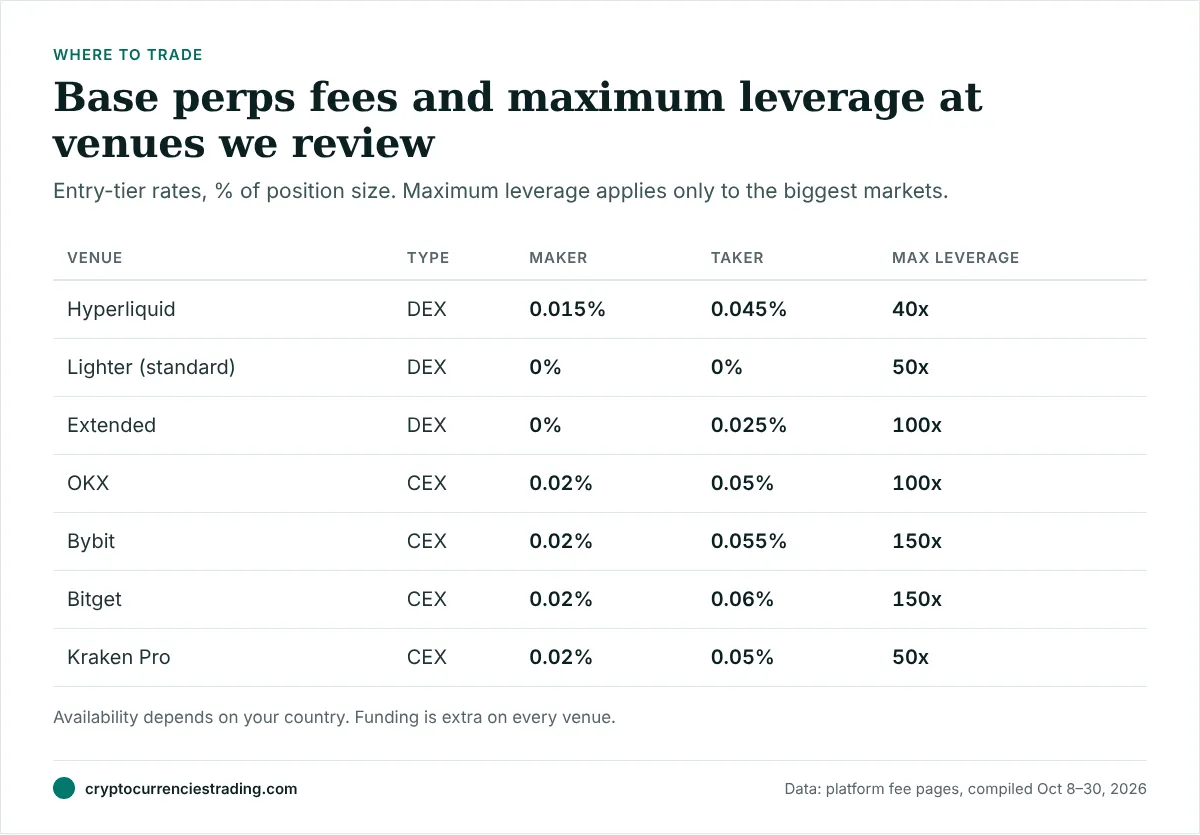
Which to use depends mostly on where you live and whether you want to hold your own keys. Many perp venues are not available in the US or the UK. Our CEX vs DEX guide covers the trade-offs, and the rankings compare perp DEXs and futures exchanges side by side.
A first trade, step by step
If you decide to try perps, keep the first trades small and boring:
- Pick a liquid market. BTC or ETH, where spreads are tight and prices are hard to push around.
- Decide your maximum loss in dollars before anything else, for example $20.
- Choose low leverage, 2x to 3x, and isolated margin.
- Set a stop-loss at the price where your $20 loss would be reached, well before the liquidation price.
- Check the order ticket. Read the position size, the fee, the liquidation price and the current funding rate.
- Close on your plan, not on hope. Review what happened before trading again.
Common mistakes
- Using maximum leverage because the slider allows it.
- Trading without a stop-loss, then watching a small loss become a liquidation.
- Ignoring funding on a position held for days.
- Confusing margin with position size when working out fees and profits.
- Using cross margin and letting one bad trade drain the whole account.
- Revenge trading after a loss with bigger size and more leverage.
Frequently asked questions
Do I own the coin when I trade a perp?
No. You hold a contract that pays the price difference. To own the coin, buy it on a spot market.
Can I lose more than my margin?
On most venues, no: liquidation closes the position before your margin is gone, and insurance funds or the venue’s own pool absorb any shortfall. Your whole margin on that position can still be lost.
What leverage should a beginner use?
Low, around 2x to 3x, or none. The maximum a venue offers is not a recommendation.
Are perps legal everywhere?
No. Many countries restrict crypto derivatives for retail traders, including the United States and the United Kingdom, and venues block users from those places. Check our guides to US availability and the UK.
What is a good first perp to trade?
BTC or ETH on a large venue. They have the deepest order books, the tightest spreads and the most predictable funding. Small coins can move 20% in minutes and are easier to manipulate.
How long can I hold a perp?
As long as you like, as long as you are not liquidated and you can afford the funding. There is no expiry date to roll.
Why do perp prices differ slightly from spot?
Because the perp trades on its own market. Funding pulls the two together, but short gaps are normal, especially in fast markets.
