A centralized exchange (CEX) is a company that holds your crypto and runs the market for you, like a bank or broker. A decentralized exchange (DEX) is a set of smart contracts you use directly from your own wallet, so you keep control of your funds. A CEX is usually easier, supports bank deposits and offers customer support, but you trust the company. A DEX gives you control and often no identity check, but every mistake is yours to fix.
Most traders end up using both: a CEX to turn money into crypto and back, and DEXs or a self-custody wallet for everything else. This guide explains the differences, what each costs and which risks each carries, so you can decide which to use for what.
We use the platforms we review as examples throughout, with their own published fees and rules, so you can see how the general points apply to real venues you might actually sign up for.
This is not financial advice. Crypto trading carries risk, and leveraged products can lose all the money you put in.
The short version
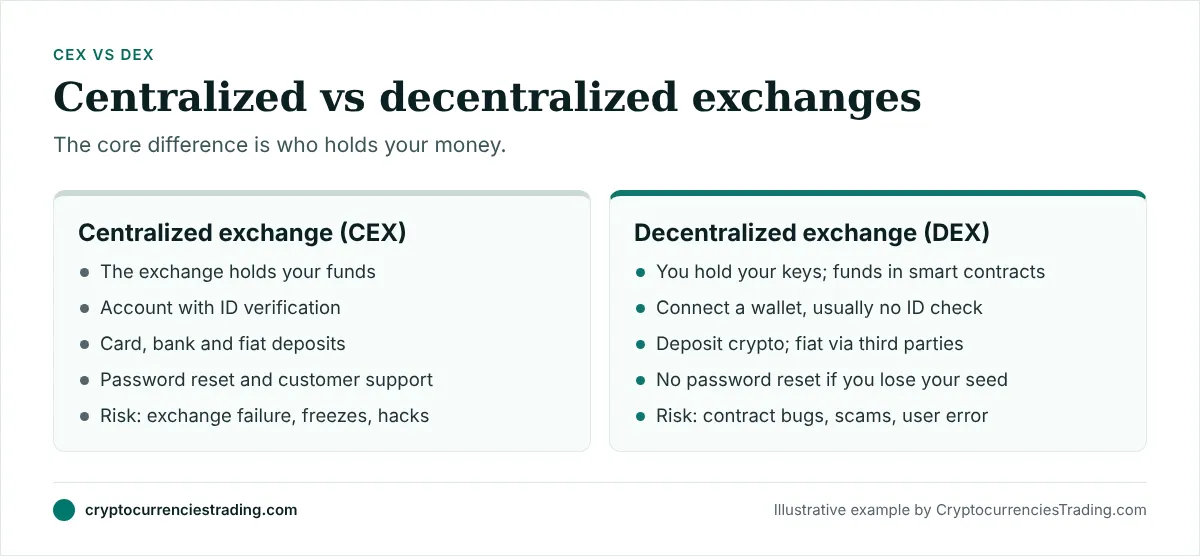
If you remember one thing, make it this: on a CEX, the exchange holds your money; on a DEX, you do. Almost every other difference follows from that.
How a centralized exchange works
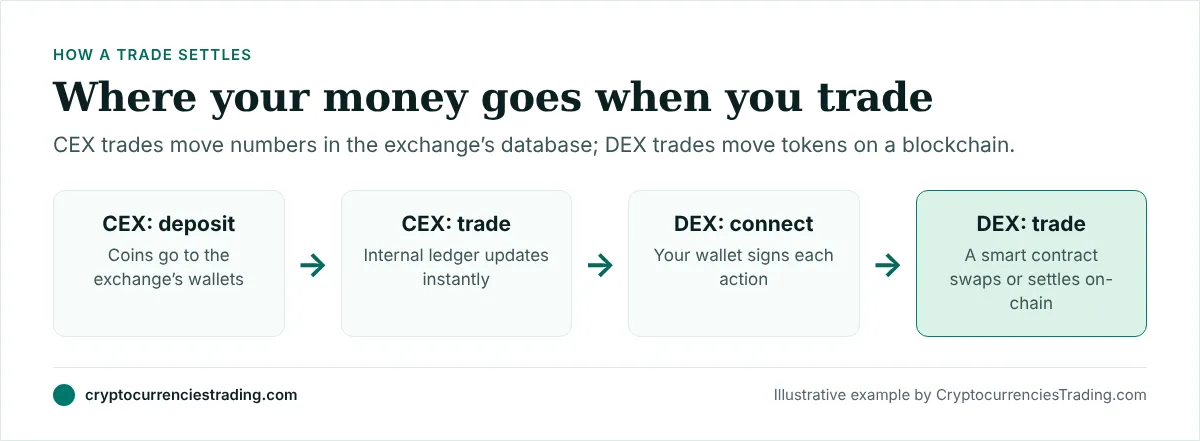
When you deposit crypto to a CEX such as OKX, Bybit, Kraken or Coinbase, the coins go to wallets the exchange controls. Your account shows a balance, which is the exchange’s record of what it owes you. When you trade, the exchange matches your order against other users’ orders on its own order book and updates its internal ledger. Nothing touches a blockchain until you withdraw.
That design makes CEXs fast and convenient:
- Fiat on and off ramps. Card payments, bank transfers and sometimes PayPal or Apple Pay, so you can go from dollars or euros to crypto in one place.
- Account recovery. Forget your password and you can reset it with your email and ID.
- Customer support. A person to contact if a deposit goes missing or an order behaves strangely.
- Deep liquidity. Large exchanges have busy order books with tight spreads on major coins.
- Many products under one login. Spot, perpetual futures, copy trading, staking and apps.
The cost is trust and paperwork. A CEX must know who you are (KYC, or “know your customer”), it decides which countries it serves, and it can freeze accounts. Your funds are only as safe as the exchange’s security and solvency. Some exchanges publish proof-of-reserves reports to show they hold customers’ assets, but those reports are snapshots, not guarantees.
How a decentralized exchange works
On a DEX such as Uniswap or Jupiter, you never hand your coins to a company. You connect a wallet, such as MetaMask or Phantom, and approve each action with your wallet’s signature. A smart contract carries out the swap and sends the tokens straight back to your wallet.
Spot DEXs usually work in one of two ways:
- Automated market makers (AMMs). Instead of an order book, liquidity providers deposit pairs of tokens into pools, and a formula sets the price. You pay a pool fee that goes to those providers.
- Aggregators. Services such as Jupiter search many pools and routes to find the best price for your swap.
Perp DEXs such as Hyperliquid, Lighter and Extended run order books more like a CEX, but settle on a blockchain and let you trade from your own wallet.
The benefits:
- You hold your keys. No company can freeze your funds or lose them in a bankruptcy.
- Usually no identity check. You connect a wallet and trade, although the DEX’s terms may still bar some countries.
- Early and wide token access. New tokens often trade on DEXs long before any CEX lists them.
- Transparency. Trades and balances are visible on the blockchain.
The costs:
- No safety net. Lose your seed phrase or sign a malicious transaction and nobody can reverse it.
- Network fees. Every action costs gas on the blockchain, from fractions of a cent to several dollars depending on the chain.
- Smart contract risk. A bug or exploit in the contract can drain funds, even on audited protocols.
- Scam tokens. Anyone can create a token with any name. Buying the wrong contract is one of the most common DEX losses.
- No fiat. To get dollars in or out you usually still need a CEX or a third-party on-ramp.
Fees compared
Fees vary much more within each group than between them. Some CEXs are very cheap for traders using their main order books; others charge more for convenience.
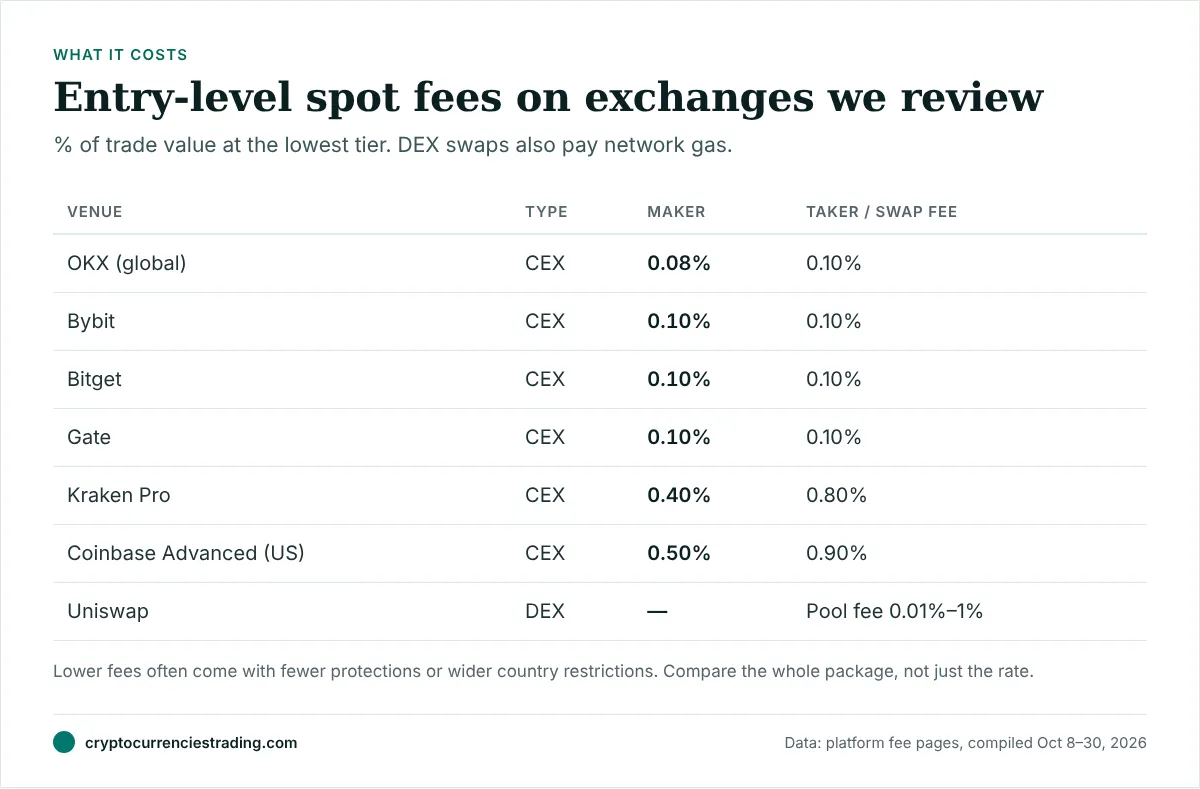
Things to compare beyond the headline rate:
- Spread. On a DEX pool or a simple “buy” button, the price you get may be worse than the market price. That gap is a cost even when the fee is low.
- Gas. A $20 swap on a busy chain can cost more in gas than in fees. Solana and many Ethereum layer-2 networks are cheap; Ethereum mainnet can be expensive.
- Deposit and withdrawal fees. CEXs charge network fees to withdraw and sometimes fees for fiat. Card purchases usually cost the most.
- Order type. On order-book venues, maker orders cost less than taker orders. See our maker vs taker guide.
Safety compared
Neither model is “safe”. They fail in different ways.
How CEXs fail. Hacks of exchange wallets, mismanagement or fraud, regulatory freezes, and withdrawal halts. In February 2025, Bybit lost about $1.46 billion from one of its Ethereum cold wallets; it says it kept paying withdrawals and replaced the funds within days. Other exchanges in the past were not so fortunate, and customers waited years for partial repayment. Protection depends on the exchange’s balance sheet and on local rules.
How DEXs fail. Contract bugs and exploits, malicious front-ends, compromised admin keys, oracle manipulation, and, most of all, user error: approving a scam contract, sending to the wrong address or losing a seed phrase.
Practical habits for each:
- On a CEX, turn on two-factor authentication and a withdrawal allowlist, and keep only what you are actively trading there.
- On a DEX, bookmark the real site, double-check token contract addresses, revoke old token approvals and keep long-term holdings on a separate hardware wallet. Our self-custody wallet guide explains how.
Regulation and access
CEXs operate under licences in the countries they serve, and they block users from places where they are not allowed. That is why the same exchange can offer derivatives in one country and only spot in another, or not operate at all. If you are in the United States, the United Kingdom or the EU, our guides to the US, the UK and Europe list the exchanges that serve you.
DEXs are not exempt. Many front-ends block certain countries in their terms, and using a DEX does not make an activity legal where it is not. Perp DEXs in particular often exclude US persons; see perp DEXs and US availability.
Perps on a CEX vs a perp DEX
For leveraged trading, the trade-offs sharpen:
- CEX perps offer deep order books, fiat-funded accounts, support and often higher maximum leverage, but you rely on the exchange during the most volatile moments, which is when withdrawals are most likely to be paused.
- Perp DEXs let you trade from your wallet and see positions on-chain. Fees on the larger ones are competitive or lower, but you depend on smart contracts, oracles and bridges, and liquidity outside the top venues can be thin.
Either way, liquidation risk is the same. Read leverage and liquidation explained before trading perps anywhere.
Moving from a CEX to a DEX, step by step
Most people’s first DEX trade starts with coins bought on an exchange. Here is the safe way to make that first move.
- Set up a self-custody wallet that supports the chain you will use, and back up the seed phrase on paper.
- Find your receiving address in the wallet for that specific chain. On Ethereum-compatible networks, the same address works on many chains, but the network you pick when sending still matters.
- On the exchange, choose Withdraw, pick the coin and, carefully, the network. Sending USDC on the wrong network is one of the most common ways to lose funds.
- Send a small test amount first, for example $10, and wait until it arrives in your wallet.
- Keep a little of the chain’s gas token in the wallet (ETH on Ethereum and its layer-2s, SOL on Solana). Without it you cannot make any transaction.
- Send the rest, then connect the wallet to the DEX by typing its address yourself or using a saved bookmark.
- Check the token contract before you swap. Use the DEX’s verified token list, or copy the address from the project’s official site.
Doing it in this order takes a few extra minutes and avoids most first-time losses.
Common mistakes
- Choosing the wrong network when withdrawing from a CEX, or sending to an exchange deposit address on a network it does not support.
- Buying a fake token with the same name and logo as a real one. On a DEX, the contract address is the only reliable identifier.
- Signing anything a site asks for. Some signatures grant unlimited spending rights over a token. Read what you sign, and revoke approvals you no longer need.
- Leaving everything on an exchange because it is convenient. Exchange balances are the exchange’s promise to pay you, not coins you control.
- Ignoring slippage settings. On thin DEX pools, a high slippage tolerance can let your trade fill at a much worse price than expected.
- Assuming a DEX is legal everywhere. Terms of use still apply, and local rules on derivatives still apply.
Which should you use?
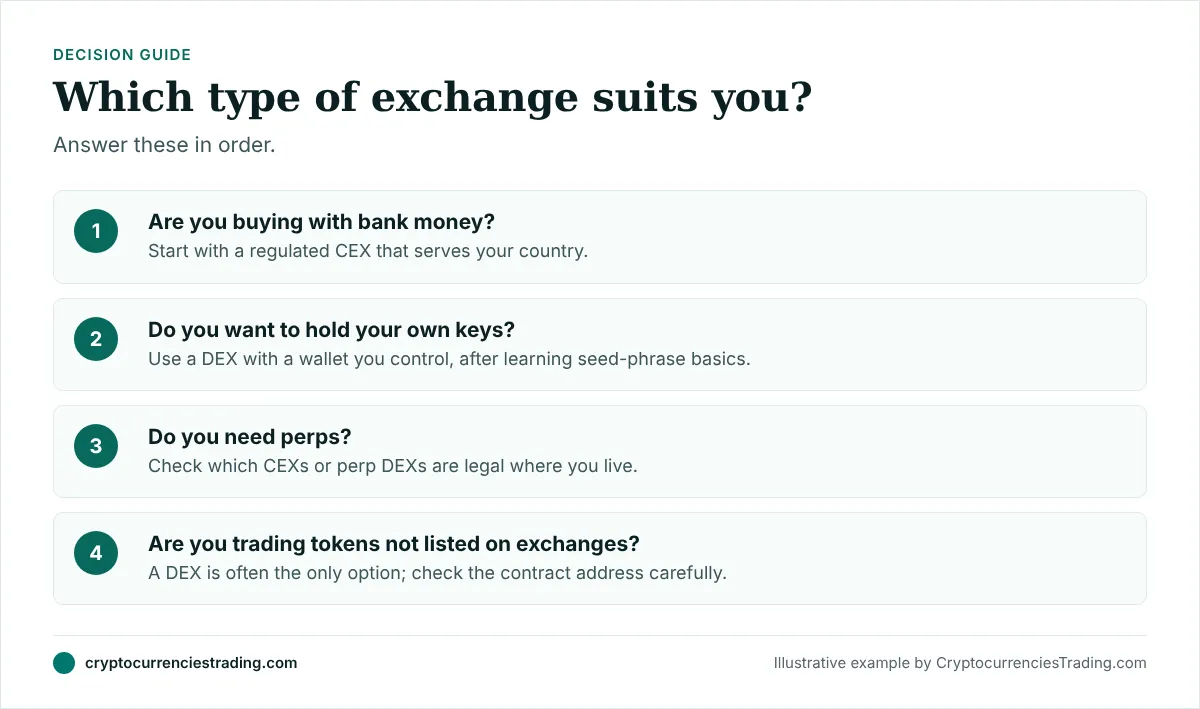
A practical setup for most people:
- Use a reputable CEX that serves your country to buy crypto with bank money and to cash out.
- Move long-term holdings to a wallet you control.
- Use DEXs for tokens and features you can’t get on your exchange, with a separate “trading” wallet holding small amounts.
- Keep perps small, on whichever venue is legal for you and has the liquidity you need.
Frequently asked questions
Is a DEX safer than a CEX?
Not automatically. A DEX removes the risk of an exchange losing or freezing your funds, but adds smart contract risk and makes you fully responsible for your keys and every transaction you sign.
Do DEXs require KYC?
Most spot DEXs and perp DEXs let you connect a wallet without an identity check. Fiat on-ramps inside DEX apps are run by third parties that usually do require it.
Can I buy crypto with a bank card on a DEX?
Some DEX apps include card on-ramps run by payment partners, but most people find it cheaper and simpler to buy on a CEX and withdraw to their wallet.
Why are some tokens only on DEXs?
Anyone can create a token and a DEX pool for it. CEXs choose what to list. That makes DEXs the first place new tokens trade, and also the first place scams appear.
Can I use both?
Yes, and most experienced traders do. A common pattern is to buy on a CEX, withdraw to a self-custody wallet, use DEXs for specific tokens or perps, and send coins back to the CEX when you want to cash out.
What happens to my funds if a CEX goes bankrupt?
Customer balances can be frozen during the proceedings, and how much you get back, and when, depends on the exchange’s assets and local law. That is the main reason to keep long-term holdings off exchanges.
Which is cheaper?
It depends. The big CEX order books charge around 0.1% or less on spot. DEX costs combine a pool fee, the price impact of your trade and gas. For small trades on expensive chains, gas can dominate; on cheap chains, DEX swaps can be very cheap.
