Since July 1, 2026, any company offering crypto services to people in the European Union needs a licence under MiCA, the EU’s Markets in Crypto-Assets Regulation. The transitional period that let firms keep operating on older national registrations is over. For you, that means the safest starting point is an exchange that holds a MiCA licence and serves your country. Among the exchanges we review, Bitvavo, OKX Europe, Bybit’s EU entity, eToro and Coinbase state that they serve EU users under MiCA, while Bitget and Gate exclude several EU countries and Gemini closed its EEA accounts in April 2026.
This guide explains what MiCA changed, what a licence does and doesn’t protect, how the main platforms compare on euro fees, and how to check any exchange before you sign up.
Fees, licences and restrictions below come from each platform’s own pages, checked in October 2026, with links to our full reviews where we have them.
This is not financial or legal advice. Crypto is high risk, and you could lose all the money you invest.
What MiCA is, in short
MiCA is a single set of EU rules for crypto-asset service providers (CASPs): companies that hold crypto for customers, run trading platforms, exchange crypto for money or transfer it. It replaced a patchwork of national registrations with one licence that, once granted in one member state, can be “passported” to serve clients across the EU.
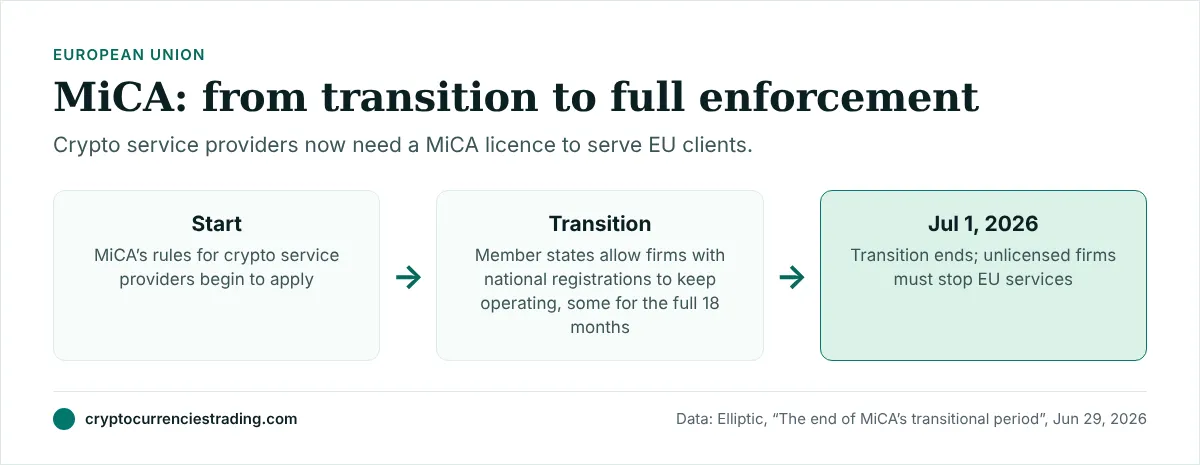
Key points from Elliptic’s summary of the deadline:
- July 1, 2026 was the outer limit of the transitional window. After it, firms relying on national registrations lost that cover.
- Some countries ended earlier. The Netherlands, Finland, Latvia, Hungary and Slovenia closed their transitional periods on June 30, 2025, and Sweden on September 30, 2025. France, Malta and Luxembourg used the full 18 months.
- No licence, no service. Article 59 of MiCA bars providing crypto services in the EU without authorization. A pending application is not a licence.
- The register. ESMA, the EU markets authority, keeps a register of licensed CASPs. On June 29, 2026, it showed 213 entries across 23 countries, led by Germany (55), the Netherlands (26) and France (19). It is updated weekly.
What MiCA protects, and what it doesn’t
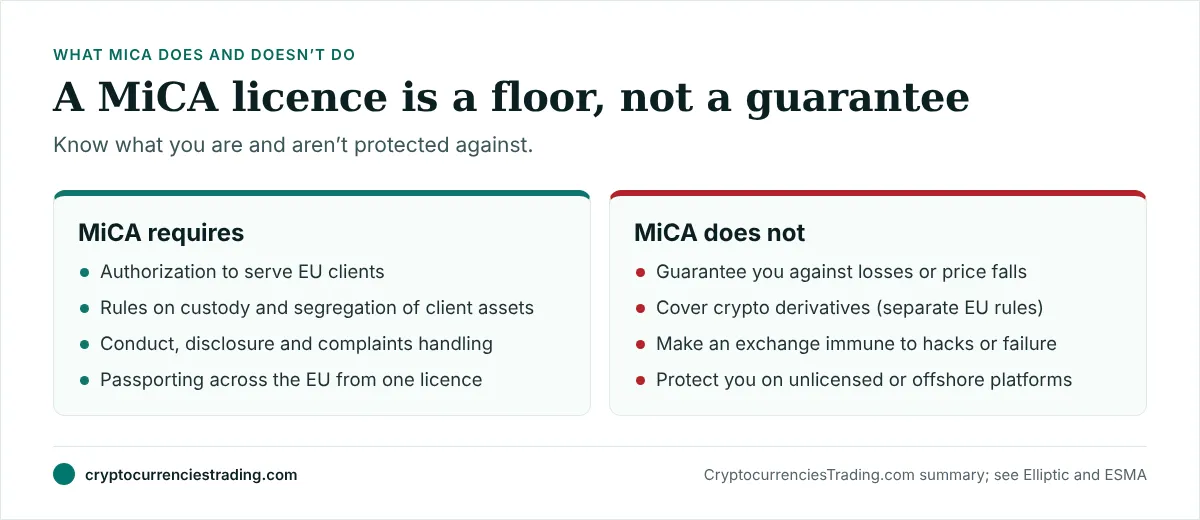
A MiCA licence means a regulator has authorized the firm and it must follow rules on how it holds client assets, how it treats customers, what it discloses and how it handles complaints. That is a meaningful step up from the unregulated platforms many Europeans used a few years ago.
It does not mean:
- Your investment is protected. Crypto prices can fall to zero, and no scheme compensates you for market losses.
- Derivatives are covered. Crypto derivatives such as perpetual futures and CFDs fall under separate EU financial rules, not MiCA, so a MiCA licence alone does not authorize a firm to sell you perps.
- The firm can’t fail or be hacked. Rules reduce the risk; they don’t remove it.
- Offshore platforms are safe to use. If an exchange serves you without a MiCA licence, you are outside these protections.
Exchanges in our reviews and the EU
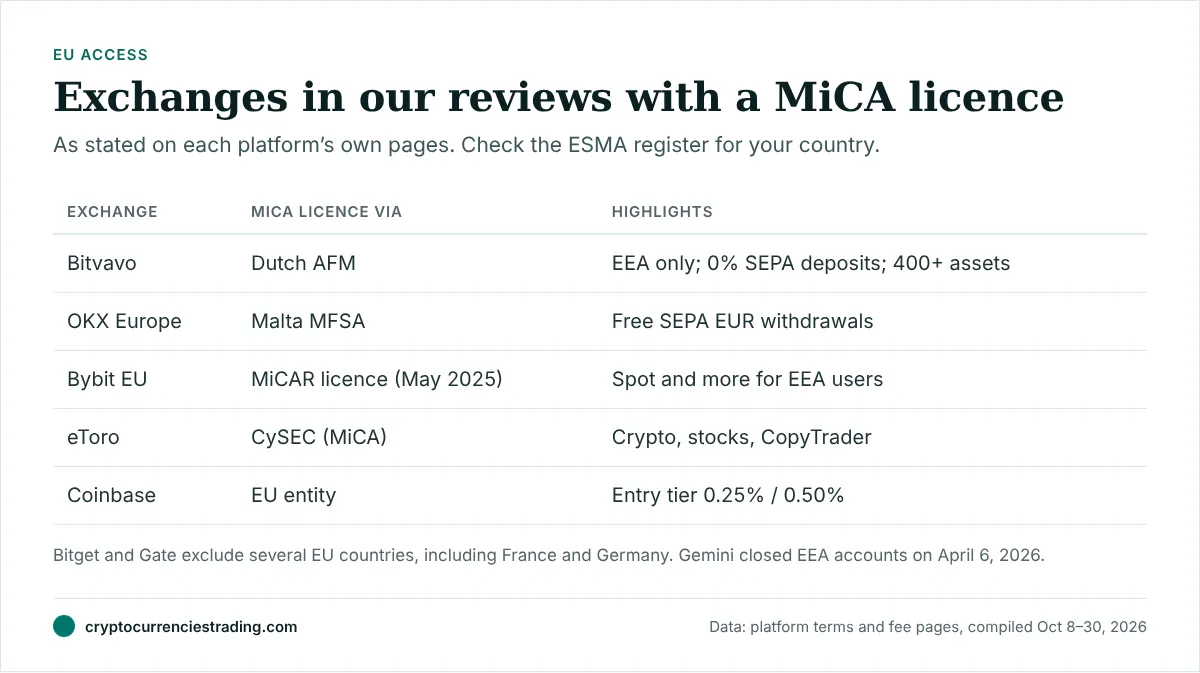
Bitvavo
Bitvavo is a Netherlands-based exchange that only serves residents of the European Economic Area, with some exceptions for SEPA countries. Its terms say it is licensed by the Dutch AFM as a crypto-asset service provider under MiCA, for custody, operating a trading platform and transfers. It lists 453 assets.
Fees on EUR markets start at 0.15% maker and 0.25% taker below €100,000 of 30-day volume, and crypto pairs on USDC markets start at 0.05% for both. Euro deposits by SEPA, iDEAL | Wero and Bancontact cost 0%, while Apple Pay, Google Pay, credit card and PayPal cost 1%. Euro withdrawals to a linked bank account are free. Bitvavo offers margin trading on 20 assets with up to 10x leverage, and publishes an annual proof-of-reserves attestation by The Network Firm.
Best for: euro-based investors who want a simple, EU-only exchange with free SEPA deposits.
OKX Europe
OKX Europe Limited states that it is licensed by the Malta Financial Services Authority as a CASP under MiCA. EEA residents can deposit and withdraw euros by SEPA, and OKX says SEPA EUR withdrawals are free. Spot fees for regular users are 0.08% maker and 0.10% taker, the same base rates as the global site. See our OKX review.
Best for: active spot traders who want low fees and a large coin list.
Bybit EU
Bybit says it secured its MiCAR licence in May 2025 and serves EEA users under it. Its base spot fees are 0.10% maker and 0.10% taker on crypto pairs, with higher rates on fiat pairs. Bybit’s referral bonuses are not available to EEA users invited from within the EEA. See our Bybit review.
Best for: traders who already use Bybit globally and want a licensed EU account.
eToro
eToro lists a CySEC-regulated entity with a MiCA licence among its group companies. It combines crypto with stocks and ETFs and offers CopyTrader. Crypto costs 1% to open and 1% to close a position, plus the spread. eToro warns that 51% of retail investor accounts lose money when trading CFDs with it.
Best for: investors who want crypto alongside shares and copy trading.
Coinbase
Coinbase serves EU users through an EU entity. On Coinbase Advanced, the EU and UK entry-level tier is 0.25% maker and 0.50% taker. Its US-regulated futures are offered in the EEA only to eligible customers through a Cyprus-regulated Coinbase entity, subject to an application. See our Coinbase review.
Best for: beginners who want a well-known brand with a straightforward app.
Kraken
Kraken serves EU users for spot trading; its restricted list does not include EU countries, and derivatives availability varies by country. Check Kraken’s licensing and restrictions page for your country, and see our Kraken review.
Platforms that don’t serve parts of Europe
- Bitget prohibits users in Germany, France and Austria, among others.
- Gate lists France, Germany, Spain, the Netherlands, Austria and Malta among restricted locations.
- KuCoin restricts France and the Netherlands.
- Gemini closed all EEA customer accounts effective April 6, 2026.
- Perp DEXs vary: some, like dYdX, say their site is not aimed at or marketed to the EU, and MetaMask does not offer perps in Belgium.
Euro deposits and withdrawals
The euro payment rails matter more than the trading fee for many people:
- SEPA bank transfer is the standard route. Bitvavo charges 0% for SEPA deposits, and OKX Europe says SEPA EUR withdrawals are free. Instant SEPA, where your bank supports it, can credit within seconds.
- Local methods such as iDEAL | Wero in the Netherlands and Bancontact in Belgium are supported by some exchanges; Bitvavo lists both at 0%.
- Cards and wallets like Apple Pay, Google Pay and PayPal are convenient but cost more. Bitvavo lists them at 1%.
- Withdrawals usually go back by SEPA to a bank account in your own name. Third-party withdrawals are generally not allowed.
Make your first deposit small, confirm the withdrawal route works, and only then move larger amounts.
What it costs: a €1,000 purchase
At each platform’s entry-level taker rate on its trading screen, buying €1,000 of crypto costs about:
- OKX Europe: €1.00
- Bybit (crypto pair): €1.00
- Bitvavo (EUR market): €2.50
- Coinbase Advanced: €5.00
- eToro: €10.00 to open, plus the spread
Remember deposit costs: SEPA transfers are usually free or cheap, while cards often cost 1% or more. On Bybit, buying directly on a fiat pair costs more than converting euros to USDT first and buying on a crypto pair. Our maker vs taker guide shows how limit orders lower costs further.
Derivatives and leverage in the EU
MiCA covers spot crypto services. Leveraged products like perpetual futures fall under separate EU rules for financial instruments, and availability to retail clients varies by platform and country. Several perp DEXs and offshore futures exchanges serve EU residents in some countries, while others exclude parts of the EU. If you use leverage at all, keep it low and read our leverage and liquidation guide first.
If your exchange stopped serving you
Some users found in 2025 and 2026 that an exchange they used closed EU accounts, moved them to a new EU entity, or restricted products, as Gemini did when it closed EEA accounts in April 2026. If that happens to you:
- Follow only the exchange’s official notices for withdrawal steps and deadlines. Ignore messages from third parties offering help.
- Withdraw rather than wait. Move funds to a licensed exchange or a self-custody wallet within the stated window.
- Check the new entity if you are migrated. Your contract, protections and available products can change.
- Keep records of balances and transfers in case questions arise later.
Common mistakes European traders make
- Trusting a brand instead of a licence. A famous name does not mean the entity serving your country is licensed. Check the register.
- Using a platform that restricts your country through a VPN. You lose protections and risk frozen funds.
- Paying by card for large amounts when SEPA is free or close to it.
- Buying on fiat pairs where crypto pairs are cheaper, as on Bybit.
- Ignoring withdrawal costs when comparing platforms; free deposits and expensive withdrawals are a common combination.
- Assuming derivatives are covered by MiCA. They are not.
Taxes
Tax on crypto differs a lot between EU countries: some tax gains as income, some as capital gains, and some exempt long-held crypto. Keep a full record of every purchase, sale, swap and transfer, with dates and euro values, and check your national tax authority’s guidance or a qualified adviser. We don’t give tax advice.
How to check an exchange before you sign up
- Search the ESMA register of crypto-asset service providers for the firm’s name and see which country licensed it.
- Check the legal entity you will contract with on the platform’s terms page, and make sure it is the licensed one.
- Confirm your country is served, especially if you live in France, Germany, Austria or the Netherlands, where several exchanges are restricted.
- Compare fees on the trading screen and the cost of SEPA versus card deposits.
- Turn on security before depositing, and keep long-term holdings in a self-custody wallet.
Frequently asked questions
What happened on July 1, 2026?
MiCA’s transitional period ended. Crypto service providers that relied on older national registrations had to hold a MiCA licence to keep serving EU clients, or stop.
Does a MiCA licence protect my money?
It means the firm is authorized and must follow rules on custody, conduct and complaints. It does not protect you from price falls, and it does not make the firm immune to failure or hacks.
Can I trade perpetual futures in the EU?
It depends on the platform and your country. MiCA does not cover derivatives, which fall under separate EU financial rules, so check each platform’s terms for your country.
Which EU exchange has the lowest fees?
Among the exchanges we review, OKX Europe has the lowest entry-level spot rates at 0.08% maker and 0.10% taker. Bitvavo’s USDC markets start at 0.05% for both.
Is my country one of the restricted ones?
It depends on the platform. France, Germany, Austria and the Netherlands appear most often on the restricted lists we checked, for example at Bitget, Gate and KuCoin. Always check the exchange’s own terms for your country before you sign up.
Can I use a non-EU exchange from Europe?
Only if it holds a MiCA licence or otherwise lawfully serves your country. Offshore exchanges that serve EU users without authorization put you outside MiCA’s protections.
How do I find out if an exchange is licensed?
Check ESMA’s register of crypto-asset service providers, which lists licensed firms and the country that authorized them. It is updated weekly.
