In the UK you can buy, sell and hold crypto on exchanges that serve UK customers, but retail investors cannot trade crypto derivatives such as perpetual futures, CFDs or options. The Financial Conduct Authority (FCA) banned their sale to retail consumers from January 6, 2021, and confirmed in 2025 that the ban stays. Since October 8, 2025, retail investors can buy crypto exchange-traded notes (ETNs) listed on a UK recognised investment exchange. Among the exchanges we review, Kraken, Coinbase and eToro serve UK users for spot crypto, OKX serves the UK without derivatives, and Gemini closed its UK accounts in April 2026.
This guide explains the rules that shape your options, compares the platforms we review, and covers fees, safety and what is changing with the UK’s new crypto regime.
Every fee, restriction and date below comes from the platform’s own pages or the FCA’s website, checked in October 2026, and we link to our full reviews where we have them.
This is not financial or legal advice. Crypto is high risk, and you could lose all the money you invest.
The rules in plain English
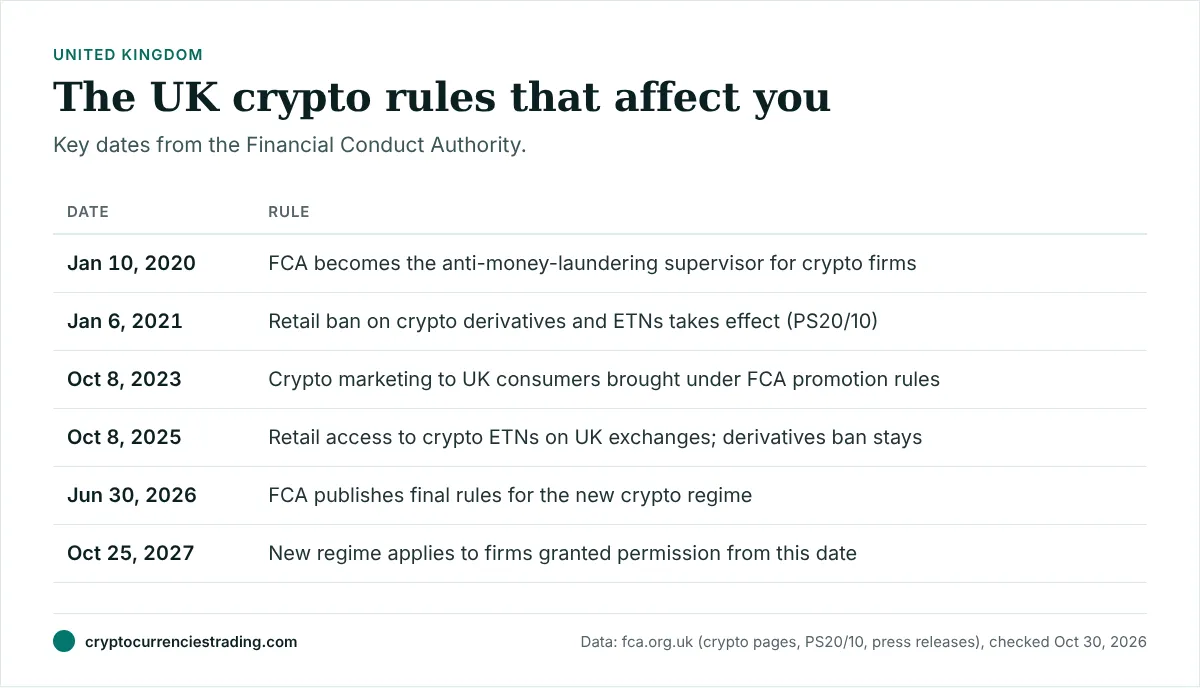
Registration. Since January 10, 2020, the FCA has supervised crypto firms for anti-money-laundering purposes. Firms doing certain crypto business in the UK must be registered. You can check a firm on the FCA register before you sign up.
Marketing rules. Since October 8, 2023, crypto promotions aimed at UK consumers fall under the FCA’s financial promotion rules, which apply to overseas firms too. This is why many platforms show risk warnings and why new UK accounts may face extra steps. Kraken, for example, makes new UK retail accounts wait through a 24-hour cooling-off period before trading.
The derivatives ban. Under policy statement PS20/10, firms may not sell crypto derivatives or crypto ETNs to retail consumers. That covers perpetual futures, futures, options and CFDs that reference crypto. In its October 2025 announcement, the FCA said the ban on retail access to cryptoasset derivatives will remain in place.
Crypto ETNs. The FCA opened retail access to crypto ETNs from October 8, 2025, as long as they trade on an FCA-approved UK investment exchange. Promotion rules and the Consumer Duty apply, and the Financial Services Compensation Scheme (FSCS) does not cover them.
The new regime. The FCA published final rules for a fuller crypto regime on June 30, 2026. They apply to firms granted permission under the Financial Services and Markets Act from October 25, 2027. Until then, the registration and promotion rules above are what apply.
What you can and can’t do
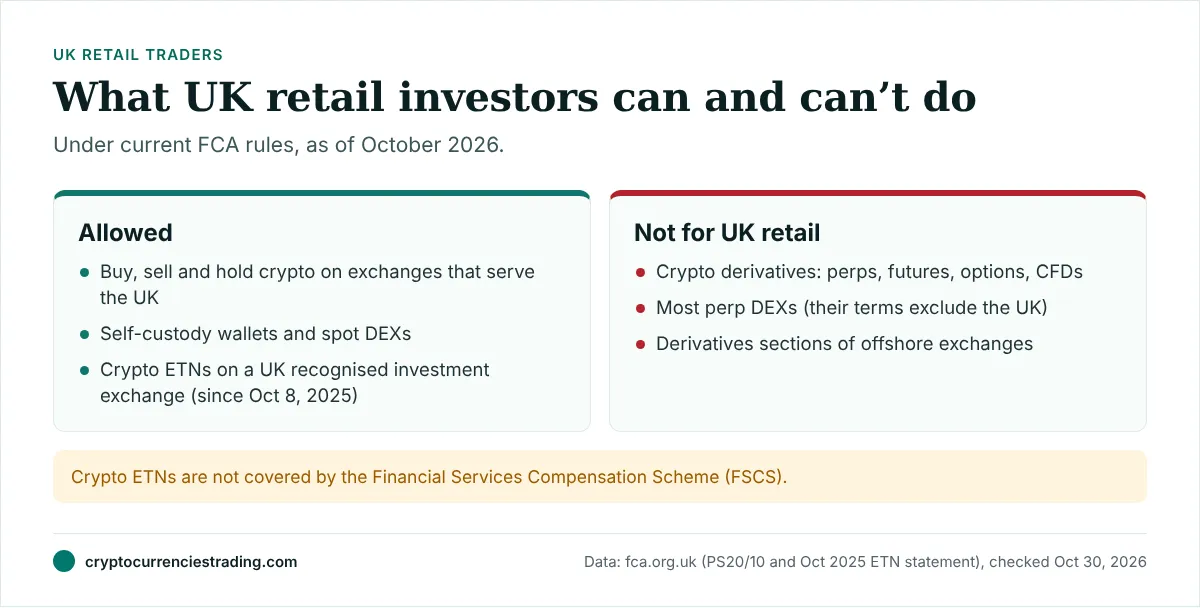
In practice, a UK retail investor can:
- Buy, sell and hold crypto on an exchange that serves UK customers.
- Use a self-custody wallet and spot DEXs, subject to each front-end’s terms.
- Buy crypto ETNs through a broker on a UK recognised investment exchange.
- Copy trade where the platform offers it to UK clients for non-derivative products, depending on the platform.
And cannot, as a retail client:
- Trade crypto perpetual futures, futures, options or CFDs. UK-facing exchanges switch these off for UK retail users.
- Use most perp DEXs, whose terms exclude UK users.
Some platforms offer derivatives to UK clients who qualify as professional or elective professional clients. That classification removes retail protections and is meant for experienced, well-resourced traders; don’t apply for it just to get leverage.
Exchanges in our reviews and the UK
Kraken
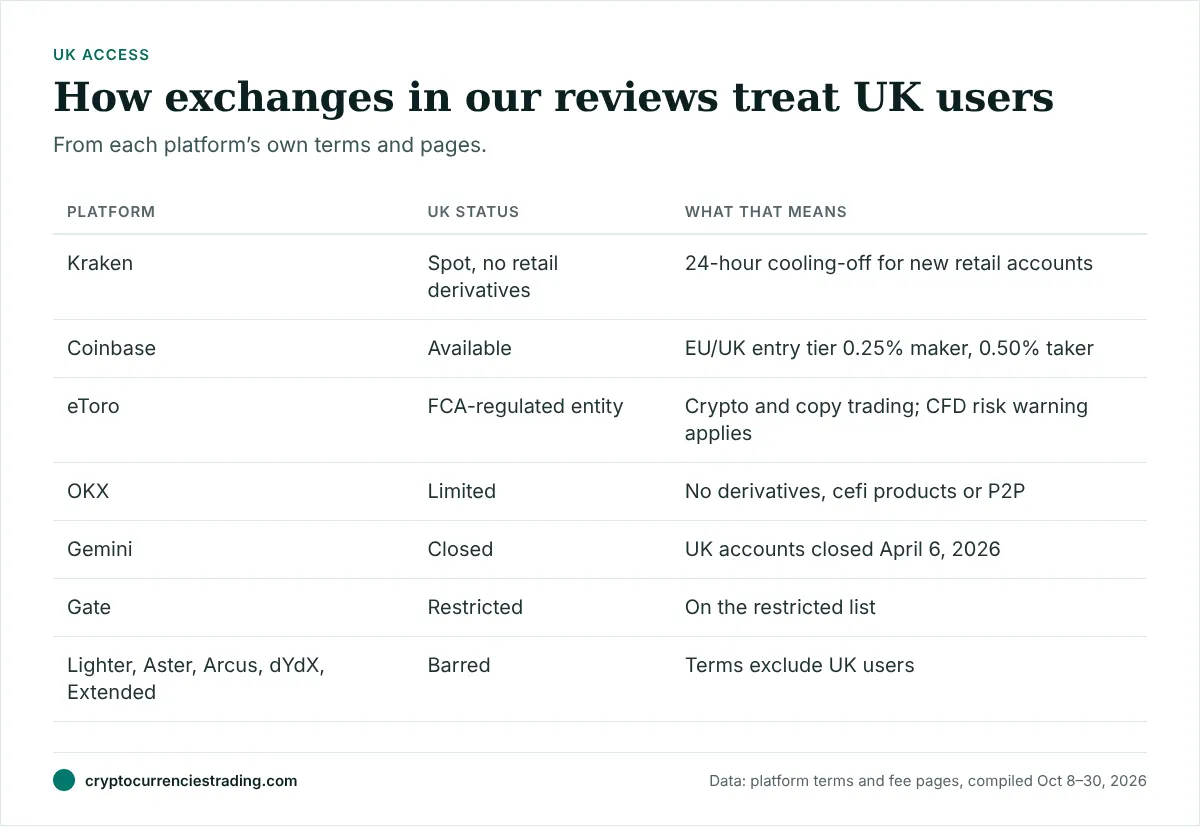
Kraken serves the UK for spot trading but does not offer derivatives to retail clients in the UK. New UK retail accounts wait through a 24-hour cooling-off period before trading. Kraken Pro charges 0.40% maker and 0.80% taker at Tier 1 on spot, falling with volume. See our Kraken review.
Coinbase
Coinbase serves UK users. On Coinbase Advanced, the EU and UK entry-level tier is 0.25% maker and 0.50% taker, lower than its US entry tier. The simple buy screen costs more. See our Coinbase review.
eToro
eToro lists an FCA-regulated entity among its group companies. It offers crypto alongside stocks and ETFs, plus CopyTrader. Crypto costs 1% to open and 1% to close a position, plus the spread. eToro’s own risk warning says 51% of retail investor accounts lose money when trading CFDs with this provider; crypto CFDs are not available to UK retail clients under the FCA ban.
OKX
OKX’s Risk & Compliance Disclosure limits UK users: no derivatives, no cefi-related products and no P2P trading. Spot trading is available. See our OKX review.
Platforms that don’t serve the UK
- Gemini closed all UK customer accounts effective April 6, 2026, after a withdrawal-only period.
- Gate lists the UK among restricted locations.
- Perp DEXs including Lighter, Aster, Arcus, dYdX, Extended and Pacifica exclude UK users in their terms. Wallet apps Phantom and MetaMask do not offer perps in the UK.
What it costs
A $1,000 spot purchase at each platform’s entry-level taker rate, on its trading screen, costs about:
- Coinbase Advanced (EU/UK tier): $5.00
- Kraken Pro: $8.00
- eToro: $10.00 to open, plus the spread, and another 1% to sell
Fees on simple buy screens are usually higher. Paying by card typically costs more than a bank transfer. Our maker vs taker guide explains how limit orders cut costs.
Moving pounds in and out
How you fund your account affects both cost and speed:
- Bank transfer in pounds is usually the cheapest way to deposit on platforms that support GBP, and often arrives quickly.
- Debit card purchases are instant but usually carry a percentage fee, so they suit small first purchases rather than regular top-ups.
- Withdrawals back to a UK bank account are typically by bank transfer. Check the platform’s fee page for any GBP withdrawal charge.
- Your bank’s own policy matters too. Some UK banks limit or block payments to crypto exchanges, especially to firms they consider higher risk. If a payment is declined, contact your bank rather than trying workarounds.
Keep the first deposit small until you know how deposits and withdrawals work on that platform.
If you were a Gemini customer
Gemini’s notice said all UK accounts closed effective April 6, 2026, after a withdrawal-only period. If you still had assets there, follow Gemini’s official support instructions only, and ignore unsolicited messages offering help to “recover” funds. For a replacement, compare the UK-serving platforms above on fees, GBP support and security, and consider moving long-term holdings to a self-custody wallet rather than another exchange.
Safety and protections
- No FSCS cover for crypto. The FSCS does not protect cryptoassets held on an exchange, and it does not cover crypto ETNs either.
- Check the FCA register to see whether a firm is registered for crypto business in the UK, and be wary of firms that are not.
- Scam warnings. The FCA publishes warnings about unauthorised firms. Unrealistic returns, pressure to act fast and requests to move money to “safe” accounts are classic signs of fraud.
- Account security is your responsibility: two-factor authentication, a withdrawal allowlist and unique passwords.
- Self-custody for long-term holdings removes exchange risk; see our self-custody wallet guide.
Crypto ETNs: how they work
A crypto exchange-traded note is a debt security issued by a company that promises to pay the value of a cryptoasset, minus fees. ETNs trade on a stock exchange like shares, so you buy them through a normal investment broker rather than a crypto exchange.
What to look for:
- Physical backing. Many crypto ETNs say they are backed by the actual coins held with a custodian. Read the prospectus to check.
- Annual fee. ETNs charge a yearly management fee that is taken from the value over time. Compare it with the one-off cost of buying the coin on an exchange.
- Issuer risk. An ETN is a promise from the issuer. If the issuer fails, holders rely on the security arrangements described in the prospectus.
- No FSCS cover. The FCA states that the FSCS does not cover crypto ETNs.
- Tax wrappers. Whether a particular ETN can be held in an ISA or pension depends on current HMRC and provider rules; check with your provider.
ETNs suit investors who want price exposure through an existing brokerage account and don’t want to manage keys. They don’t suit anyone who wants to use crypto on-chain.
Copy trading in the UK
Copy trading for UK users depends heavily on the platform. eToro offers CopyTrader through its FCA-regulated entity; copied crypto positions follow the same rules as manual ones, so copied crypto CFDs are not available to UK retail clients. OKX’s copy trading FAQ excludes the United Kingdom entirely. Many offshore futures-based copy trading products are derivatives and therefore off-limits to UK retail investors. Our copy trading guide explains how to judge any copy trading offer.
Common mistakes UK traders make
- Signing up to an offshore exchange that doesn’t serve the UK because it advertises higher leverage. You have no UK protection, and accounts can be closed with funds frozen while the platform reviews them.
- Applying for professional client status just to unlock derivatives. You give up retail protections that exist for good reasons.
- Buying through the simplest button in an app, which often includes a wide spread.
- Paying by card for large amounts instead of a bank transfer.
- Falling for “recovery” services after a scam. Firms promising to recover lost crypto for an upfront fee are a common second scam.
- Not keeping records. Every disposal can matter for tax.
Tax basics
For most individuals in the UK, selling, swapping or spending crypto can trigger Capital Gains Tax, and some crypto income, such as staking rewards, may be taxed as income. HMRC publishes guidance on cryptoassets. Keep a record of every purchase, sale and transfer, including dates, amounts and values in pounds, and take advice from a qualified adviser for your situation. We don’t give tax advice.
How to choose
- Confirm the platform serves UK retail clients and is registered with the FCA where required.
- Decide what you need: simple buying, active spot trading, copy trading or ETN exposure.
- Compare fees on the trading screen, not the quick-buy button.
- Check GBP deposit and withdrawal options and their costs.
- Set up security before you deposit.
If you want leverage on crypto, the honest answer for UK retail investors is that regulated access is closed. Platforms that offer it to UK retail users are breaking UK rules or their own terms, and you would have little protection if things went wrong.
Frequently asked questions
Can I trade crypto perpetual futures in the UK?
Not as a retail client. The FCA bans the sale of crypto derivatives to retail consumers, and UK-facing exchanges switch them off. Most perp DEXs also exclude UK users.
Are crypto ETNs available to UK investors?
Yes, since October 8, 2025, when listed on an FCA-approved UK investment exchange. They are not covered by the FSCS.
Is my crypto protected by the FSCS?
No. Crypto held on an exchange is not covered by the Financial Services Compensation Scheme.
Why did Gemini leave the UK?
Gemini’s notice said all UK, EEA and Australian customer accounts would close effective April 6, 2026, after a withdrawal-only period. Former users need another platform.
Can I use a crypto exchange’s app in the UK?
Yes, if the exchange serves UK customers. Kraken, Coinbase and eToro have apps that UK users can use for spot crypto. Features such as derivatives are switched off for UK retail clients.
Do UK platforms have a cooling-off period?
Some do. Kraken makes new UK retail accounts wait 24 hours before trading. Expect similar extra steps, such as appropriateness questions, on other UK-facing platforms.
What changes in 2027?
The FCA’s new crypto regime, with final rules published on June 30, 2026, applies to firms granted permission from October 25, 2027. Expect more firms to need full FCA authorisation rather than registration alone.
