If you live in the United States, your choice of crypto exchange is narrower than in most of the world. Many of the biggest global exchanges, including Bybit, Bitget, Gate and KuCoin, do not accept US customers at all. Those that do serve the US usually run separate US companies with their own licences, apps and fee schedules. Among the exchanges we review, the main options are Coinbase, Kraken, Gemini, OKX US and eToro US. Coinbase and Kraken also offer CFTC-regulated perpetual futures to eligible US customers.
This guide compares what each offers US customers, what it costs, which states are excluded and how to choose. We don’t rank the options in a single order here, because the right pick depends on what you want to do; our main crypto exchange ranking has the scored comparison.
All fees and restrictions below come from each platform’s own pages, checked in October 2026, and link to our full reviews where we have one.
This is not financial or legal advice. Rules differ by state and change often; check each platform’s current terms before you sign up.
Why the US is different
The US has no single national licence for crypto exchanges. A platform that holds customer funds and moves money generally needs money transmitter licences state by state, or a trust charter, and any crypto derivatives it offers fall under the Commodity Futures Trading Commission (CFTC). Global exchanges that don’t want to go through that process simply block US users.
The result for you:
- Fewer platforms, and the ones available are mostly large, well-known, regulated companies.
- Higher base fees on many US platforms than on offshore exchanges, at least at entry-level tiers.
- State-by-state gaps. A platform can serve 48 states but not yours.
- Derivatives only through regulated venues. Since 2025 and 2026, regulated perpetual-style and perpetual futures have arrived onshore, covered below.
The main options
Coinbase
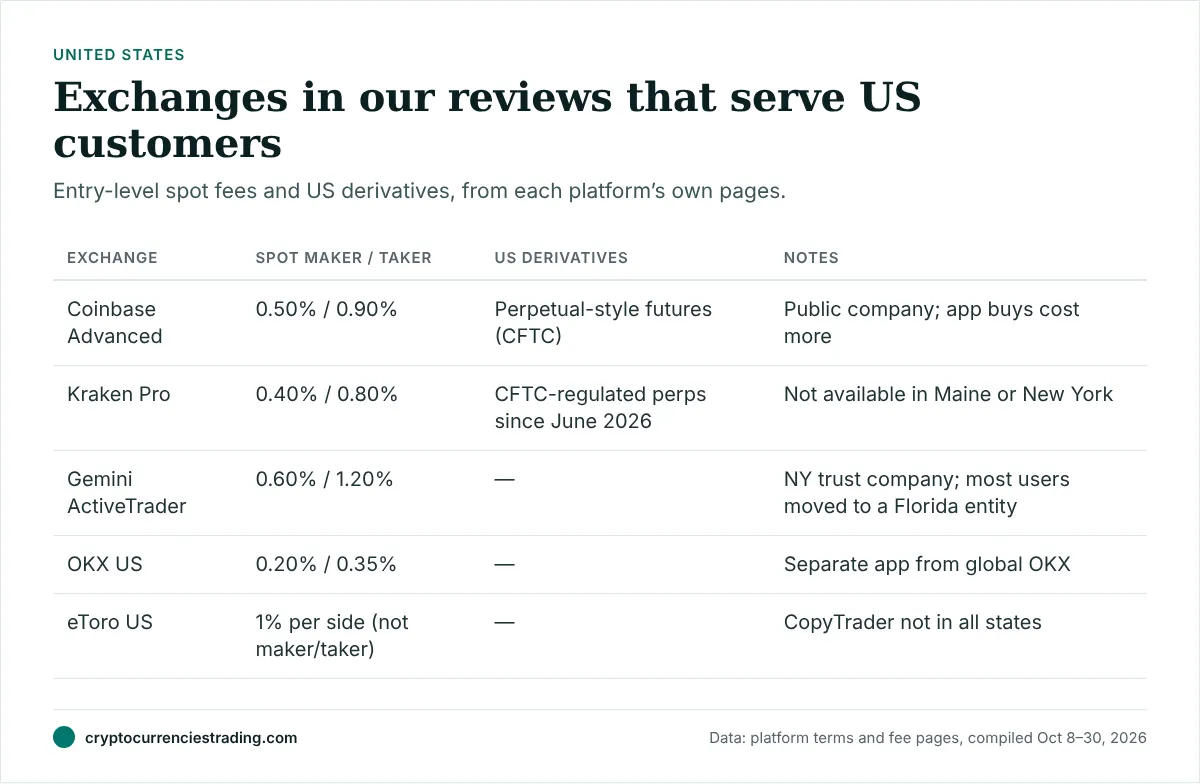
Coinbase is a US public company and the best-known name for American crypto buyers. Its simple app is easy but expensive; active traders should use Coinbase Advanced, the order-book screen inside the same account. At the US entry-level tier, Advanced charges 0.50% maker and 0.90% taker on spot, according to the fee schedule announced on September 16, 2026.
Coinbase also offers US derivatives. It launched perpetual-style futures for US customers on July 21, 2025, with nano Bitcoin and nano Ether contracts. These are long-dated futures that expire after five years, with hourly funding, and they were launched at fees as low as 0.02% per contract with a $0.15 minimum. In May 2026 the CFTC gave Coinbase Financial Markets no-action relief to offer further perpetual products, as reported by CoinDesk.
Best for: beginners who want a familiar, regulated app, and traders who want US-regulated futures in the same account.
Kraken
Kraken is a long-running US-founded exchange. Kraken Pro, its trading screen, charges 0.40% maker and 0.80% taker on spot at Tier 1. Fees fall with volume, and the simple Kraken app costs more than Pro.
In June 2026, Kraken launched CFTC-regulated perpetual futures for eligible US clients on Kraken Pro. The contracts are listed on Bitnomial, an exchange owned by Kraken’s parent Payward. Reports at the launch listed BTC, ETH, SOL, XRP, ADA, LINK, DOGE, LTC and AVAX perps. Kraken Pro’s futures fees start at 0.02% maker and 0.05% taker.
Kraken is not available to residents of Maine and New York, according to its own restrictions page.
Best for: active traders who want lower fees than the simple apps and access to US-regulated perps.
Gemini
Gemini is a New York-chartered trust company, and its parent trades on Nasdaq under the ticker GEMI. Its ActiveTrader screen charges 0.60% maker and 1.20% taker at the base tier, on the fee schedule dated September 1, 2026. ACH deposits and withdrawals are free; debit card deposits cost 3.49%.
From May 21, 2025, Gemini began moving most US users to Gemini Moonbase, LLC, a Florida-based money transmitter, while New York customers stay with the trust company. Gemini publishes SOC 1 and SOC 2 Type 2 reports but no proof-of-reserves report. Its Trust Center lists 99 cryptocurrencies.
Best for: New York residents and users who prioritise a conservative, compliance-focused platform over the lowest fees.
OKX US
OKX serves Americans through a separate OKX US service with its own app. Regular users pay 0.20% maker and 0.35% taker on spot, much lower than the US entry tiers at Coinbase, Kraken and Gemini, but about three times OKX’s global rate. The US fee page has no futures tab. The global OKX site lists certain US jurisdictions and all US territories as restricted. See our OKX review for the global service.
Best for: fee-sensitive spot traders in states OKX US serves.
eToro US
eToro charges 1% of the position value to open and 1% to close a crypto position, on top of the market spread, rather than maker/taker fees. Its US platform lets you copy the portfolios of crypto, stock and ETF investors through CopyTrader, which is not available in all US states. Its US broker-dealer is SEC-registered and a FINRA member.
Best for: people who want crypto alongside stocks and ETFs, and copy trading, in one app.
US-regulated perpetual futures
For years, US traders who wanted perpetual futures had only offshore platforms, which they were not supposed to use. That changed in 2025 and 2026.
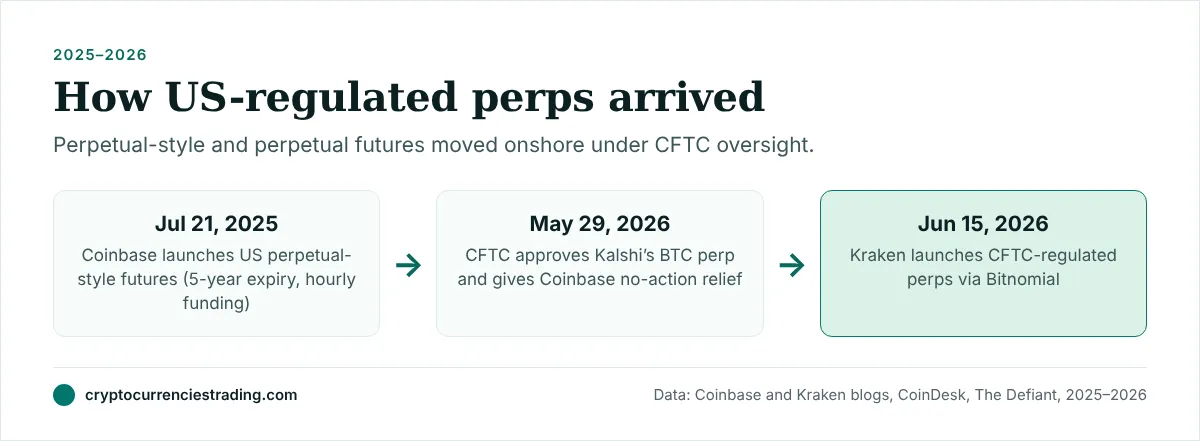
- July 21, 2025: Coinbase launched perpetual-style futures for US customers: five-year contracts with hourly funding that behave much like perps.
- May 29, 2026: the CFTC approved Kalshi to list a bitcoin perpetual contract and gave Coinbase Financial Markets no-action relief for further perpetual products. CoinDesk noted this was staff action, not a formal rule, so future leadership could change course.
- June 15, 2026: Kraken went live with CFTC-regulated crypto perps through Bitnomial, the same day Coinbase activated four equity-index perpetual futures, according to The Defiant.
Leverage on US-regulated products is typically far lower than offshore. Coinbase’s perpetual-style futures launched with up to 10x intraday leverage on crypto. Lower leverage is a safety feature, not a drawback: see our leverage and liquidation guide.
What about offshore exchanges and perp DEXs?
Offshore exchanges such as Bybit, Bitget, Gate and KuCoin exclude US users in their terms. Bybit’s restrictions follow nationality, so US citizens living abroad are excluded too.
Almost every perp DEX we review also bars US persons, including Hyperliquid, Lighter, Aster, dYdX, GMX, Paradex, Extended, Veranta and Arcus. Using a VPN to get around these terms breaks them and can lead to frozen funds. Our guide to perp DEXs and US availability goes through each one.
Fees: what a $1,000 purchase costs
Using each platform’s entry-level taker fee on its pro screen, a $1,000 market buy of bitcoin costs about:
- OKX US: $3.50
- Kraken Pro: $8.00
- Coinbase Advanced: $9.00
- Gemini ActiveTrader: $12.00
- eToro: $10.00 to open, plus the spread, and another 1% to sell
Limit orders that rest on the book pay the lower maker rate. The simple “buy” buttons in each app usually cost more than these figures. Fees fall as your monthly volume grows, so active traders should check the full tier tables. Our maker vs taker guide explains how to pay the lower rate.
If you live in New York
New York runs its own licensing regime for crypto businesses through the state’s Department of Financial Services, and several platforms choose not to serve the state. Among the exchanges we review:
- Gemini is a New York trust company licensed by the NYDFS, and New York customers stay with that entity.
- Kraken does not serve New York residents.
- Coinbase and other platforms vary by product; check each product’s state list before you sign up.
New Yorkers often have fewer coins and features available than people in other states, because each listing must meet the state’s rules.
Funding your account
How you move dollars in and out can cost more than the trading fee:
- ACH bank transfer is usually free but can take a few business days to clear, and new accounts often face holding periods before withdrawals.
- Wire transfer is faster for large amounts, but banks and exchanges often charge for it. Gemini, for example, lists a $25 fee for USD wire withdrawals.
- Debit card purchases are instant but expensive. Gemini lists 3.49% for debit card deposits; similar charges are common elsewhere.
- PayPal is supported by some platforms at a fee; Gemini lists 2.50%.
For anything beyond a small first purchase, ACH is usually the cheapest route. If you plan to trade actively, deposit once and leave the cash on the exchange’s trading screen rather than buying with a card each time.
Moving coins between platforms
You can withdraw crypto from one US exchange and deposit it on another, or to your own wallet. Before you do:
- Check the network. Choose a network both sides support for that coin. Sending on the wrong network can lose the funds.
- Send a small test first, especially to a new address.
- Expect a network fee, shown before you confirm the withdrawal.
- Mind holding periods. Newly deposited funds may not be withdrawable for a few days on some platforms.
Safety and protections
US-regulated platforms carry real protections, but not the ones many people assume.
- No FDIC or SIPC cover for crypto. Bank-style deposit insurance does not protect crypto holdings. Some platforms hold customer cash in insured bank accounts, which is a different thing.
- Custody. Your coins on an exchange are held by the exchange. Look for clear statements about segregation of customer assets, and for audited financial statements or proof-of-reserves reports.
- Account security is your part: two-factor authentication with an app or security key, a withdrawal allowlist, and never reusing passwords.
- Self-custody for long-term holdings removes exchange risk entirely; see our self-custody wallet guide.
How to choose
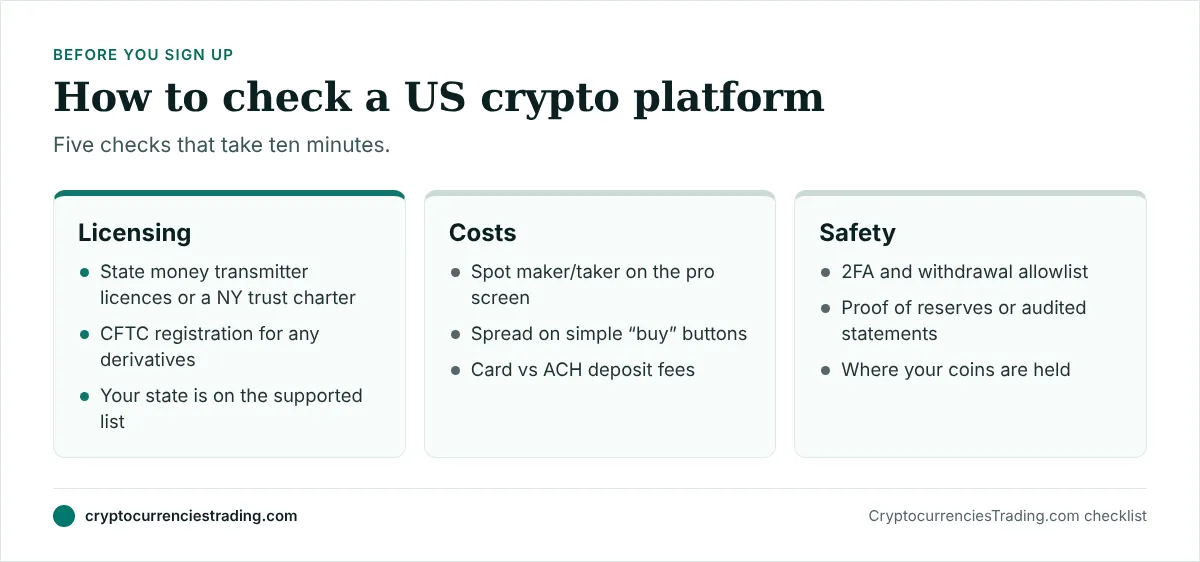
- Check your state. Make sure the platform serves it. Kraken, for example, excludes Maine and New York.
- Decide what you need. Simple buying, active spot trading, regulated futures, or copy trading.
- Compare pro-screen fees, not the simple app prices.
- Check deposit and withdrawal costs. ACH is usually free; debit cards can cost several percent.
- Read the safety disclosures and set up two-factor authentication before depositing.
A sensible setup for most people: one regulated exchange that serves your state, for buying and selling, plus a self-custody wallet for coins you plan to hold.
Frequently asked questions
Can I use Bybit, Bitget or Binance in the US?
Bybit and Bitget exclude the US in their terms, and we do not list Binance on this site. Using a VPN to get around restrictions breaks the terms and can lead to frozen funds.
Can US residents trade perpetual futures?
Yes, through CFTC-regulated products. Coinbase offers perpetual-style futures, and Kraken launched CFTC-regulated perps in June 2026. Offshore perp exchanges and most perp DEXs remain closed to US persons.
Which US exchange has the lowest fees?
Among the exchanges we review, OKX US has the lowest entry-level spot fees at 0.20% maker and 0.35% taker. Coinbase, Kraken and Gemini cost more at entry level but have lower tiers for high-volume traders.
Is crypto on a US exchange insured?
Not by the FDIC or SIPC. Some platforms insure cash balances held at partner banks, and some carry private insurance for certain losses, but crypto holdings are generally not protected the way bank deposits are.
Which US exchange is best for beginners?
For most beginners, a large regulated platform with a simple app, clear support and ACH deposits is the easiest start, such as Coinbase or Kraken. Move to the pro trading screen once you are comfortable, because the simple buy buttons cost more.
Do I need to pay tax on crypto trades in the US?
Generally yes: the IRS treats crypto as property, and selling or swapping it can create a taxable gain. Keep records of every trade and consult a tax professional.
