| Market | Maker | Taker | Notes |
|---|---|---|---|
| Spot | 0% | 0% | Standard account (the default). Plus accounts pay 0.005% maker and taker. Premium accounts pay 0.004% maker and 0.028% taker before LIT staking discounts. |
| Perpetuals | 0% | 0% | Standard account (the default); TWAP, other advanced orders and RFQ cost 1 bp. Plus accounts pay 0.005% maker and taker. Premium accounts pay 0.004% maker and 0.028% taker before LIT staking discounts. |
Lighter DEX fees are zero on the default Standard account: 0% maker and 0% taker on perps and spot, so a $1,000 market order costs nothing to place. The cost to watch is funding on perps, paid every hour, plus a 1 basis point (0.01%) charge on TWAP and RFQ orders from a Standard account.
The catch with Standard is speed. Taker orders and cancels wait 300 milliseconds before they reach the order book, and traders who want them faster pay for a Plus or Premium account.
This is not financial advice. Perps are leveraged, and a leveraged position can be liquidated, losing the collateral behind it.
Lighter’s terms exclude the United States, Canada, the United Kingdom and several other countries. See where Lighter is available.
Lighter DEX fees by account type
Lighter DEX trading fees depend on the account type, not on your volume, and every account starts on Standard. The trading fees page lists three types, and the rates apply to perps and spot alike.
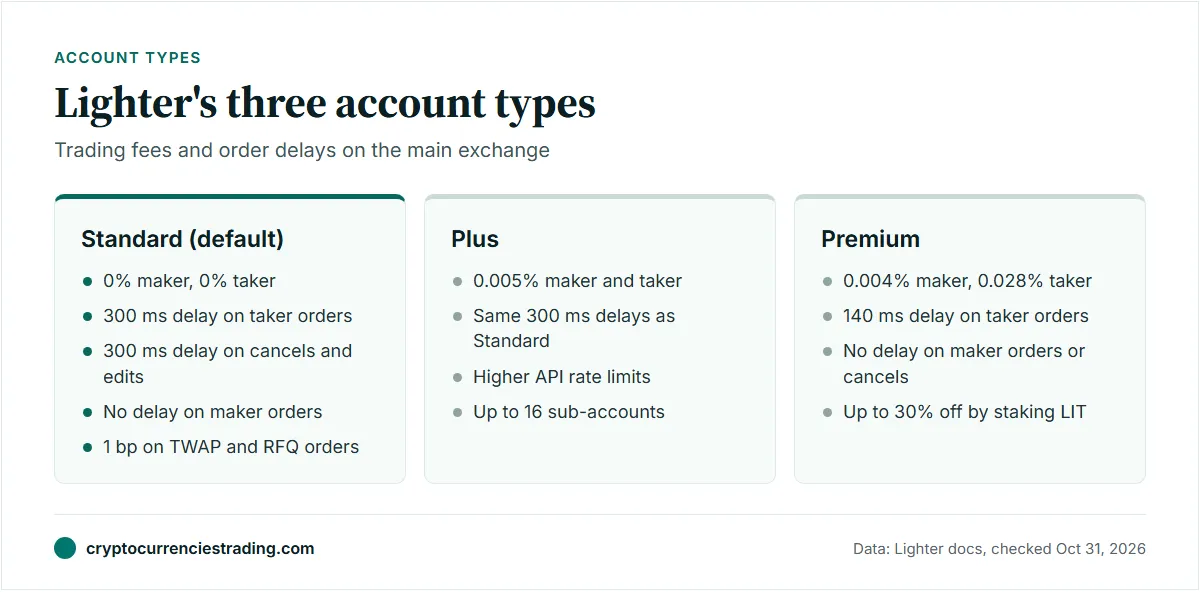
- Standard (default): 0% maker and 0% taker. Taker orders, cancels and edits are delayed 300 ms; maker orders are not. TWAP, other advanced orders and RFQ orders pay 1 bp. Up to 4 sub-accounts.
- Plus (opt-in): 0.005% maker and taker. The same 300 ms delays, but far higher API rate limits and up to 16 sub-accounts.
- Premium (opt-in, also called Advanced): 0.004% maker and 0.028% taker before discounts. Taker orders are delayed 140 ms, and maker orders and cancels have no delay. Staking LIT cuts the fees by up to 30%.
You can switch in the app or through the API. Per the account types reference, upgrades can happen at any time, but a downgrade needs 24 hours since your last tier change, and your sub-accounts must fit the lower tier’s limit.
The latency trade-off: is Standard fast enough?
A 300 ms delay means your market order or cancel reaches the book about a third of a second after you send it. In a fast market, the price can move before your order lands, which costs you slippage instead of a fee, and a cancel can arrive after its order has filled.
Resting limit orders are never delayed, so a Standard trader who mostly uses limit orders gives up little. The docs aim Premium at high-frequency traders, who also hit API limits first: Standard accounts get 60 REST requests a minute, Plus accounts can send 4,000 transactions a minute, and Premium accounts 4,000 to 72,000 depending on LIT staked, per the rate limits page.
Premium fees and LIT staking discounts
Premium fees fall as you stake more LIT, counted across your main account and its sub-accounts:
| LIT staked | Discount | Maker | Taker |
|---|---|---|---|
| 0 | none | 0.0040% | 0.0280% |
| 1,000 | 2.5% | 0.0039% | 0.0273% |
| 3,000 | 5% | 0.0038% | 0.0266% |
| 10,000 | 10% | 0.0036% | 0.0252% |
| 30,000 | 15% | 0.0034% | 0.0238% |
| 100,000 | 20% | 0.0032% | 0.0224% |
| 300,000 | 25% | 0.0030% | 0.0210% |
| 500,000 | 30% | 0.0028% | 0.0196% |
Premium fees on the main Lighter exchange, from Lighter’s trading fees page, checked October 31, 2026.
Staking has its own costs: a 3-day unstaking lockup, per the LIT utility page, and a fall in LIT’s price can outweigh the fees you save. LIT Fee Credits are the alternative: an upfront LIT payment that counts as staked LIT for a chosen period, at a price the docs don’t publish.
Advanced orders, RFQ and third-party apps
Three extra charges depend on how you trade:
- TWAP and other advanced orders cost 1 bp (0.01%) on Standard accounts, per the order types page. A $10,000 TWAP costs $1.
- RFQ orders, which ask market makers to quote a large trade, cost 1 bp on Standard accounts, per the perpRFQ page. The option appears only for large orders.
- Integrator fees. Apps built on Lighter can add their own fee of up to 0.1% on perps and 1% on spot, which you must approve with a signature. The partner attribution page says these fees need a Plus or Premium account, so a Standard account can’t be charged one.
Spot trading fees
Spot trades use the same account rates as perps: 0% on Standard, 0.005% on Plus, and 0.004% maker and 0.028% taker on Premium before staking discounts. Pairs trade against USDC and pay no funding. Our Lighter spot section lists the pairs.
Funding on Lighter perps
Funding is paid every hour between longs and shorts, and the funding docs say the exchange takes no fee from it. When the rate is positive, longs pay shorts; when it is negative, shorts pay longs.
When Lighter’s price sits close to the index, funding on many markets defaults to 1 bp (0.01%) per 8 hours, charged in hourly slices. On a $10,000 position that is $1 every 8 hours, or $3 a day. The cap on most markets is 4% per 8 hours, or 0.5% per hour: $50 an hour on $10,000. Our funding rates guide explains the mechanics.
Worked examples
A $1,000 order. A market order pays the taker rate: $0 on Standard, $0.05 on Plus and $0.28 on Premium with no LIT staked. A limit order that rests on the book pays the maker rate: $0, $0.05 and $0.04.
A $10,000 perp held for a day. You post $1,000 of margin at 10x, open a $10,000 long with a market order, hold it for 24 hours at the default funding rate, then close with a market order. Fees are charged on the full position, not your margin.
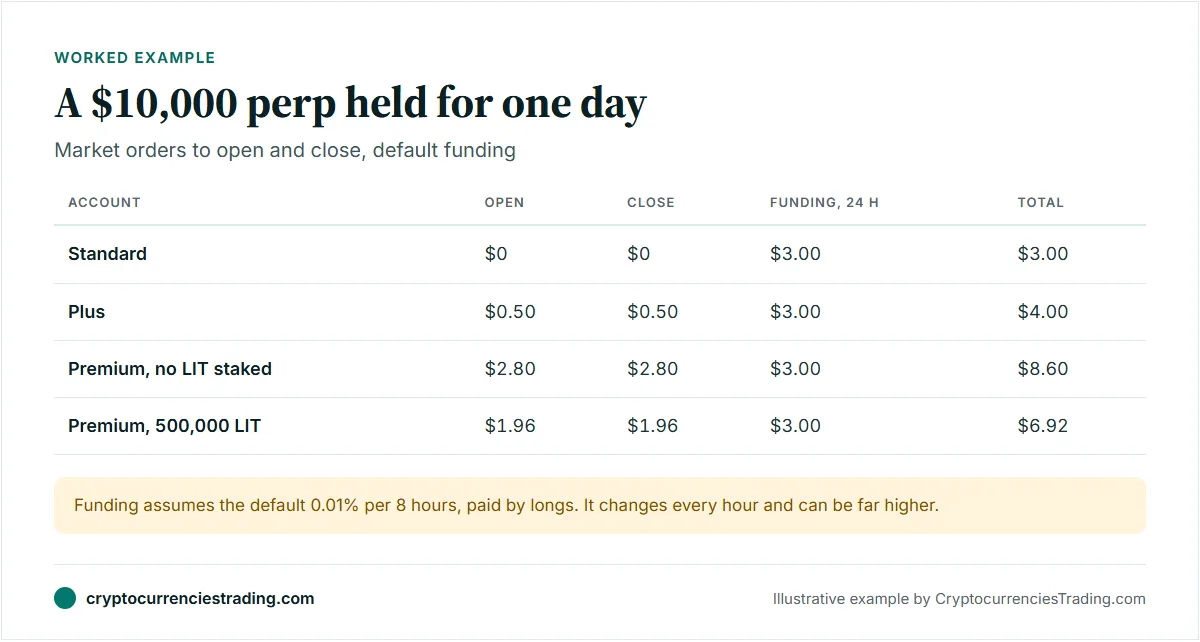
- Standard: $0 + $0 + $3.00 of funding = $3.00.
- Plus: $0.50 + $0.50 + $3.00 = $4.00.
- Premium, no LIT staked: $2.80 + $2.80 + $3.00 = $8.60.
- Premium, 500,000 LIT staked: $1.96 + $1.96 + $3.00 = $6.92.
If you hold the side being paid, funding is income. At 10x, a move of less than 10% against you can trigger liquidation, which costs far more than any fee. See leverage and liquidation explained.
Deposit and withdrawal costs
Lighter’s deposits and withdrawals docs list no deposit fee, but each route has a minimum:
- Directly on Ethereum: at least 1 USDC, or the equivalent in another listed token. It is an Ethereum transaction, so you also pay Ethereum gas.
- Deposit address on another chain: $5 for a new account. After that, $3 from EVM chains and Solana, $5 from Ethereum mainnet and Tron, and $10 from Bitcoin. Deposits are converted to USDC or ETH, and the docs warn that bridging and swaps can cause slippage, so send a little more than the minimum. They typically arrive within a few minutes.
Withdrawals come in two kinds, plus transfers inside Lighter:
- Secure withdrawal: any asset, minimum 1 USDC or equivalent, only to the wallet that owns the account. It settles through Ethereum, and Lighter usually completes the Ethereum claim for you. The limit is 3 per 2 hours per wallet.
- Fast withdrawal: USDC only, minimum 4 USDC, to any Ethereum address, paid from a liquidity pool. It works as a transfer to Lighter’s withdrawal pool and uses the same fee lookup as transfers.
- Transfer to another Lighter account: instant, minimum 1 USDC or equivalent, with the fee charged on top of the amount.
The docs don’t publish these fees or a typical withdrawal time for either kind. Our guide to funding a perp DEX covers each step.
Other costs
- Liquidation. The liquidations docs set a fee of up to 1%, paid to the LLP insurance pool. Spot collateral such as ETH seized from a unified account carries a maximum fee of 2%, per the multi-asset margin page.
- Public Pools. The operator keeps a percentage of your profits when you withdraw, set per pool. See Public Pools on Lighter.
- Binary options. Up/Down markets on crypto prices trade on the main Lighter exchange; Lighter on Robinhood Chain does not list them. They have their own fee model: 0% maker and up to 1% taker, scaled by the share price. Buying 100 shares at 0.60 as a taker costs 0.24 USDC.
- Lighter on Robinhood Chain. This separate USDG exchange has its own schedule: Standard is 0%, Plus is 0.015%, and Premium starts at 0.012% maker and 0.035% taker, falling with 14-day volume.
How Lighter’s perp DEX fees compare
On a $10,000 market order, Lighter’s Standard account charges nothing and Premium charges $2.80. Hyperliquid charges $4.50 at its base perps rate of 0.045% taker (0.015% maker), and Aster charges $4.00 at its 0.04% VIP 1 taker rate on Crypto General pairs, with 0% maker. Funding settles hourly on Hyperliquid and every 8 hours by default on Aster. Hyperliquid also publishes a fixed withdrawal cost, 1 USDC to Arbitrum in 3 to 4 minutes, while Aster charges gas that depends on the destination chain. Lighter perp DEX fees are the lowest of the three on the default account; its withdrawal costs are the least documented.
How to pay less on Lighter
- Stay on Standard unless the 300 ms delay costs you more in slippage than Premium’s fees would.
- On Plus or Premium, use limit orders. Premium’s maker rate is a seventh of its taker rate.
- Check funding before holding a position for days. It is the main cost on a zero-fee account.
- Read any integrator fee before approving it in a third-party app.
- Withdraw less often. Secure withdrawals are capped at 3 per 2 hours, and fast withdrawals and transfers can carry a fee each time.
- Referral. Referred users get a 10% discount on the trading fees they pay, rebated every Monday. On Premium with no LIT staked, a $10,000 market order costs $2.80, and $0.28 of it comes back. Lighter calls the rebates discretionary. See Lighter’s referral program.
Frequently asked questions
Does Lighter charge trading fees?
Not on the default Standard account, which pays 0% maker and 0% taker on perps and spot. TWAP and RFQ orders cost 1 bp, and you still pay or receive hourly funding on perps.
What is the difference between Lighter Standard and Premium?
Standard is free but delays taker orders and cancels by 300 ms. Premium charges 0.004% maker and 0.028% taker, cuts the taker delay to 140 ms and removes it for maker orders and cancels.
How much does it cost to withdraw from Lighter?
Lighter’s docs don’t publish withdrawal fees. Secure withdrawals settle through Ethereum with a 1 USDC minimum. Fast withdrawals are USDC only, with a 4 USDC minimum.
How often is funding paid on Lighter?
Every hour, directly between longs and shorts. The default on many markets is 0.01% per 8 hours, about $3 a day on a $10,000 position.
Can I switch from Premium back to Standard?
Yes, once 24 hours have passed since your last tier change, and if your sub-accounts fit Standard’s limit of 4.
