Paradex Review & Trading Guide
DEXParadex is a self-custody DEX for perpetuals, options and spot on its own Starknet appchain, with zero fees on retail orders and up to 50x leverage.
- 5.8/10#11 in Best Perp DEXs
We may earn a commission if you sign up.How we choose
Key facts
- Type
- Decentralized exchange (DEX)
- Custody
- Self-custody (you hold your keys)
- KYC
- Not required
- Products
- Spot, Perpetuals, Mobile app
- Spot fees
- 0% maker / 0% taker
- Perps fees
- 0% maker / 0% taker
- Max leverage
- Up to 50x
- Chains
- Paradex Chain, Ethereum, Arbitrum, Avalanche, Base, BNB Chain, Linea, Manta, Mantle, Optimism, Polygon, Scroll, Sei, Solana, Sonic, Sophon, Starknet, ZKsync Era
- Apps
- iOS, Android
- Points program
- LiveXP Season 3 has run since February 1, 2026 with no end date announced. 4,000,000 XP are distributed each week, on Wednesdays.
- Restricted regions
- United States, Canada, Cuba, Iran, North Korea, Syria and 8 more
What is Paradex?
Paradex is a self-custody exchange for perpetual futures, options and spot, running on its own Starknet-based appchain with USDC collateral and up to 50x leverage. Its standout feature is zero trading fees on retail orders placed through its app. It suits traders outside the US and Canada who trade manually, want no-fee perps and value privacy, and who accept a short delay on their orders in exchange.
Paradex says it was incubated by Paradigm, which it describes as the largest institutional liquidity network for crypto options, in its DIME token announcement. That heritage shows in its product range: besides perps, Paradex lists dated options that are European-style and cash-settled in USDC at 08:00 UTC on expiry, with daily, weekly and monthly expiries.
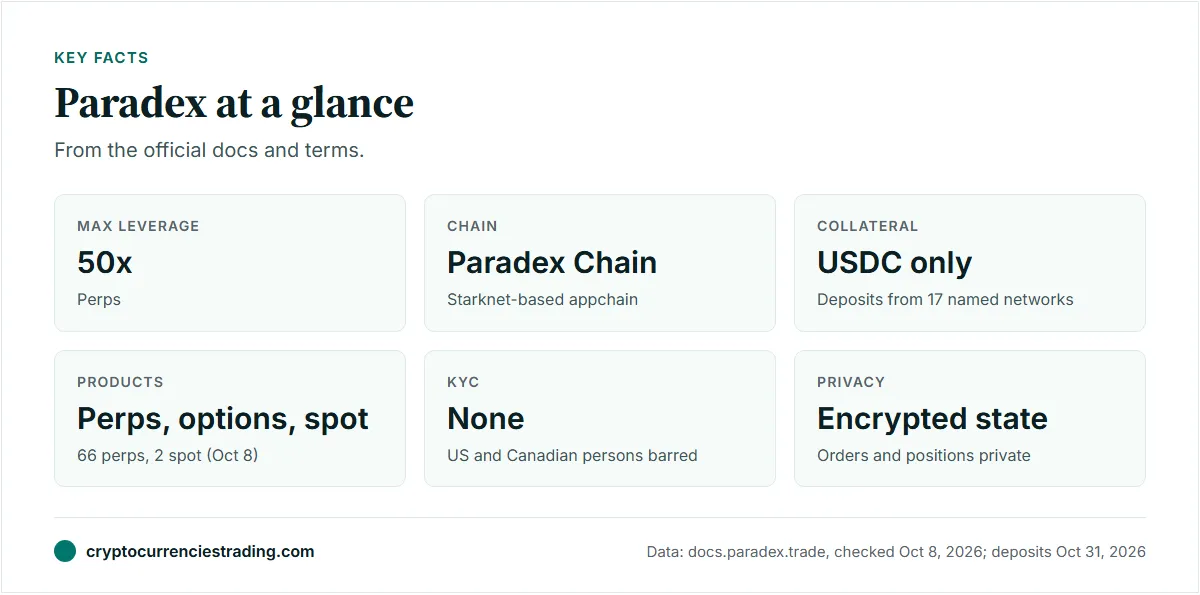
Paradex’s public markets API listed 66 perpetual markets and 2 spot markets (ETH-USD and DIME-USD) on October 8, 2026. It uses an off-chain order book, which its docs say protects orders from front-running, and it encrypts account data: orders, positions and trades are private, RPC nodes mask account data, and state posted to Ethereum is encrypted with keys held by its Privacy Council, according to the privacy docs.
USDC is the only collateral Paradex accepts. You deposit USDC to trade, and all profit and loss is paid in USDC.
Spot trading on Paradex
Paradex’s spot market is small: ETH-USD and its own token’s DIME-USD pair on October 8, 2026. Retail orders on spot are free, like perps. For buying a wide range of tokens, a centralized exchange or spot DEX is a better fit; see our DEX ranking.
Perpetuals and options on Paradex
Perps. Paradex’s perps are margined in USDC on an off-chain order book, with settlement on Paradex Chain. You get market, limit and conditional orders, and up to 50x leverage on the largest markets.
Retail vs Pro orders. This is the key design choice. Orders placed in the Paradex app, or by API with an “interactive” token, count as retail orders. They pay zero fees but carry a 300-millisecond speed bump and a limit of 1,000 orders per 24 hours. Orders sent by the standard API count as Pro orders, which pay fees but skip the speed bump. For a person clicking buttons, a third of a second makes no practical difference; for high-frequency bots it does. That is how Paradex can offer free trading to people while charging professional market makers.
Options. Dated options let you buy or sell calls and puts on major coins, cash-settled in USDC. A bought option can lose only the premium you paid, which some traders prefer to a leveraged perp with liquidation risk. Selling options carries much larger risk. Options pricing is more complex than perps; learn the basics before trading them.
An options example. Say ETH trades at $4,000 and you think it will rise this week but don’t want liquidation risk. Instead of a 10x long perp, you could buy a weekly call option with a $4,200 strike. If ETH ends the week above $4,200 plus the premium you paid, you profit; if it doesn’t, you lose only the premium. The trade-off is that options lose value as expiry approaches, so you need the move to happen in time. Paradex’s options are cash-settled in USDC, so you never receive or deliver ETH itself. The numbers here are illustrative; real premiums depend on volatility and time to expiry.
Funding on perps is paid between longs and shorts; see our funding rates guide.
Leverage and liquidation. If your margin falls below the maintenance requirement, positions are liquidated and you can lose all the margin behind them. At 50x, a move of about 2% is enough. Keep leverage low. See leverage and liquidation explained.
How Paradex compares. Most perp DEXs charge takers 0.025% to 0.05% per trade; Paradex charges retail traders nothing. Lighter also offers 0% fees on its standard account, so the two are the obvious picks for fee-sensitive manual traders. Paradex’s extras are options and encrypted positions; Lighter’s are its larger order books and a different set of markets. Hyperliquid charges fees but has far deeper liquidity, which can matter more than fees on large orders. Paradex caps leverage at 50x, the same as Lighter and above Hyperliquid’s 40x on its biggest markets.
Who Paradex suits. Manual traders outside the US and Canada who want zero-fee perps, privacy for their positions, and access to options in the same account. It suits less well high-frequency traders, who pay Pro fees, or anyone who needs the very deepest order books.
The Paradex app
Paradex has apps on the App Store and Google Play. Orders placed in the app count as retail orders, so they trade at zero fees, just like on the web.
Paradex fees
| Market | Maker | Taker | Notes |
|---|---|---|---|
| Spot | 0% | 0% | Retail orders, meaning orders placed in the Paradex interface or by API with an interactive token. They carry a 300 ms speed bump and rate limits (1,000 orders per 24 hours). Pro orders (standard API) pay 0.003% maker and 0.045% taker at Pro 0. The Pro taker rate falls to 0.035% at $25M of 14-day volume, DIME staking and fee payment add discounts, and the floor is 0.0175%. |
| Perpetuals | 0% | 0% | Retail orders, meaning orders placed in the Paradex interface or by API with an interactive token. They carry a 300 ms speed bump and rate limits (1,000 orders per 24 hours). Pro orders (standard API) pay 0.003% maker and 0.045% taker at Pro 0. The Pro taker rate falls to 0.035% at $25M of 14-day volume, DIME staking and fee payment add discounts, and the floor is 0.0175%. |
Paradex trading fees at a glance
Entry-tier rates as a % of position size, from the official docs.
| Tier / market | Maker | Taker |
|---|---|---|
| Retail orders (app or interactive API) | 0% | 0% |
| Pro orders, Pro 0 | 0.003% | 0.045% |
| Pro orders, $25M+ / 14 days | — | 0.035% |
| Pro floor with discounts | — | 0.0175% |
Retail orders carry a 300 ms speed bump and a 1,000-orders-per-day limit.
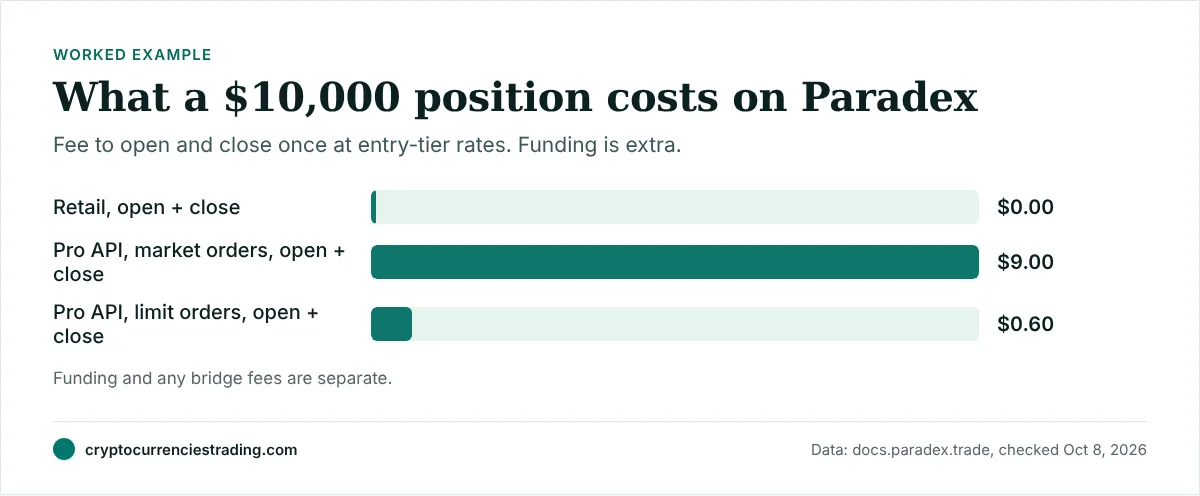
Retail orders are free on perps and spot. Pro orders pay 0.003% maker and 0.045% taker at Pro 0. The Pro taker rate falls to 0.035% at $25 million of 14-day volume, and staking DIME or paying fees in it adds discounts, down to a floor of 0.0175%.
Paradex’s own sources differ on Pro fees. The trading fees page and Paradex’s volume tiers API both give the Pro 0 rates above. Its public markets API lists 0% maker and 0.02% taker for API and RPI orders on every perp and spot market, and its API docs call that figure a per-market override. Paradex doesn’t say which one an account pays, so we use the fee schedule. If you trade by API, check the fee charged on your first Pro orders. Retail orders are 0% in all three.
Worked example. Open and close a $10,000 perp position in the app: no trading fee. The same round trip by Pro API with market orders costs $9, and with limit orders $0.60.
Why can Paradex offer zero fees? Its model charges the professional traders and market makers who use the standard API, while slowing retail orders slightly so that those professionals can quote tight prices without being picked off by faster bots. Retail traders get free trading; market makers get protection. It is a deliberate design, not a temporary promotion, though Paradex can change its fees at any time.
Zero fees don’t mean zero cost. You still pay funding on perps, the spread when you cross the order book, and bridge or network fees when you deposit and withdraw. Compare the total, not just the fee line.
Where Paradex is available
Not available in: United States, Canada, Cuba, Iran, North Korea, Syria, Micronesia, Guam, Marshall Islands, Northern Mariana Islands, Puerto Rico, Palau, U.S. Outlying Islands, U.S. Virgin Islands.
From the Restricted Persons page, which also names the Crimea, Donetsk, Luhansk and Sevastopol regions of Ukraine. US persons and Canadian persons are barred wherever they are, as is anyone under US, EU, UK, Singapore or UN sanctions. The terms of service prohibit using a VPN to get around the restrictions.
Paradex’s Restricted Persons page bars US persons and Canadian persons wherever they live, plus the US territories listed above and the Crimea, Donetsk, Luhansk and Sevastopol regions of Ukraine. It also excludes anyone under US, EU, UK, Singapore or UN sanctions. The terms prohibit using a VPN to get around the restrictions.
Because the ban covers US and Canadian persons wherever they are, moving abroad does not make a US or Canadian citizen eligible.
There is no KYC. US readers can see our guide to perp DEXs and US availability.
Is Paradex safe?
Audits
- May 12, 2025Cairo Security Clan
Incidents
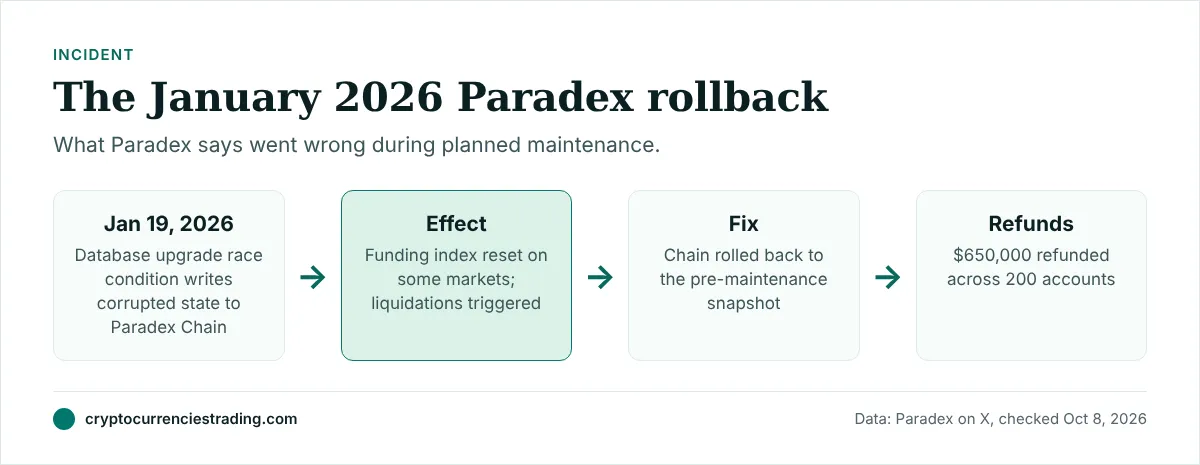
- January 19, 2026Paradex said a race condition during a planned database upgrade wrote corrupted state to Paradex Chain, resetting the funding index on some markets and triggering liquidations. It rolled the chain back to the pre-maintenance snapshot and said it refunded $650,000 across 200 accounts. (x.com)
Custody. Paradex is self-custody: your USDC sits in contracts on Paradex Chain, which settles to Ethereum through Starknet technology.
Audits. Cairo Security Clan published an audit report for Paradex in May 2025. We found no other audit listed.
The January 2026 rollback. On January 19, 2026, Paradex said a race condition during a planned database upgrade wrote corrupted state to Paradex Chain. That reset the funding index on some markets and triggered liquidations. Paradex rolled the chain back to the pre-maintenance snapshot and said it refunded $650,000 across 200 accounts.
Two lessons from that episode. First, an appchain run by one team can be rolled back, which helped users here but also shows how much control the operator has. Second, operational errors, not just hacks, can liquidate positions. The Rekt News leaderboard of the largest crypto exploits lists no Paradex incident as of October 31, 2026.
Privacy in practice. On transparent perp DEXs, anyone can look up a wallet’s positions and liquidation prices, and large positions sometimes get targeted. Paradex hides that information from the public. For most retail traders the bigger benefit is simply that strangers can’t watch your account. The cost is less public verifiability, so you’re relying more on Paradex’s own systems and its Privacy Council.
Privacy has trade-offs. Encrypted state protects your positions from being watched, but it also means outsiders can’t independently verify everything on-chain the way they can on fully transparent DEXs.
How to start on Paradex
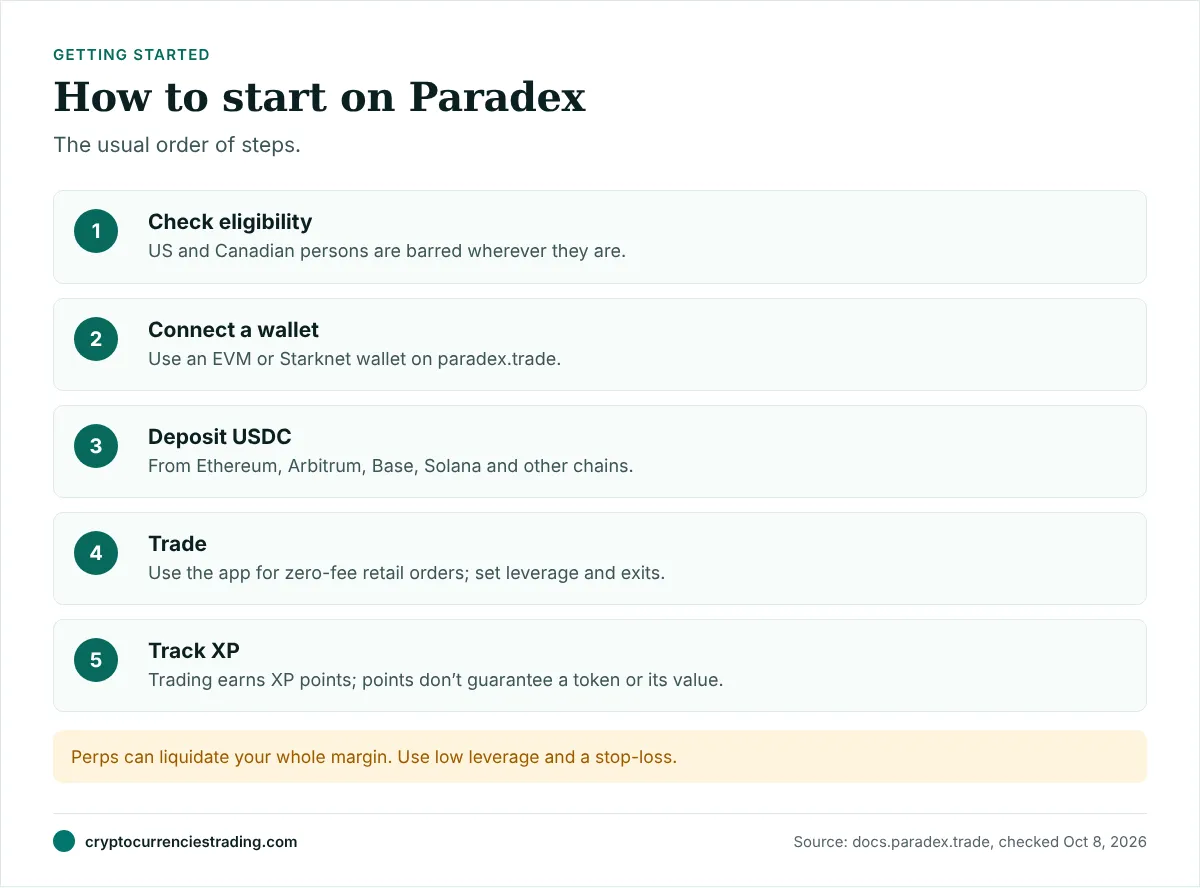
- Check you’re eligible. US and Canadian persons are barred wherever they are.
- Connect a wallet at paradex.trade. EVM and Starknet wallets work.
- Deposit USDC from a supported network, such as Ethereum, Arbitrum, Base, Solana or Starknet. Send a small test first.
- Trade in the app or web to get zero-fee retail orders. Set leverage and read the liquidation price.
- Add stop-loss and take-profit orders.
- Withdraw USDC to a supported network when done.
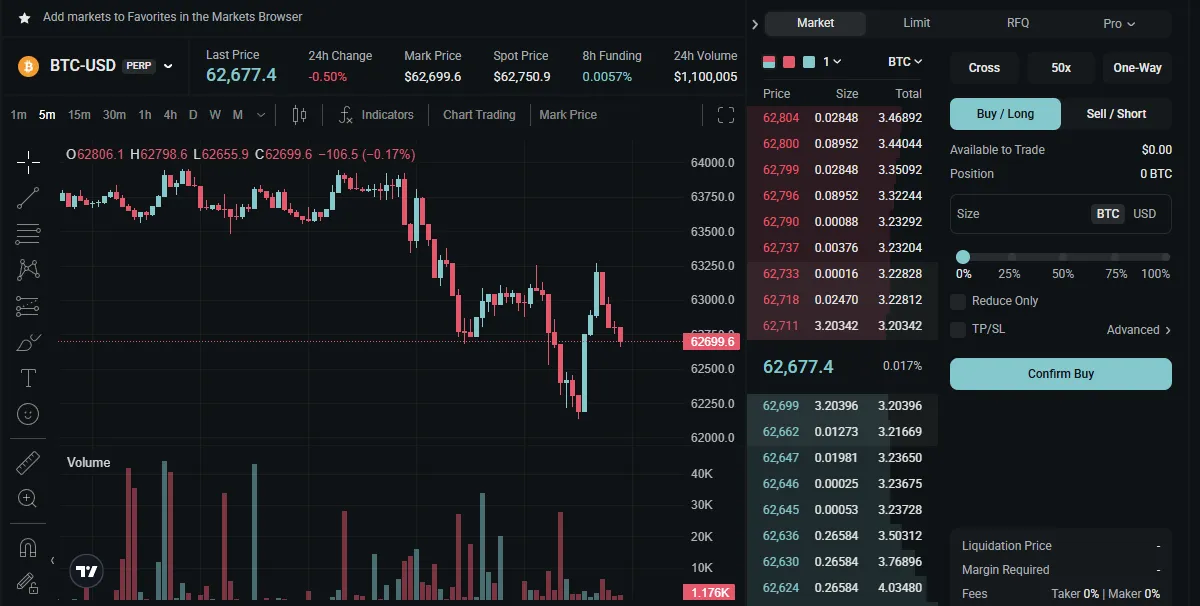
Depositing. Paradex’s bridges page says Layerswap, its main deposit route, supports 20+ networks, and it names 17: Ethereum, Arbitrum, Avalanche, Base, BNB Chain, Linea, Manta, Mantle, Optimism, Polygon, Scroll, SEI, Solana, Sonic, Sophon, Starknet and zkSync Era. Orbiter Finance lists more chains, but for now you use it from Orbiter’s own website. Paradex says bridge fees vary by provider and chain, so compare routes before you transfer. Choose the network your USDC already sits on to avoid an extra hop.
Tips. Don’t try to beat the 300 ms speed bump; it’s irrelevant for manual trading. Use limit orders to avoid crossing a wide spread on smaller markets. And if you try options, start by buying, not selling, so your maximum loss is the premium.
Common mistakes on Paradex.
- Overtrading because it’s free. Zero fees remove one cost, but funding, spreads and bad trades remain. Many traders lose more by trading more.
- Using the standard API by accident. Bots and scripts that don’t use an interactive token pay Pro fees.
- Selling options without understanding the risk. A sold option can lose far more than the premium received.
- Ignoring funding on long holds. Funding is not covered by the zero-fee promise.
Paradex referrals and XP
Paradex runs a points program called XP. XP Season 3 has run since February 1, 2026 with no end date announced, and 4,000,000 XP are distributed each week, on Wednesdays. Referred users get a 5% XP bonus on their trading activity.
The DIME token. DIME is Paradex’s native token. Its main practical use for traders is on Pro orders, where staking DIME or paying fees in it adds discounts down to the 0.0175% taker floor. Retail traders already pay nothing, so DIME offers them little on fees. Like any token, it can be very volatile.
Paradex has a token, DIME, and XP may matter for future distributions, but points don’t guarantee a token or its value. Don’t trade more or with more leverage just to earn XP; zero fees can tempt overtrading, and losses from bad trades will dwarf any points.
Paradex pros and cons
Pros
- Zero fees on retail orders for perps and spot
- Perps, options and spot in one USDC account
- Private orders and positions
- No KYC; deposits from 17 named networks via Layerswap
- XP Season 3 live, with a 5% bonus for referred users
Cons
- US and Canadian persons barred wherever they live
- 300 ms speed bump and 1,000-orders-per-day limit on retail orders
- A January 2026 chain incident triggered wrongful liquidations (refunded)
- One published audit, from May 2025
- Very small spot market
Paradex FAQ
Is Paradex really free to trade?
For retail orders placed in the app or with an interactive API token, yes: 0% maker and taker on perps and spot. Funding, spreads and bridge fees still apply. Pro API orders pay fees.
What is the retail speed bump?
Retail orders wait 300 milliseconds before reaching the book and are limited to 1,000 per 24 hours. That protects market makers from fast bots and doesn’t affect manual traders in practice.
What is Paradex’s maximum leverage?
Up to 50x on perps.
Does Paradex need KYC?
No. US and Canadian persons and sanctioned regions are excluded by the terms.
What is DIME?
Paradex’s token. Staking it or paying fees with it discounts Pro fees.
What happens if Paradex has an outage?
You may be unable to trade or close positions until it’s fixed, as in January 2026, when Paradex rolled its chain back and refunded affected accounts. Keep position sizes small enough to ride out an interruption.
Can I trade options on Paradex?
Yes. Paradex lists dated, European-style options that are cash-settled in USDC at 08:00 UTC on expiry, with daily, weekly and monthly expiries.
Is Paradex XP worth farming?
Points don’t guarantee a token or its value. Trade only what you would trade anyway, and treat XP as a bonus at most.
Featured in
- Best Perp DEXs (#11)
Alternatives: Lighter, Aster, Hyperliquid
Compare side by side: Paradex vs Lighter, Paradex vs Aster, Paradex vs Hyperliquid
Sources
Every figure on this page comes from the pages below, checked on the date shown.
- paradex.tradeOfficial website. Checked October 8, 2026.
- docs.paradex.trade/docs/getting-started/official-linksOfficial website. Checked October 8, 2026.
- docs.paradex.trade/trading/overviewProducts, Max leverage. Checked October 8, 2026.
- docs.paradex.trade/trading/spot-trading/quoting-settlementProducts. Checked October 8, 2026.
- docs.paradex.trade/vtfs/introductionProducts. Checked October 8, 2026.
- docs.paradex.trade/llms.txtProducts. Checked October 8, 2026.
- docs.paradex.trade/docs/mobile-access-guideProducts, KYC. Checked October 8, 2026.
- paradex.trade/terms-of-serviceCustody, KYC, Availability. Checked October 8, 2026.
- docs.paradex.trade/api/prod/authentication/onboardingKYC. Checked October 8, 2026.
- docs.paradex.trade/docs/getting-started/what-is-paradexChains. Checked October 31, 2026.
- docs.paradex.trade/docs/getting-started/bridgesChains. Checked November 1, 2026.
- docs.paradex.trade/trading/trading-feesSpot fees, Perps fees. Checked November 1, 2026.
- docs.paradex.trade/trading/trader-profilesSpot fees, Perps fees. Checked October 31, 2026.
- api.prod.paradex.trade/v1/system/volume-tiersSpot fees, Perps fees. Checked November 1, 2026.
- api.prod.paradex.trade/v1/marketsSpot fees, Perps fees, Max leverage. Checked November 1, 2026.
- apps.apple.com/us/app/paradex/id6741532722iOS app. Checked October 8, 2026.
- paradex.trade/mobile-appiOS app, Android app. Checked October 8, 2026.
- play.google.com/store/apps/detailsAndroid app. Checked October 8, 2026.
- docs.paradex.trade/docs/getting-started/dime-utilityToken. Checked October 8, 2026.
- paradex.trade/blog/dime-genesisToken. Checked October 8, 2026.
- docs.paradex.trade/docs/xp-referrals/xpPoints program. Checked October 8, 2026.
- paradex.trade/xpPoints program. Checked October 8, 2026.
- paradex.trade/restricted-personsAvailability. Checked October 8, 2026.
- docs.paradex.trade/chain/security/audit-pentestsAudits. Checked October 8, 2026.
- github.com/Cairo-Security-Clan/Audit-Portfolio/blob/main/Paradex_Audit_Report.pdfAudits. Checked October 8, 2026.
- x.com/paradex/status/2014616141508051376Incidents. Checked October 8, 2026.
- docs.paradex.trade/docs/xp-referrals/affiliate-referralsReferral bonus. Checked October 8, 2026.
- api.prod.paradex.trade/v1/system/stateStatus. Checked October 8, 2026.
