| Market | Maker | Taker | Notes |
|---|---|---|---|
| Spot | 0.1% | 0.1% | VIP 0 on the global gate.com site. With GT deduction turned on, the fee is paid in GT at 0.09% maker and 0.09% taker. VIP 14, the top level for regular users, is 0.008% maker and 0.023% taker; VIP 15 and 16 are for institutions, and VIP 16 is 0% maker and 0.0175% taker. Alpha tokens (the Trenches menu) are listed separately at a 0.5% trading fee. |
| Perpetuals | 0.02% | 0.05% | VIP 0 for USDT-margined perpetuals, the same in fee groups A, B and C. Funding settles every 8 or 4 hours depending on the contract, and hourly if a rate hits its limit. |
Gate fees start at 0.1% per spot trade for a new account, so a $1,000 buy costs $1.00, and at 0.02% maker and 0.05% taker on USDT-margined perpetual futures. The costs to watch are the taker fee and funding on perps, and the network you pick when you withdraw: the same USDT withdrawal costs from 0.05 to 1.5 USDT.
Gate was called Gate.io until it moved to gate.com in May 2025, so Gate.io fees and Gate.com trading fees are one schedule. This page covers the global gate.com site, which does not accept users from the US, the UK and many other countries; see where Gate is available.
This is not financial advice. Crypto prices move fast, and leveraged positions can be liquidated.
Gate.com trading fees: spot by VIP level
Every account starts at VIP 0. Gate’s fee page lists 17 levels, and you reach a level by meeting any one of its three thresholds.
| Level | 30-day volume | or 14-day GT | or assets | Spot maker / taker | With GT |
|---|---|---|---|---|---|
| VIP 0 | $0 | 0 | $0 | 0.1% / 0.1% | 0.09% / 0.09% |
| VIP 1 | $60,000 | 50 | $2,000 | 0.099% / 0.099% | 0.089% / 0.089% |
| VIP 3 | $240,000 | 500 | $10,000 | 0.097% / 0.097% | 0.087% / 0.087% |
| VIP 5 | $1,000,000 | 2,000 | $40,000 | 0.09% / 0.095% | 0.081% / 0.085% |
| VIP 9 | $50,000,000 | 50,000 | $1,000,000 | 0.07% / 0.075% | 0.05% / 0.068% |
| VIP 14 | $800,000,000 | 1,500,000 | $30,000,000 | 0.008% / 0.023% | 0.008% / 0.023% |
Selected levels from Gate’s fee page, checked October 31, 2026. VIP 16 is 0% maker and 0.0175% taker.
- Maker and taker are equal up to VIP 3, so on spot a resting limit order saves nothing over a market order until VIP 4. See maker vs taker fees.
- Early levels barely move the rate. VIP 1 saves one cent on a $1,000 trade; GT deduction saves ten cents.
- VIP 15 and 16 are for institutions. Gate says the top level for regular users is VIP 14.
The USDC/USDT pair is 0% maker and taker, and its volume does not count toward your level, per Gate’s April 2026 fee announcement.
Alpha, Gate’s section for on-chain tokens, is priced separately. Gate’s menu labels it Trenches, and the fee page lists a Trenches trading fee of 0.5% at every VIP level, so a $1,000 Alpha buy costs $5.00. Gate’s September 2026 transparency report also gives a unified 0.5% on buys and sells.
How Gate sets your VIP level
- 30-day trading volume. Spot (including Convert) and stocks count in full, perpetual and delivery futures at 40%, USD1 futures and options at 20%, and CFDs at 10%. Copy trading volume is included.
- 14-day average GT holdings, including GT2.
- Asset balance in US dollars, daily or as a 30-day average.
A level earned through volume is kept for 60 days, then falls one level every 15 days. Levels earned through GT or assets get no grace period. Because of the 40% weighting, $10,000 of perpetual trades counts as $4,000 toward VIP 1.
GT deduction and Points deduction
GT deduction covers spot fees only. Turn it on and Gate takes the fee in GT at 0.09% instead of 0.1% at VIP 0, a 10% saving. If your GT runs short, the normal VIP rate applies, and from VIP 10 up the two rates are the same. GT’s price moves, so buying it just for the discount can cost more than it saves.
Points deduction spends Points, a balance earned through Gate activities where 1 Point equals $1. It fixes spot fees at 0.2% maker and taker at any level, and the futures taker fee at a base of 0.075%, which Gate says can work out as low as 0.0225%. It can’t run alongside GT deduction, and Gate uses Points first if your futures account holds any.
Futures and perpetual fees
Gate charges futures fees on the full position value, not your margin, whenever you open, close or reduce a position, and takes them from your margin, per its futures fee help page. Unfilled orders cost nothing.
| Level | USDT perps maker / taker |
|---|---|
| VIP 0 to 2 | 0.02% / 0.05% |
| VIP 5 | 0.02% / 0.045% |
| VIP 9 | 0.012% / 0.032% |
| VIP 14 | 0.002% / 0.022% |
| VIP 16 | 0% / 0.016% to 0.02% |
USDT-margined perpetuals, selected levels from Gate’s fee page, checked October 31, 2026.
Contracts sit in three fee groups (A is BTC, ETH, SOL and XRP; B is about 60 mid-tier contracts; C is the rest), with identical rates up to VIP 14. Since September 1, 2026, perpetuals on stocks, commodities and other traditional assets have their own schedule, also starting at 0.02% and 0.05%.
Leverage magnifies losses as well as the dollar fee. Gate liquidates a position when its maintenance margin ratio reaches 100% or below, and you can lose the margin you posted. Its liquidation page sets a 0.075% liquidation fee rate. See leverage and liquidation explained.
Funding on Gate perpetuals
Funding is paid between traders: longs pay shorts when the rate is positive, and shorts pay longs when it is negative. Gate charges no fee on it, per its funding help page.
Contracts settle every 8 hours (00:00, 08:00 and 16:00 UTC) or every 4 hours. If a rate hits its contract’s limit, Gate switches that contract to hourly settlement without notice. Funding fee = position value × funding rate, and the rate includes an interest component of 0.01% per 8 hours on crypto contracts. See funding rates explained.
Worked examples
A $1,000 spot buy at VIP 0. A market buy costs 0.1%, $1.00. A resting limit order also costs $1.00. With GT deduction it is $0.90 in GT, and with Points deduction $2.00 in Points. Selling later costs the same again.
A $10,000 perpetual held for a day. Say you post $1,000 of margin at 10x on the BTC/USDT perpetual at VIP 0:
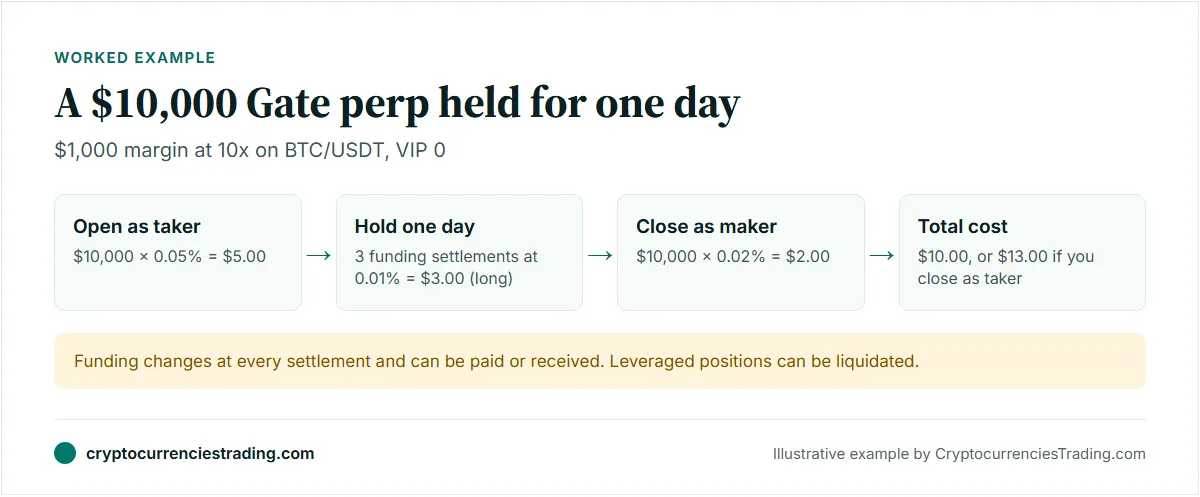
- Open with a market order: $10,000 × 0.05% = $5.00.
- Hold one day on an 8-hour contract, with the rate at 0.01% at all three settlements: $3.00 if you’re long.
- Close with a resting limit order: $10,000 × 0.02% = $2.00.
That is $10.00, or 1% of your margin, and $13.00 if you close with a market order. Real funding changes at every settlement and can be received instead of paid. At 10x, a 10% move against you wipes out the margin, and liquidation comes before that.
Deposit and withdrawal fees
Crypto deposits carry no Gate fee; you pay only the sending network’s fee. Crypto withdrawals cost a flat fee that varies by coin and network, and Gate’s beginner FAQ says it adjusts them hourly. The withdrawal page shows the live fee.
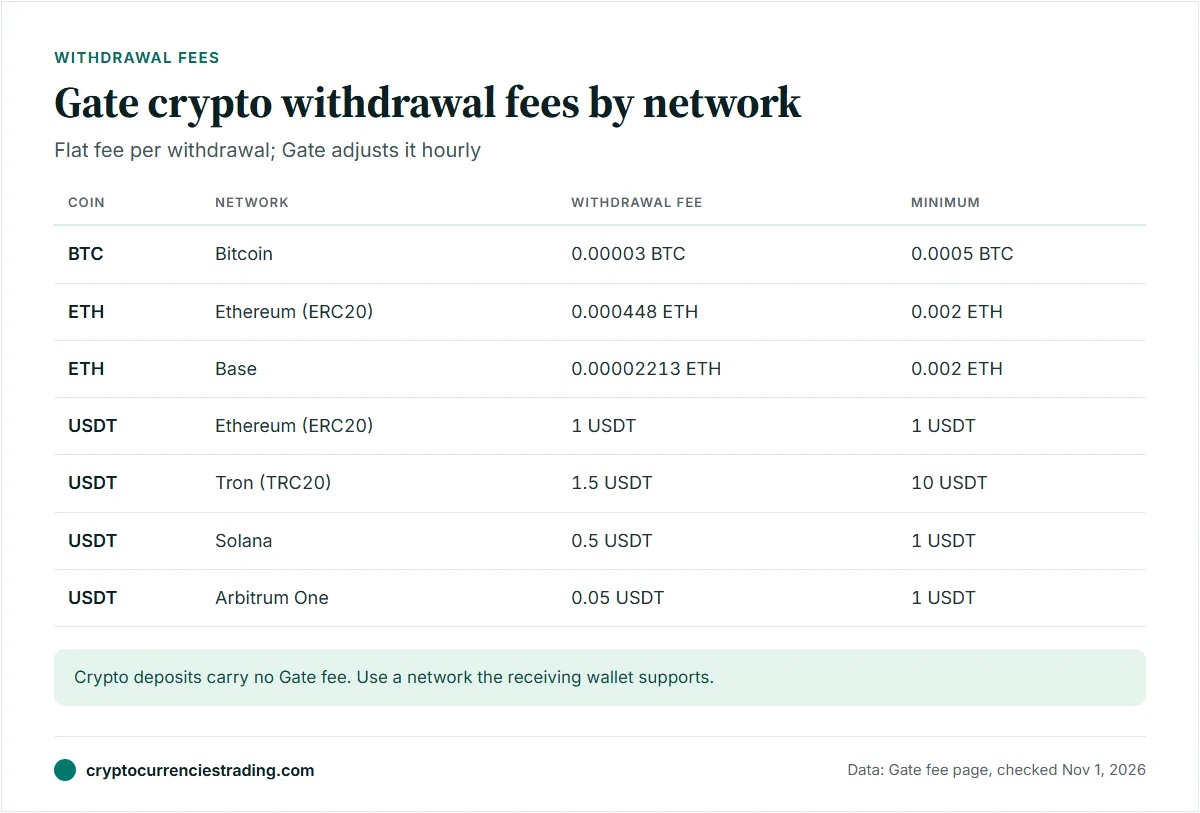
On November 1, 2026, BTC cost 0.00003 BTC on Bitcoin (minimum 0.0005 BTC). ETH cost 0.000448 ETH on Ethereum or 0.00002213 ETH on Base (minimum 0.002 ETH). USDT cost 1 USDT on Ethereum, 1.5 USDT on Tron, 0.5 USDT on Solana and 0.05 USDT on Arbitrum One, with a 1 USDT minimum, or 10 USDT on Tron. Polygon was no longer offered for USDT withdrawals that day.
Use a network the receiving wallet supports; see wrong-network mistakes and sending crypto to a wallet.
Fiat. Gate Connect buys and sells crypto in more than 110 currencies by card, bank transfer, Apple Pay, Google Pay, PIX, PromptPay and more, by country. Gate publishes no fixed fee; the rate and cost show in the order. P2P is advertised with zero fees, but merchants set their own prices. Compare routes in card vs bank transfer.
Gate is also opening US dollar deposits by SWIFT bank transfer to users in stages. Its June 2026 announcement gives no deposit fee and says deposits usually arrive within 0 to 5 business days. Withdrawing dollars to a bank costs USD 50, with a USD 100 minimum.
Margin interest and other costs
- Margin interest is charged hourly, and part of an hour counts as a full hour, per Gate’s margin FAQ. The rate is the Simple Earn lending rate plus a service fee of 18% of that rate at VIP 0, falling to 5.4% at VIP 14. Margin positions can be liquidated, at a fee of 2% of the repayment amount.
- Convert charges no trading fee, per Gate’s Convert page. Its FAQ adds that the conversion price is usually a little above the spot price when you buy and a little below it when you sell, so compare the quote with the order book price. The price on the preview screen is the one you get.
- Inactivity: Gate’s fee page lists no account or inactivity fee.
Copy trading and bot costs
Copy trading has no separate copier fee. Copied positions pay normal futures fees and funding, and the lead trader takes a share of your copy’s profit. Each lead trader sets that share within the limit for their level, and you can’t change it, per Gate’s copiers guide. Gate’s 2024 notice set 30% for expert lead traders, plus a 1% bonus for premium lead traders; it doesn’t say whether that bonus comes out of copiers’ profits. Minimums start at 10 USDT. Copied trades are leveraged and can be liquidated. See copy trading on Gate and copy trading explained.
Trading bots you create cost only normal trading fees, with VIP discounts, per Gate’s bot FAQ. Copying another user’s bot adds a 5% to 30% profit share, and futures bots pay funding. See our trading bots guide.
How to pay less on Gate
- Turn on GT deduction if you already hold GT.
- Use resting limit orders on perps: 0.02% maker against 0.05% taker.
- Leave Points deduction off unless you have Points to use up; it doubles the VIP 0 spot rate.
- Withdraw on a cheap network your wallet supports.
- Watch funding on positions you hold for days.
Gate fees compared with OKX, Bybit and Bitget
At VIP 0, Gate’s 0.1% spot fee matches Bybit and Bitget and sits just above OKX at 0.08% maker and 0.1% taker. GT takes Gate’s rate to 0.09%, BGB takes Bitget’s to 0.08%, and MNT takes 25% off Bybit’s spot fees. On USDT perpetuals, Gate’s 0.02% and 0.05% match OKX and undercut the taker fee at Bybit (0.055%) and Bitget (0.06%). The cheapest venue is one that serves your country; see our best crypto futures exchanges.
Frequently asked questions
Are Gate.io fees the same as Gate fees?
Yes. Gate.io became Gate, at gate.com, in May 2025. The exchange and fee schedule are the same.
What are Gate’s fees for a new account?
At VIP 0: 0.1% maker and taker on spot, or 0.09% paid in GT, and 0.02% maker and 0.05% taker on USDT-margined perpetuals.
Does Gate charge deposit fees?
Not for crypto; you pay only the network fee. Gate Connect shows any fiat cost in the order.
How much does it cost to withdraw USDT from Gate?
On November 1, 2026, it was 1 USDT on Ethereum, 1.5 USDT on Tron, 0.5 USDT on Solana and 0.05 USDT on Arbitrum One. Gate adjusts these fees hourly.
How do I reach a higher VIP level on Gate?
Meet one threshold: VIP 1 needs $60,000 of 30-day volume, 50 GT on 14-day average, or $2,000 in assets.
