
Grvt Review & Trading Guide
DEXGrvt is a self-custodial perps and spot exchange on its own ZKsync-based Layer 2: off-chain order book, USDT and USDC margin, up to 50x leverage.
We may earn a commission if you sign up.How we choose
Key facts
- Type
- Decentralized exchange (DEX)
- Custody
- Self-custody (you hold your keys)
- KYC
- Tiered (limits rise with verification)
- Products
- Spot, Perpetuals, Mobile app
- Spot fees
- 0.06% maker / 0.085% taker
- Perps fees
- -0.0001% maker / 0.045% taker
- Max leverage
- Up to 50x
- Chains
- Ethereum, Arbitrum, Base, BNB Chain, Solana, Tron, Kaia
- Apps
- iOS, Android
- Points program
- EndedSeason 1 closed on 22 September 2025. Season 1 and Season 2 points were settled as shares of the fixed 280 million GRVT airdrop pool (100 million and 180 million shares) at the 30 July 2026 token launch. The help center describes no later season.
- Restricted regions
- United States, Singapore, Hong Kong SAR China, North Korea, Iran, Myanmar (Burma) and 10 more
What is Grvt?
Grvt (pronounced “gravity”) is a self-custodial exchange for perpetual futures and spot trading that runs on its own ZKsync-based Layer 2, with an off-chain order book, USDT and USDC margin and up to 50x leverage. Unlike most perp DEXs, it asks you to verify your identity before you open an account. It suits traders who want a centralized-exchange-style order book and maker rebates, with withdrawals that only their own key can sign, and who are comfortable with KYC.
Grvt describes itself as a hybrid. Its user agreement says perps trade on a central limit order book matched off-chain by Grvt, while smart contracts on its ZKsync-based Layer 2 handle margin and settlement. A withdrawal needs an instruction signed by your key, which Grvt says it never holds. Grvt’s Earn on Equity program works differently: on by default since August 11, 2026, it puts user funds into third-party protocols such as Aave to pay interest, and Grvt says users bear the principal risk. The safety section covers what that means.
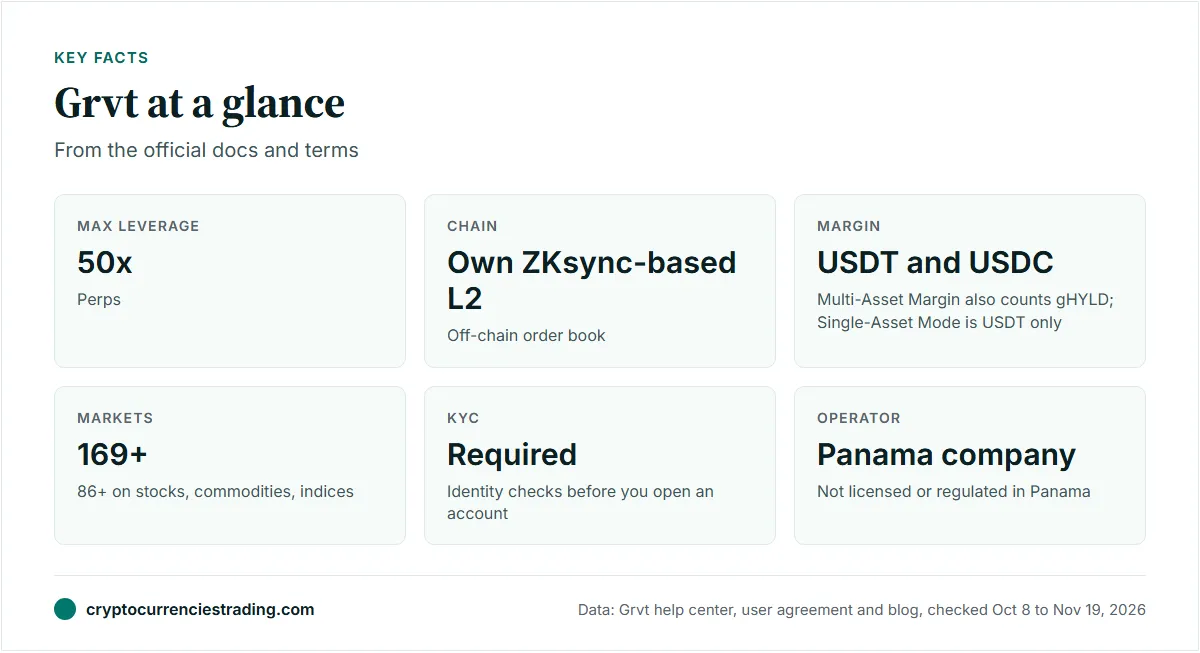
Grvt said on July 27, 2026 that more than 169 pairs trade on the platform, over 86 of them perps on equities, commodities and indices, in a blog post. DefiLlama listed about $464 million of open interest on Grvt in early October 2026, the fifth-largest among perp DEXs at the time.
The operator matters. The user agreement names Albatross Group Overseas S.A. of Panama and says it is not licensed or regulated by any regulatory authority in Panama. KYC does not make Grvt a regulated exchange.
Spot trading on Grvt
Grvt offers spot trading alongside perps, from the same account. Spot fees start at 0.06% maker and 0.085% taker at Level 1, falling to 0% maker and 0.025% taker at Level 9, from $1 billion of 30-day volume.
Spot on Grvt is useful mainly for moving between assets you use as collateral or for simple buys within the same balance. For a wide selection of tokens, a centralized exchange or a spot DEX aggregator will usually offer more. See our crypto exchange ranking.
Perpetuals on Grvt
Grvt’s core product is perpetual futures. Each contract settles in USDT or USDC.
Margin modes. In Single-Asset Mode, only USDT counts as collateral, and you trade USDT-settled contracts only. Multi-Asset Margin counts USDT, USDC and gHYLD (shares in Grvt’s High Yield vault) together and trades both USDT- and USDC-settled contracts, according to Grvt’s margin guide (checked November 19, 2026). When the balance in a contract’s settlement currency goes negative, it automatically borrows USDT or USDC for you and charges hourly interest. New accounts start in Multi-Asset Margin, and existing accounts stay in Single-Asset Mode until you switch. Each asset counts at a discount to its value, so check how your USDC or gHYLD is valued before you rely on it.
Order book. Because matching is off-chain, order placement feels like a centralized exchange, with limit, market and conditional orders and no gas per order.
Markets. Beyond crypto, Grvt lists perps on stocks, commodities and indices. These follow their underlying assets’ prices, and off-hours trading can be thinner, so check the spread before trading them.
Leverage. Up to 50x on perps, with lower limits on smaller markets and larger positions.
Funding is paid between longs and shorts; see our funding rates guide.
Leverage and liquidation. If your margin falls below the maintenance requirement, Grvt liquidates positions, and you can lose the whole margin behind them. At 50x, a move of about 2% against you is enough. Use low leverage and a stop-loss. See leverage and liquidation explained.
Real-world-asset perps. Grvt’s stock, commodity and index perps let you take a leveraged view on, say, gold or a large tech stock from the same balance as your crypto trades. They are synthetic contracts that follow a price; you never own the underlying asset, and there are no dividends or voting rights. Their prices can move sharply around the underlying market’s opening and closing times, and liquidity outside those hours is usually thinner. The December campaign that pays retail makers a -0.01% rebate on these markets makes limit orders especially worthwhile there while it lasts.
Why the margin asset matters. Most perp DEXs margin in USDC. Grvt’s Single-Asset Mode uses USDT only, while Multi-Asset Margin mixes USDT, USDC and gHYLD. In practice, the two stablecoins usually trade close to one dollar each, but they are issued by different companies with different reserves and different regulatory exposure. If one ever slipped from its peg, an account margined in it would feel the effect. In Multi-Asset Margin, Grvt can also convert your USDC or gHYLD into USDT automatically to cover a shortfall, and that conversion carries a fee. Holding the settlement currency of the contracts you trade avoids borrowing and conversion surprises; check how Grvt values each asset in the margin screen.
Grvt vs fully decentralized perp DEXs. Hyperliquid, Lighter and dYdX let anyone with a wallet trade, without an identity check, and match orders on their own chains. Grvt matches off-chain and requires KYC, which makes it look more like a centralized exchange from the outside, while withdrawals still need your own signature. Some traders see that combination as safer because the venue knows who its users are; others see KYC as giving up one of the main reasons to use a DEX. Which matters more to you decides whether Grvt fits.
Who Grvt suits. Grvt fits traders outside its restricted list who want order-book trading with maker rebates, a mix of crypto and traditional markets, and withdrawals that need their own signature, and who don’t mind passing KYC. It fits less well if you want to trade without sharing your identity, if you don’t want your balance placed in third-party protocols, if you live in Canada, Singapore or Hong Kong, or if you want the deepest possible order books, where the largest perp DEXs still lead.
The Grvt app
Grvt offers a mobile app for trading from your phone, using the same account and balance as the web app. As with any trading app, download it only from the official store listing linked from grvt.io, and turn on every security option it offers.
Grvt fees
| Market | Maker | Taker | Notes |
|---|---|---|---|
| Spot | 0.06% | 0.085% | Level 1 of 9, for under $1,000,000 of 30-day futures volume per the fee model page; the spot trading article says perps and spot volume count together. Level 9, from $1 billion, pays 0% maker and 0.025% taker. Locking GRVT in the membership program raises the fee level. |
| Perpetuals | -0.0001% | 0.045% | Level 1 of 9, for under $1,000,000 of 30-day futures volume per the fee model page; the spot trading article says perps and spot volume count together. The negative maker rate is a rebate. Level 9, from $1 billion, is -0.003% maker and 0.024% taker. A campaign that ends on 21 December sets the maker rebate on RWA perps at -0.01% for retail accounts. |
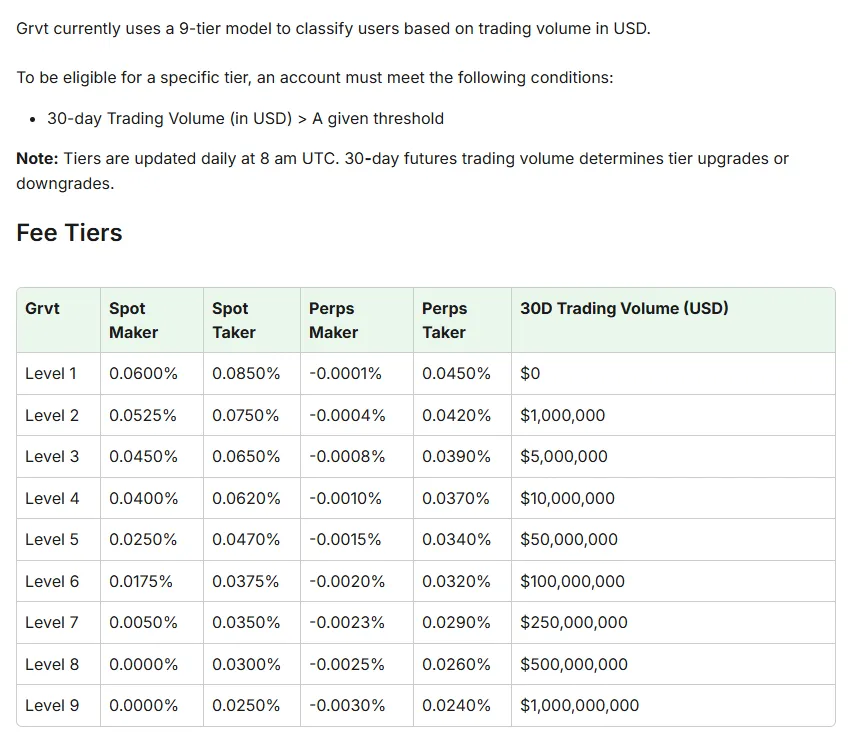
Grvt uses nine fee levels based on 30-day futures volume, according to its fee model page. Its spot trading article of June 25, 2026 says perps and spot volume count together, so it is unclear whether spot trades move you up a level. At Level 1, under $1 million of volume, perps pay a small maker rebate and a 0.045% taker fee.
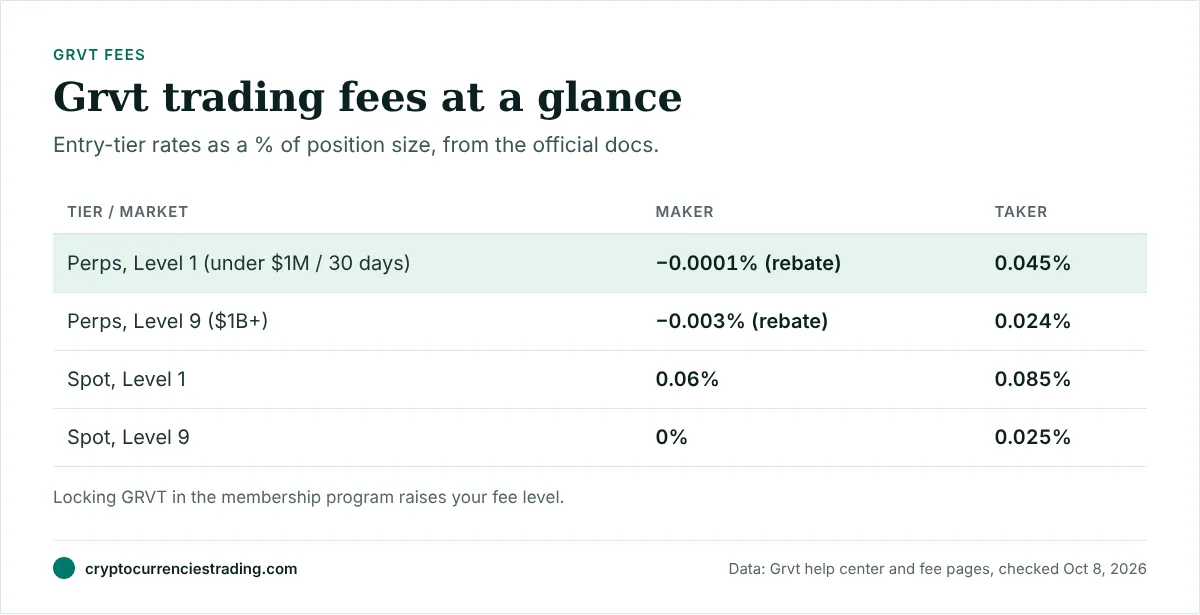
The negative maker rate means Grvt pays you a tiny amount for limit orders that rest on the book: -0.0001% at Level 1, rising to -0.003% at Level 9. A campaign ending on December 21 sets the maker rebate on real-world-asset perps at -0.01% for retail accounts. Locking GRVT tokens in the membership program raises your fee level.
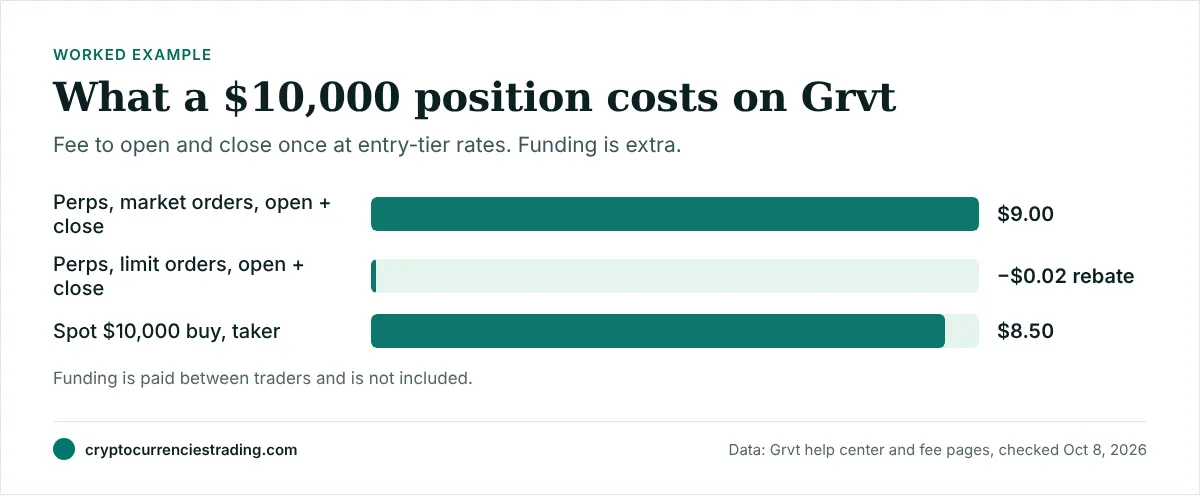
Worked example. Open and close a $10,000 perp position with market orders and you pay 0.045% twice: $9. With limit orders that rest on the book, you receive about $0.02 in rebates instead. A $10,000 spot buy at the Level 1 taker rate costs $8.50.
Other costs: funding on open perps, and network or bridge fees when you deposit and withdraw.
How the fee levels work. Your level is set by 30-day futures volume, and there are nine of them. Most retail traders stay at Level 1, where the taker fee of 0.045% is in line with Hyperliquid’s base tier and the small maker rebate is a bonus. Locking GRVT tokens in the membership program can move you up a level without the volume. Do the sums first: the saving from one level is a few thousandths of a percent per trade, which matters for very active traders and hardly at all for occasional ones.
Where Grvt is available
Not available in: United States, Singapore, Hong Kong SAR China, North Korea, Iran, Myanmar (Burma), Belarus, Cuba, Afghanistan, Canada, Libya, Russia, Somalia, South Sudan, Sudan, Syria.
From the Restricted Jurisdictions page updated 3 August 2026. The US entry includes all US territories. The page also bans Crimea, Donetsk, Luhansk, Kherson, Zaporizhzhya and the City of Sevastopol, and says the list may change.
Grvt’s Restricted Jurisdictions page, updated August 3, 2026, lists the countries shown above. The US entry includes all US territories. The page also bans Crimea, Donetsk, Luhansk, Kherson, Zaporizhzhya and the City of Sevastopol, and says the list may change.
Because Grvt requires identity verification, it can enforce these rules more strictly than wallet-only DEXs. Users in Singapore, Hong Kong and Canada, which many other perp DEXs allow, are also excluded here. If you’re in the US, see our guide to perp DEXs and US availability.
Is Grvt safe?
Audits
- December 14, 2024Spearbit
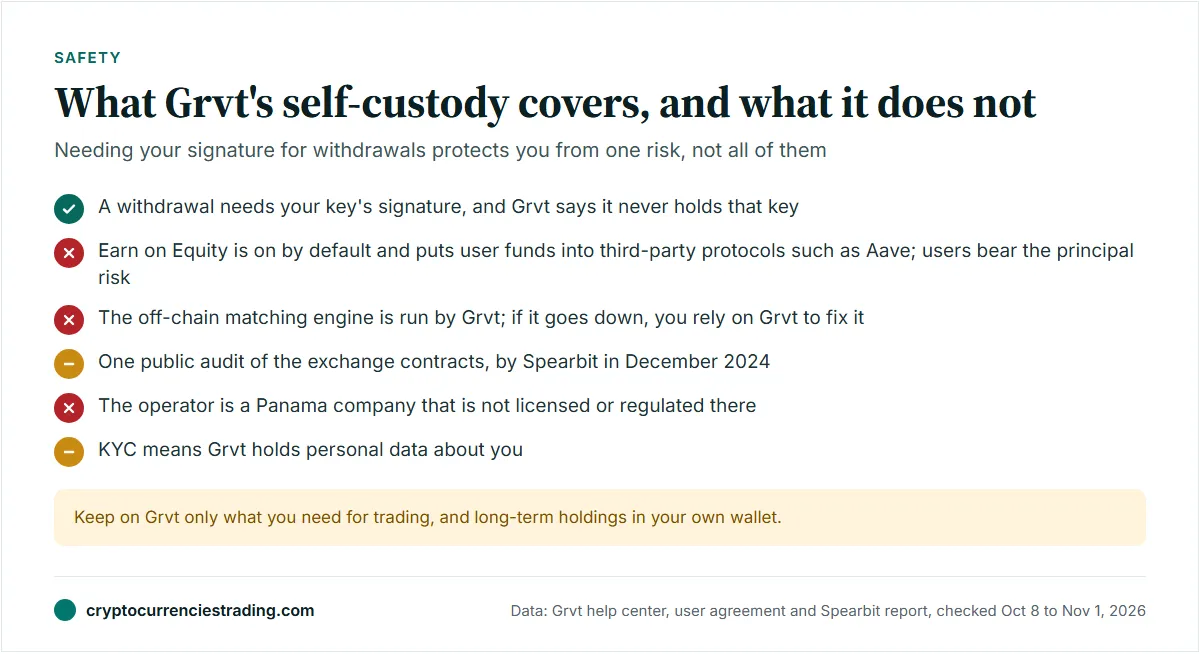
Grvt combines withdrawals that need your signature with an off-chain order book, a yield program that is on by default and an unregulated operator. Each part carries its own risk.
Custody. A withdrawal needs your key’s signature, and Grvt says it never holds that key and cannot sign for you. The custody risks there are smart-contract bugs and losing your own keys.
Earn on Equity. Since August 11, 2026, Grvt has paid interest on the USDT and USDC in your funding and trading accounts, at a 3.5% APY base rate. It is on by default, with nothing to sign up for. On November 19, 2026 the Earn on Equity article also offered referrers an extra 1% APY, up to 4.5% in total, with the referral bonus capped at 50 USDT per 4-week cycle. These rates can change. Grvt’s Earn on Equity article of August 9, 2026 says the product puts user funds into third-party protocols such as Aave and short-term credit instruments, and that users bear the full principal risk from those protocols, including smart-contract failure, exploits, insolvency and depegging. Grvt’s Earn page says USDT used as margin in open positions earns interest too. So your balance on Grvt carries the risk of those outside protocols as well as Grvt’s own contracts. The guarantee the Earn page mentions is a minimum 3.5% rate, not protection for your principal.
Grvt’s pages differ on how Earn fits with self-custody. Its self-custody article says nothing Grvt controls can move your funds, and it does not mention Earn. Its Yield Layer article says funds stay self-custodial and move on the authorization you give through using the platform.
Neither the Earn article nor the Earn on Equity terms of August 11, 2026 says how to switch Earn off; the terms say interest accrues automatically on all USDT and USDC in those accounts. If you don’t want that exposure, keep on Grvt only what you need for trading and hold the rest in your own wallet.
Audits. Spearbit audited Grvt’s exchange contracts in December 2024; the report is on GitHub. We found no later audit listed for newer contract versions.
Operator and matching. The off-chain matching engine is run by Grvt. If it goes down or misbehaves, you rely on Grvt to fix it. The operator is a Panama company that is not licensed or regulated there.
Incidents. We found no security incident on Grvt’s own pages, and the Rekt News leaderboard of the largest crypto exploits lists none for Grvt as of October 31, 2026. Smaller incidents may not appear on that list.
KYC data. Identity checks mean Grvt holds personal data about you. Consider that alongside the privacy benefits that drew you to a DEX.
What to do with this. Needing your signature for withdrawals protects you from one risk: someone withdrawing your balance to their own wallet. It does not keep your USDT and USDC out of other protocols, because Earn on Equity is on by default. It also does less to protect you from the matching engine going offline in a volatile market, or from a bug in contracts that have had only one public audit. Keep on Grvt only what you need for trading, size positions so that a few hours without access would not ruin you, and keep long-term holdings in a separate self-custody wallet.
How to start on Grvt
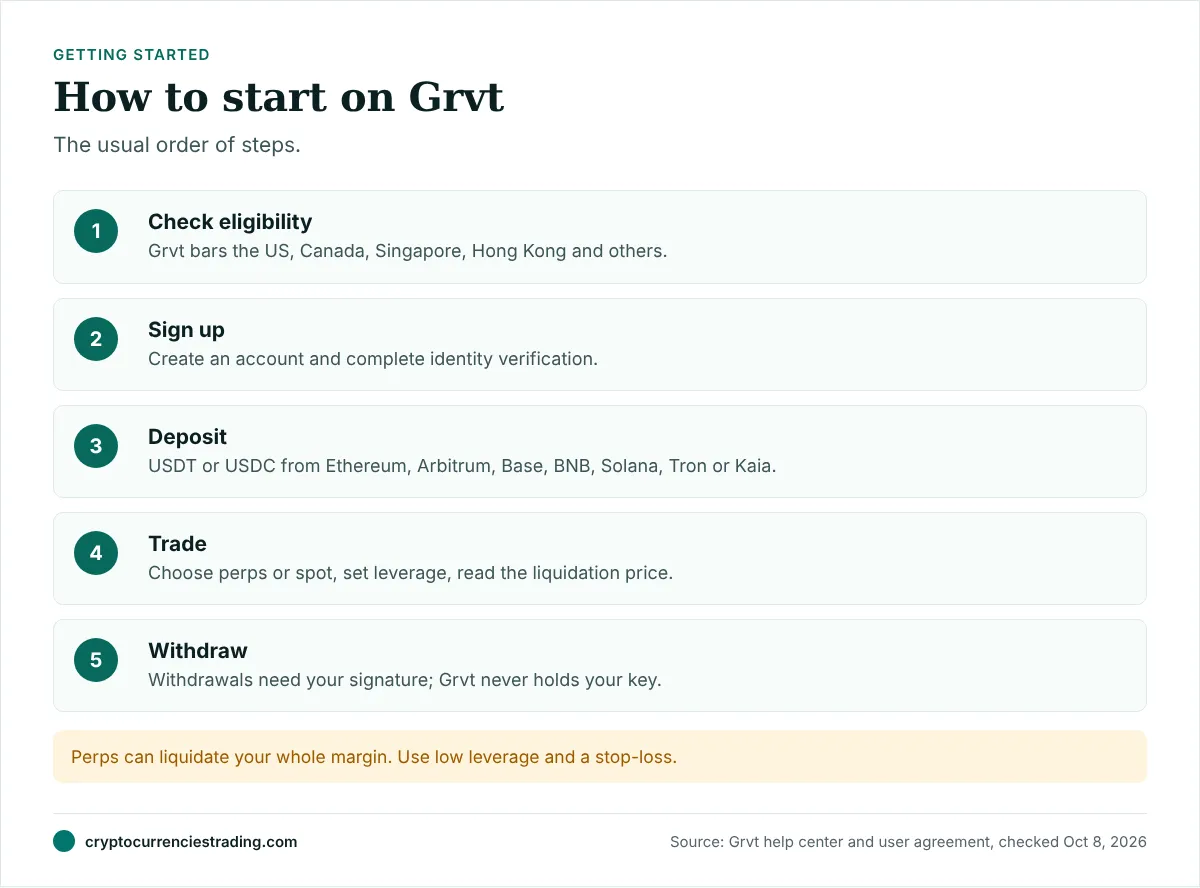
- Check you’re eligible under the Restricted Jurisdictions page.
- Sign up at grvt.io and complete identity verification. The user agreement of September 14, 2026 says you must pass it before opening an account.
- Deposit USDT or USDC from Ethereum, Arbitrum, Base, BNB Chain, Solana, Tron or Kaia. Send a small test first.
- Choose margin mode. New accounts start in Multi-Asset Margin; Single-Asset (USDT only) is simplest to start.
- Place a small trade with low leverage and read the liquidation price.
- Withdraw when done; it needs your signature.
Funding your account. Grvt accepts deposits from seven networks: Ethereum, Arbitrum, Base, BNB Chain, Solana, Tron and Kaia. Fees and speed vary by network: Ethereum mainnet is usually the slowest and most expensive, while layer-2 networks and Tron are typically cheaper. Pick the network your exchange or wallet already uses for USDT to avoid an extra conversion, double-check the address and network before sending, and remember that every withdrawal needs your own signature, so keep your wallet and its recovery phrase safe. Once your USDT or USDC arrives, it is in Earn on Equity by default, which puts user funds into third-party protocols such as Aave at your risk; the safety section explains what that means.
Tips. Use limit orders to earn the maker rebate instead of paying 0.045%. Keep spare USDT in the account if you use cross margin. And treat stock and commodity perps as more volatile around their market opens and closes.
Grvt referral program and token
Grvt has a referral program, but its official docs don’t state what a referred user receives, so check the referral terms in the app before you sign up. For referrers, the Earn on Equity article (checked November 19, 2026) lists an extra 1% APY for referring eligible friends, up to 4.5% in total and capped at 50 USDT per 4-week cycle; Grvt can change it.
Grvt also has a token, GRVT, which can be locked in a membership program to raise your fee level. Tokens are volatile; buying one only for a fee discount rarely makes sense unless you trade a lot.
Grvt pros and cons
Pros
- Maker rebates on perps even at the entry level
- Withdrawals need your own signature, and Grvt says it never holds your key
- Large market list, including stocks, commodities and indices
- Order-book trading with no gas per order
- Spot and perps in one balance
Cons
- KYC required, unlike most perp DEXs
- Earn on Equity, on by default, puts user funds into third-party protocols such as Aave, and users bear the principal risk
- Excludes the US, Canada, Singapore, Hong Kong and others
- Operator is a Panama company that is not licensed or regulated
- Off-chain matching means relying on Grvt’s engine
- Only one published audit, from December 2024
Grvt FAQ
Does Grvt require KYC?
Yes. Grvt’s user agreement says you must complete identity verification before opening an account.
Is Grvt a DEX?
It is a hybrid: orders are matched off-chain by Grvt, while margin and settlement run in smart contracts on its own ZKsync-based Layer 2, and withdrawals need your signature. Its Earn on Equity program, on by default, also puts user funds into third-party protocols such as Aave, with users bearing the principal risk.
What are Grvt’s fees?
At Level 1, perps pay a -0.0001% maker rebate and a 0.045% taker fee; spot pays 0.06% maker and 0.085% taker.
What is Grvt’s maximum leverage?
Up to 50x on perps.
Can I trade stocks on Grvt?
You can trade perps that follow stock, commodity and index prices. You don’t own the underlying shares, and leverage and liquidation apply as with crypto perps.
What collateral does Grvt accept?
Single-Asset Mode accepts USDT only. Multi-Asset Margin, the default for new accounts, counts USDT, USDC and gHYLD (High Yield vault shares) as collateral.
Is Grvt available in the US?
No. The US and its territories are on the Restricted Jurisdictions list, along with Canada, Singapore, Hong Kong and others.
Featured in
- Best Perp DEXs (#8)
Alternatives: Lighter, Aster, Hyperliquid
Compare side by side: Grvt vs Lighter, Grvt vs Aster, Grvt vs Hyperliquid
Sources
Every figure on this page comes from the pages below, checked on the date shown.
- grvt.ioOfficial website. Checked October 8, 2026.
- help.grvt.io/en/articles/15456179-spot-trading-on-grvtProducts, Spot fees, Perps fees. Checked November 1, 2026.
- help.grvt.io/en/articles/9614699-how-does-grvt-s-fee-model-workProducts, Spot fees, Perps fees. Checked November 19, 2026.
- help.grvt.io/en/articles/15942962-grvt-litepaperProducts, Token. Checked October 8, 2026.
- play.google.com/store/apps/detailsProducts, Android app. Checked October 8, 2026.
- help.grvt.io/en/articles/15885124-what-does-self-custody-of-funds-mean-on-grvtCustody. Checked November 1, 2026.
- help.grvt.io/en/articles/15475723-grvt-earn-on-equityCustody. Checked November 19, 2026.
- help.grvt.io/en/articles/12552649-grvt-earn-on-equity-terms-and-conditionsCustody. Checked November 1, 2026.
- help.grvt.io/en/articles/14107072-grvt-yield-layerCustody. Checked November 1, 2026.
- help.grvt.io/en/articles/9614719-user-agreementCustody, KYC. Checked October 8, 2026.
- edge-cdn.grvt.io/i18n/unverified/mobile/mob-es.jsonKYC. Checked October 8, 2026.
- help.grvt.io/en/articles/13038840-how-to-log-in-sign-up-with-your-wallet-step-by-step-guideKYC. Checked October 8, 2026.
- help.grvt.io/en/articles/9630123-how-do-i-deposit-funds-into-grvtChains. Checked November 19, 2026.
- help.grvt.io/en/articles/14272382-grvt-supported-usdt-contract-addressesChains. Checked October 8, 2026.
- help.grvt.io/en/articles/9588408-getting-startedChains. Checked October 8, 2026.
- help.grvt.io/en/articles/15456051-grvt-membership-programSpot fees. Checked October 8, 2026.
- help.grvt.io/en/articles/16812773-paid-mode-on-campaignPerps fees. Checked October 8, 2026.
- help.grvt.io/en/articles/10255049-what-are-the-margin-requirements-on-grvtMax leverage. Checked October 8, 2026.
- help.grvt.io/en/articles/10393222-how-is-configurable-leverage-calculatedMax leverage. Checked October 8, 2026.
- apps.apple.com/sg/app/grvt/id6544785149iOS app. Checked October 8, 2026.
- help.grvt.io/en/articles/16106859-everything-about-tgeToken, Points program. Checked November 20, 2026.
- help.grvt.io/en/collections/9848928-rewardsPoints program. Checked November 20, 2026.
- help.grvt.io/en/articles/9711621-restricted-jurisdictionsAvailability. Checked October 8, 2026.
- github.com/gravity-technologies/exchange-contract/blob/main/docs/docs/Audit_Spearbit_Report_December_14_2024.pdfAudits. Checked October 8, 2026.
- help.grvt.io/en/articles/12545768-audit-spearbit-reportAudits. Checked October 8, 2026.
- help.grvt.io/en/articles/16857432-multi-asset-margin-a-complete-guideProducts. Checked November 19, 2026.
