| Market | Maker | Taker | Notes |
|---|---|---|---|
| Spot | 0.04% | 0.07% | Base tier. Rates fall with 14-day volume and HYPE staking; spot volume counts double toward the tier. |
| Perpetuals | 0.015% | 0.045% | Base tier. Rates fall with 14-day volume and HYPE staking; builder-deployed (HIP-3) markets can differ. |
Hyperliquid fees start at 0.045% for takers and 0.015% for makers on perpetuals, so a $1,000 perp market order costs $0.45. The fee most traders miss is the builder fee that wallets and other apps can add on top, up to 0.1% on perps.
Moving money is cheap: the docs list no Hyperliquid deposit fee beyond gas on the chain you send from, and a USDC withdrawal costs 1 USDC.
This is not financial advice. Perpetuals use leverage, and a leveraged position can be liquidated.
Hyperliquid’s terms bar people in the United States and Ontario, Canada; see perp DEXs and US availability. For how the exchange works, see our Hyperliquid guide.
Hyperliquid fees by volume tier: maker and taker rates
Your rate depends on your rolling 14-day volume, which Hyperliquid’s fee page says is assessed at the end of each day in UTC. One tier covers perps, builder-deployed (HIP-3) perps and spot, and spot volume counts double toward it. Sub-accounts share the master account’s tier; a vault’s volume is counted separately.
| Tier | 14-day weighted volume | Perps taker | Perps maker | Spot taker | Spot maker |
|---|---|---|---|---|---|
| 0 | Up to $5M | 0.045% | 0.015% | 0.070% | 0.040% |
| 1 | Over $5M | 0.040% | 0.012% | 0.060% | 0.030% |
| 2 | Over $25M | 0.035% | 0.008% | 0.050% | 0.020% |
| 3 | Over $100M | 0.030% | 0.004% | 0.040% | 0.010% |
| 4 | Over $500M | 0.028% | 0% | 0.035% | 0% |
| 5 | Over $2B | 0.026% | 0% | 0.030% | 0% |
| 6 | Over $7B | 0.024% | 0% | 0.025% | 0% |
Rates before staking and referral discounts, from Hyperliquid’s fee page, checked October 31, 2026.
Tier 1 needs over $5 million in 14 days, so for most retail traders the bigger lever is the order type. A market order pays the taker rate. A limit order that rests on the book pays the maker rate, a third of the taker rate on perps, and Hyperliquid’s Post Only (ALO) order guarantees it. See maker vs taker fees.
Maker rebates. Makers with more than 0.5%, 1.5% or 3.0% of the exchange’s 14-day weighted maker volume get a fee of -0.001%, -0.002% or -0.003%, a rebate paid on each trade straight to the trading wallet. Those shares suit market-making firms, not retail traders.
HYPE staking fee discounts
Staking HYPE, Hyperliquid’s token, takes a percentage off whatever your volume tier charges:
| Staking tier | HYPE staked | Fee discount |
|---|---|---|
| Wood | More than 10 | 5% |
| Bronze | More than 100 | 10% |
| Silver | More than 1,000 | 15% |
| Gold | More than 10,000 | 20% |
| Platinum | More than 100,000 | 30% |
| Diamond | More than 500,000 | 40% |
From Hyperliquid’s fee page, checked October 31, 2026.
At tier 0, Gold lowers the perps taker fee from 0.045% to 0.036%, and Diamond to 0.027%.
You can link a separate staking address to your trading account, but the fee page warns that linking is permanent and lets the staking address move every fund out of the trading account, so link only addresses you control. Unstaking takes 7 days and HYPE’s price moves, so buying it just for the discount can cost more than it saves. See our vaults and staking guide.
Referral discount
A referral code gives a 4% discount on trading fees for your first $25M in volume. The referral docs add that it does not apply to vaults or sub-accounts. More in Hyperliquid’s referral program.
Builder fees in wallets and other apps
Many apps place orders on Hyperliquid for you, including wallets with built-in perps. Hyperliquid’s builder codes let them add their own fee:
- Caps. Up to 0.1% on perps and 1% on spot.
- Approval. You sign a maximum fee for each app and can revoke it at any time.
- Which trades. Both buys and sells on perps; on spot, not the buying side.
Phantom, for example, charges 0.095% of position value on its perps, which run on Hyperliquid: 0.05% for Phantom plus Hyperliquid’s 0.045%.
Fees on HIP-3 builder-deployed markets
HIP-3 markets are perps run by third-party deployers, who can add a fee share of 0% to 300% to the normal rate, and above 100% the protocol fee rises to match. Using the examples in Hyperliquid’s HIP-3 developer docs, at tier 0:
- A 100% share doubles the taker fee to 0.09%.
- The 300% maximum makes it six times the normal fee: 0.27%.
- Growth mode cuts fees by at least 90%, to an all-in taker rate of 0.0045% to 0.009%. It is allowed only on markets that don’t overlap Hyperliquid’s own perps, so not on crypto.
Staking and referral discounts still apply. Check a HIP-3 market’s fee before you trade it.
Funding fees on Hyperliquid perps
Funding passes between traders every hour, and Hyperliquid’s funding docs say no fee is collected on it. The rate combines a fixed interest component of 0.01% every 8 hours (0.00125% an hour), paid by longs to shorts, with a premium that follows the gap between the perp and oracle prices. When the perp trades above the oracle, longs pay; below it, shorts pay. Each payment is position size × oracle price × the hourly rate, capped at 4% an hour. See funding rates explained.
Worked examples
$1,000 orders. At tier 0, a $1,000 perp market order costs $0.45 (0.045%), or $0.15 (0.015%) as a resting limit order. A $1,000 spot market buy costs $0.70 (0.07%), or $0.40 (0.04%) as a maker.
A $10,000 perp held for a day. Say you put up $1,000 at 10x to go long $10,000 of BTC. Fees are charged on the position, not your margin.
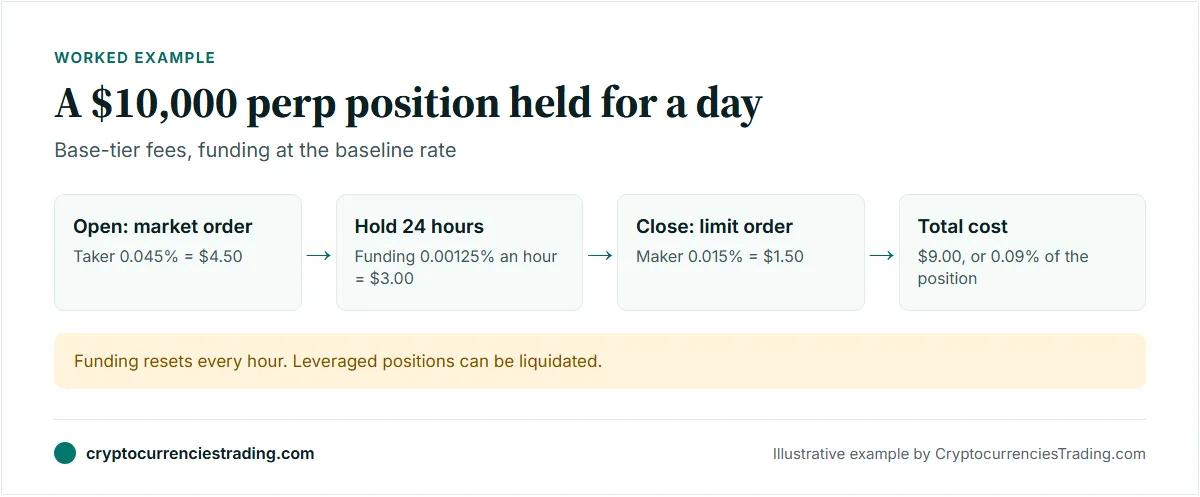
- Open with a market order: $10,000 × 0.045% = $4.50.
- Hold for 24 hours. If funding stayed at the 0.00125% hourly baseline: $10,000 × 0.00125% × 24 = $3.00.
- Close with a resting limit order: $10,000 × 0.015% = $1.50.
The total is $9.00, or 0.09% of the position and 0.9% of your margin. An app adding a 0.05% builder fee (an illustrative rate under the 0.1% cap) would add $10. Funding resets every hour and can run far above the baseline. At 10x, a move of less than 10% against you can get the position liquidated; see leverage and liquidation explained.
Hyperliquid deposit fee and minimum
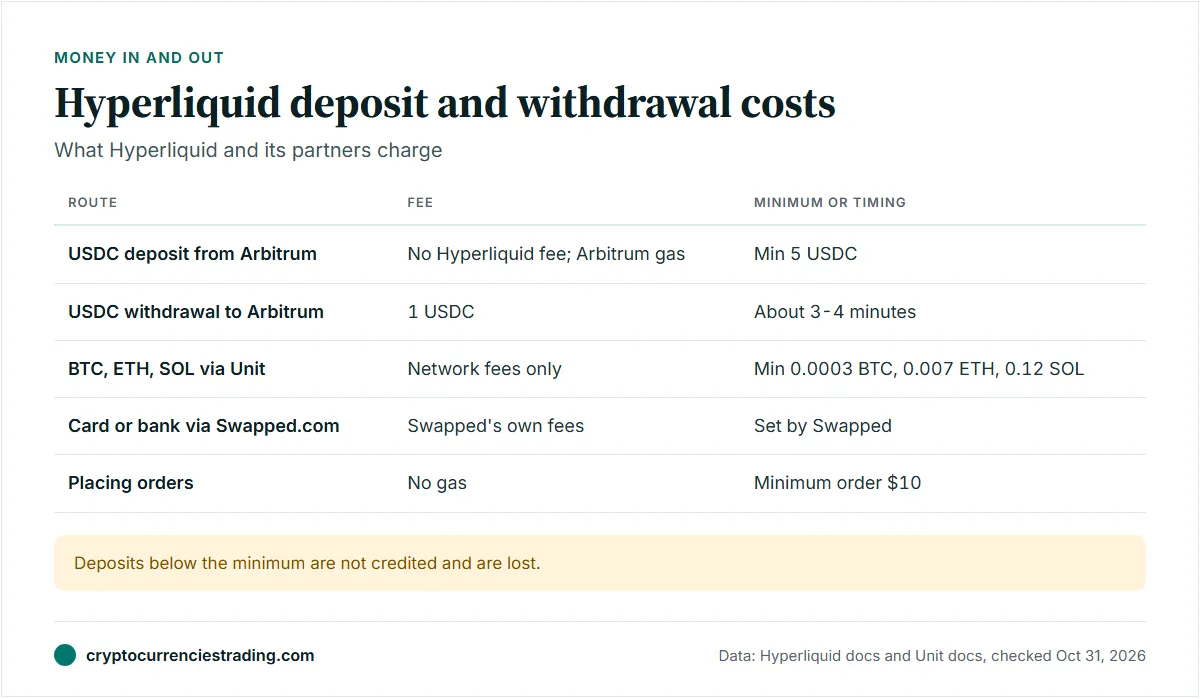
The docs list no Hyperliquid fee for depositing USDC. You pay gas on the source chain: a wallet deposit of USDC on Arbitrum needs a little ETH on Arbitrum, and trading after that is gas-free.
- Minimum. 5 USDC for a wallet deposit. Hyperliquid’s deposit FAQ says wallet-connected accounts deposit USDC from Arbitrum only and that deposits under 5 USDC are lost, and the USDC docs say the same of the Arbitrum bridge. Circle’s CCTP docs say CCTP deposits have no minimum and no fast-transfer fee from Arbitrum, but staying above 5 USDC is safe on either route.
- Email login. The app shows a deposit address that takes USDC from Arbitrum, Ethereum, Base or Polygon. The deposit FAQ says Across Protocol handles these deposits, and neither it nor the onboarding guide lists a fee for them. Deposits under 5 USDC are not credited and go to your email wallet instead, and deposits under 1 USDC are lost.
- Other coins. BTC, ETH, SOL and others come in through Unit, an independent team that says it takes no revenue, so you pay only network fees. Its minimums include 0.0003 BTC, 0.007 ETH and 0.12 SOL.
- Card or bank. The fiat on-ramp is run by Swapped.com, which sets its own fees, per Hyperliquid’s fiat deposit FAQ.
Our guides to funding a perp DEX and bridging USDC walk through each route.
Hyperliquid withdrawal fee: 1 USDC
Withdrawing USDC to Arbitrum costs 1 USDC. Hyperliquid’s support FAQ says you need 1 USDC for a withdrawal, and the API docs give a $1 fee “at the time of this writing”. You need no ETH, and the USDC docs say funds arrive in 3 to 4 minutes. Because the fee is flat, it is 1% of a 100 USDC withdrawal but 0.1% of 1,000 USDC, so fewer, larger withdrawals cost less.
Circle’s CCTP docs also describe a one-time 1 USDC activation fee for a new account that first receives USDC through CCTP, charged on its first withdrawal or transfer out. Neither Circle’s docs nor Hyperliquid’s say whether it comes on top of the 1 USDC withdrawal fee.
Withdrawing BTC, ETH or SOL through Unit costs the destination network’s fee, and Hyperliquid’s onboarding guide notes that some chains and methods carry small gas fees.
Hyperliquid vault performance fee: 10%
The leader of a user vault keeps 10% of the profit you make. In the depositor docs’ example, a 100 USDC share that grows to 200 USDC pays out 190 USDC, less any slippage. HLP, the protocol’s own vault, takes no fees or profit share. Vaults can lose money; lock-ups and risks are in our vaults and staking guide.
Other costs
- Liquidation. Order-book liquidations carry no clearance fee and you keep any margin left. In a backstop liquidation, the liquidation docs say your maintenance margin is not returned.
- Borrowing. Borrowed USDC or USDT pays interest. The portfolio margin docs set the stablecoin rate at 5% a year, rising once more than 80% of supply is borrowed.
- Minimum order. Orders must be worth at least $10.
How Hyperliquid fees compare
Hyperliquid isn’t the cheapest perp DEX on fees. On a $10,000 perp market order at entry-level rates, its 0.045% taker fee is $4.50. Aster charges 0.04% ($4.00) on its main crypto pairs, Extended a flat 0.025% ($2.50) with 0% maker, and Lighter’s default Standard account charges nothing. Hyperliquid’s case is liquidity: DefiLlama listed about $8.3 billion of open interest there on October 8, 2026, the most in our perp DEX ranking. Spread and slippage count alongside the fee.
Frequently asked questions
What are Hyperliquid’s maker and taker fees?
At the base tier, perps cost 0.015% maker and 0.045% taker, and spot 0.04% maker and 0.07% taker. Rates fall above $5 million of 14-day weighted volume, and HYPE staking takes 5% to 40% off.
Does Hyperliquid charge a deposit fee?
The docs list none for USDC; you pay gas on the source chain. The minimum for a wallet deposit from Arbitrum is 5 USDC, and smaller deposits are lost.
How much does it cost to withdraw from Hyperliquid?
1 USDC for a USDC withdrawal to Arbitrum, whatever the amount. It arrives in about 3 to 4 minutes.
What is the Hyperliquid vault performance fee?
10% of profits on user vaults, paid to the vault leader. HLP takes no fee or profit share.
Do apps built on Hyperliquid charge more?
They can. Builder fees of up to 0.1% on perps and 1% on spot come on top of Hyperliquid’s fee, up to a maximum you approve for each app.
