| Market | Maker | Taker | Notes |
|---|---|---|---|
| Spot | n/a | n/a | Not maker/taker. Jupiter commission per swap is 0% to 0.5% in Ultra mode (default) depending on the pair, and 0% in Manual mode. Limit and DCA orders (V2) cost 0.03% to 0.1% plus the Ultra routing fee. Solana network fees are extra. |
| Perpetuals | n/a | n/a | SOL, ETH and wBTC markets charge a flat 0.06% base fee on open and on close, plus a price impact fee and an hourly borrow fee. Beta markets (order-book markets such as JUP, HYPE, ZEC, NEAR and stock perps) charge 0.005% maker and 0.035% taker instead. |
Jupiter fees on a swap are 0% to 0.5% of the trade in Ultra mode, the default on jup.ag, and most pairs pay 0.1%, so a $1,000 swap usually costs $1 or less in Jupiter fees plus a small Solana network fee. The rate to watch is 0.5% on tokens less than 24 hours old, and on Jupiter Perps it is the hourly borrow fee on positions you keep open.
Manual mode swaps carry no Jupiter commission at all. For how Jupiter works overall, see our Jupiter review.
This is not financial advice. Token prices can move sharply, and leveraged perps positions can be liquidated, losing the collateral behind them.
Jupiter swap fees by pair type
Instead of maker and taker fees, Jupiter charges a commission per swap, shown as the Platform Fee row in the quote. The rates come from Jupiter’s Ultra mode docs and, for swaps placed natively in the Jupiter Mobile app, a separate mobile schedule:
| Pair | jup.ag (Ultra) | Jupiter Mobile |
|---|---|---|
| Stablecoin to stablecoin, or between liquid staking tokens (LSTs) | 0% | 0% |
| SOL or a stablecoin into JUP, JLP or jupSOL | 0% | 0% |
| SOL to or from a stablecoin | 0.02% | 0.1% |
| An LST to or from a stablecoin | 0.05% | 0.1% |
| Bluechip token to any token | 0.1% (all other swaps) | 0.1% |
| All other pairs | 0.1% | 0.2% |
| Tokens less than 24 hours old | 0.5% | 0.5% |
Rates checked October 31, 2026.
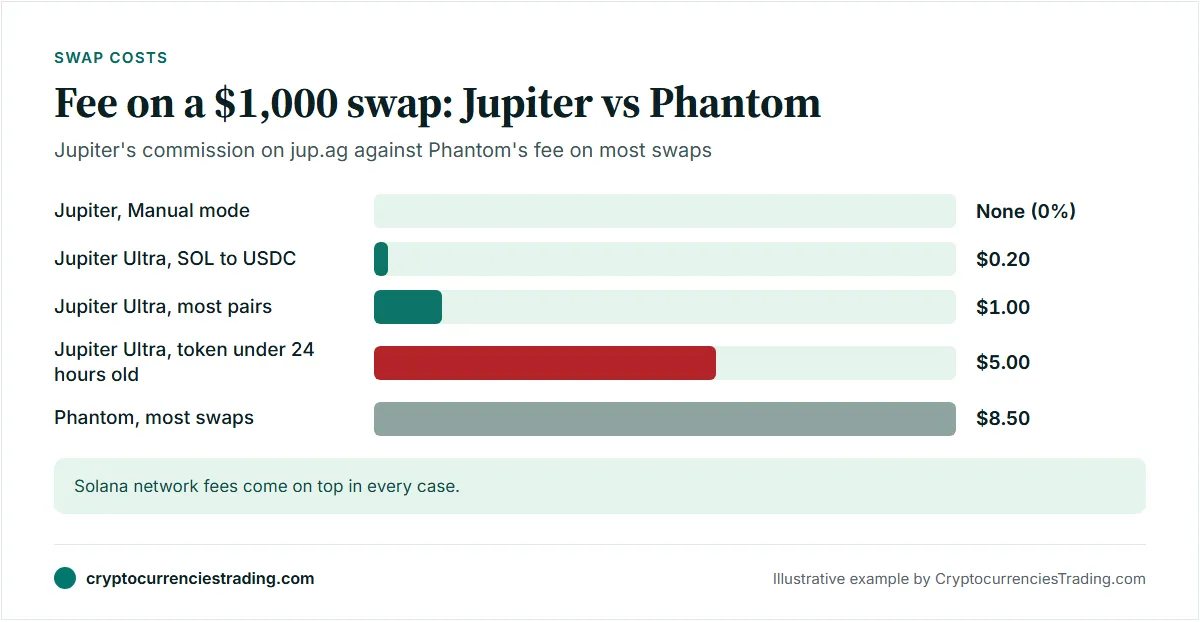
On $1,000, that is $0.20 for SOL to USDC on jup.ag, $1.00 for most other pairs and $5.00 for a token launched today.
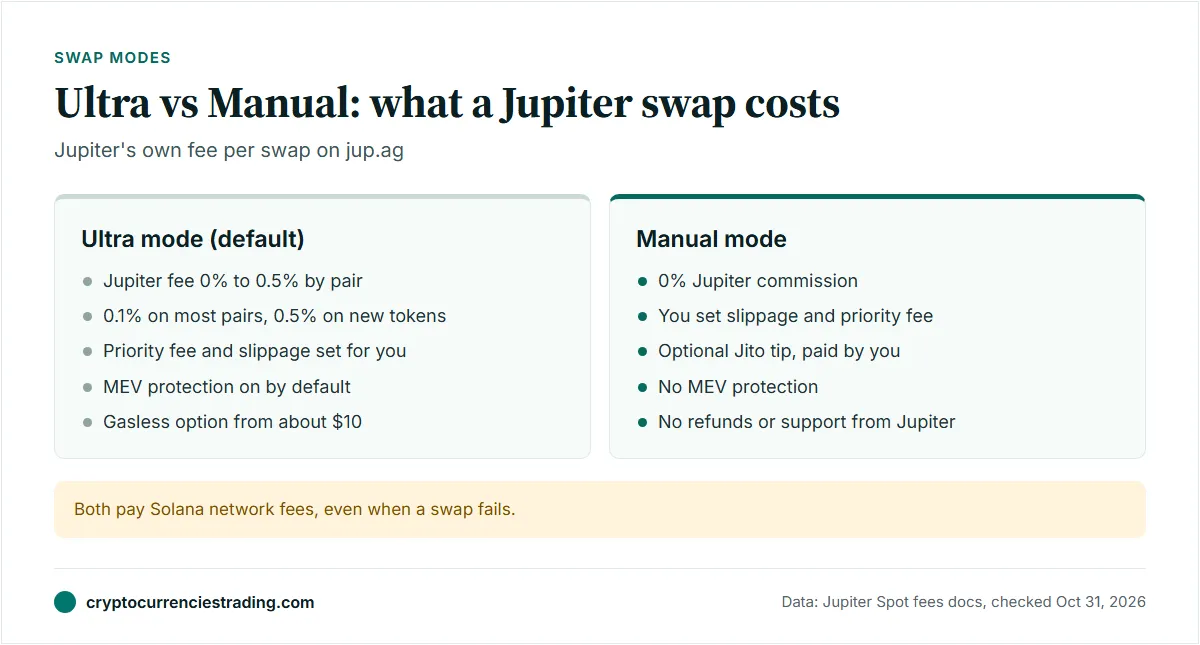
Manual mode charges 0% Jupiter commission on any pair. In exchange, you set slippage and the priority fee yourself, there is no MEV protection, and Jupiter’s Manual mode page says it comes with no refunds and no support.
What goes to Jupiter and what goes to the pools
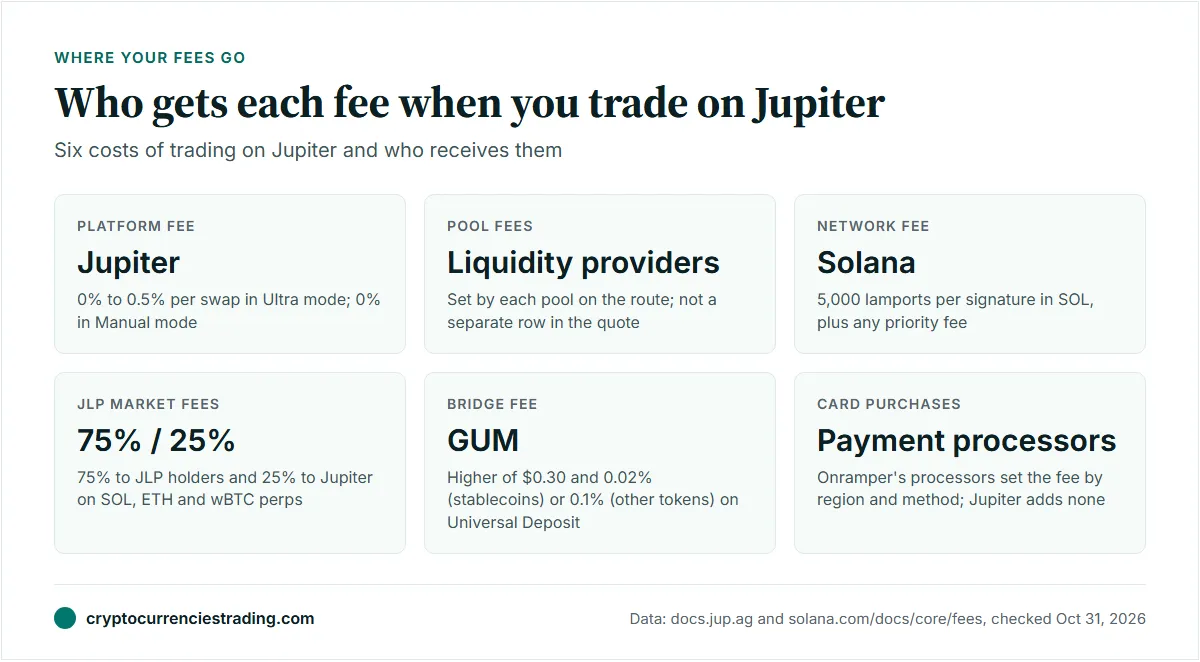
Jupiter routes your swap across AMM pools, third-party sources and its own routers, Metis and JupiterZ. The Platform Fee goes to Jupiter. Each pool on the route also charges its own trading fee, paid to its liquidity providers, as Jupiter’s AMM guide explains. The quote does not list pool fees as a separate row.
Solana network fees, priority fees and gasless swaps
Every Solana transaction pays a network fee in SOL, which goes to the network, not Jupiter. Solana’s fee docs set the base fee at 5,000 lamports (0.000005 SOL) per signature, plus an optional priority fee that helps a transaction land faster. Ultra sets that fee for you; in Manual mode you set it and can add a Jito tip.
- Failed swaps still cost gas. Jupiter’s spot FAQ says Ultra users may be compensated after more than three failed trades in a row that cost gas.
- Token accounts need a small SOL deposit (rent), which Rent Reclaim on jup.ag returns from empty accounts.
Gasless swaps. If your wallet holds less than 0.01 SOL, Ultra can pay the gas and recover the same value from your trade output. There is no separate fee, but the cost is fixed, so it weighs more on small trades; Jupiter offers it only when it stays within 10% of the trade, a minimum of about $10.
Browser extensions. Jupiter’s FAQ says some unaffiliated extensions inject referral fees, naming Kerberus, which it says raises the platform fee to 0.95%. If the fee looks high, disable them.
Limit order and DCA fees
Per the limit order and DCA docs:
- Limit orders V2 and DCA V2: 0.03% base on stable or pegged pairs and 0.1% on all other pairs, plus the Ultra routing fee of 0% to 0.5%. Fees come off when the order, or each DCA suborder, executes.
- V1 orders: 0.1% flat. New V1 orders can no longer be created.
- Jupiter Mobile: Recurring orders cost 0.1% flat. Limit orders launched at 0.1% flat, and the fee on the order form prevails.
A $1,000 limit order to buy a token with USDC pays a $1.00 base fee when it fills, plus the routing fee. DCA V2 needs at least $10 per suborder; $1,000 split into ten $100 buys pays $1.00 in base fees in total. Some Token-2022 tokens add their own transfer fee each time they move, set by the token, not Jupiter.
Jupiter Perps fees
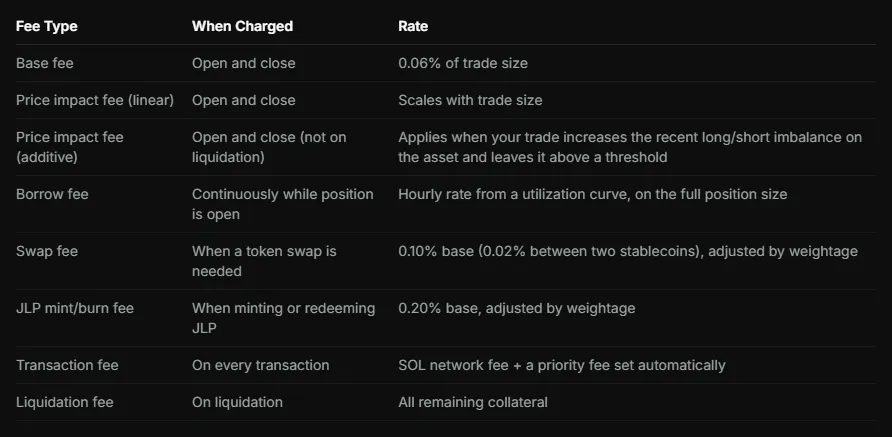
Jupiter Perps runs two kinds of markets with different fee models (see our Jupiter perps section):
| Cost | SOL, ETH and wBTC (JLP markets) | Beta markets |
|---|---|---|
| Trading fee | 0.06% base on open and on close | 0.005% maker, 0.035% taker |
| Price impact fee | At least 0.01%; base plus impact capped at 0.50% | None |
| While open | Hourly borrow fee | Hourly funding, paid or received |
| Liquidation | All remaining collateral | 0.75% or 1% of position value, plus the taker fee |
Rates checked October 31, 2026 (Beta markets rechecked November 19, 2026), from Jupiter’s perps fees and Beta markets pages.
Fees are charged on position size, not collateral: $1,000 at 10x opens a $10,000 position. Leverage magnifies losses, and a position is liquidated if the price moves far enough against you. Our leverage and liquidation guide explains the maths.
SOL, ETH and wBTC: base fee, price impact and borrow
- Base fee: 0.06% to open and 0.06% to close, for market and limit orders alike.
- Price impact fee: rounded up to a whole basis point, so every trade pays at least 0.01%; at October 2026 parameters, a SOL trade pays 0.01% per started $375,000 or so of size. More applies only when your trade pushes the recent long/short imbalance past $1.5 million (SOL, ETH) or $750,000 (wBTC).
- Borrow fee: an hourly rate that rises with pool use, charged on the full position size and taken from your collateral. It moves your liquidation price closer the longer you hold.
- Swap fee: paying with a token other than the collateral adds 0.1% base, or 0.02% between stablecoins, adjusted by pool weights.
- Network: the Solana fee plus an automatic priority fee; the app recommends keeping 0.03 SOL.
Of the fees on these markets, 75% go to JLP holders and 25% to Jupiter, per the JLP docs.
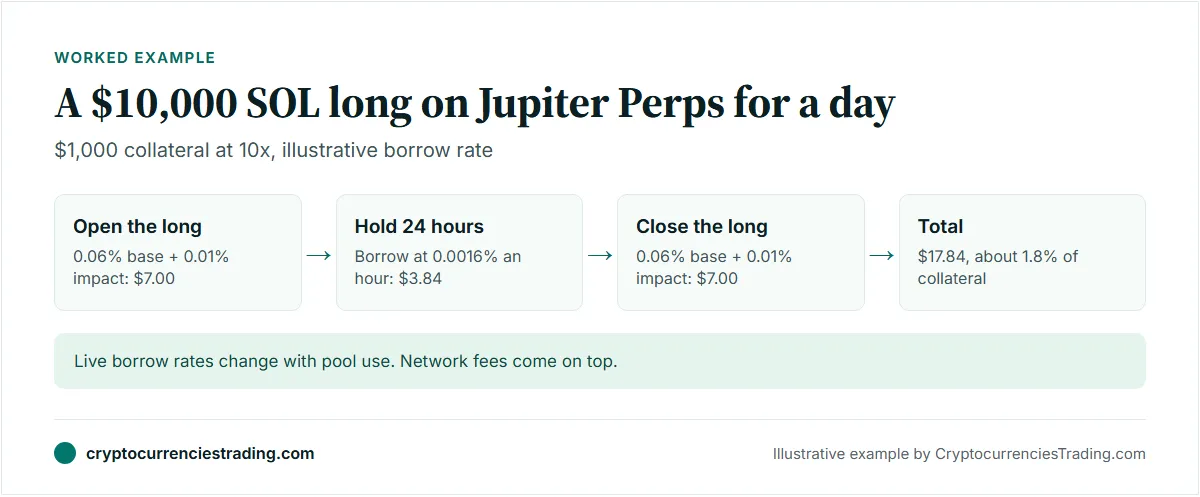
Worked example: a $10,000 SOL long held for a day
You open a $10,000 SOL long with $1,000 of collateral at 10x and close it 24 hours later. Assume neither trade pushes the imbalance past the threshold, and use Jupiter’s illustrative borrow rate of 0.0016% an hour.
- Open: 0.06% base ($6.00) plus 0.01% price impact ($1.00) = $7.00.
- Hold: $10,000 × 0.0016% × 24 hours = $3.84.
- Close: another $6.00 plus $1.00 = $7.00.
- Total: $17.84, about 1.8% of your collateral, plus network fees.
Held for a week at the same rate, borrow alone would be $26.88. The live rate appears in the trade form.
Beta markets: maker, taker and funding
Beta markets (crypto markets such as JUP, HYPE, ZEC and NEAR, plus the stock perps SPCX and SKHYNIX) run on an order book with no base, price impact or borrow fee. Funding is paid hourly on your position value; when the rate is positive, longs pay shorts. See our funding rates guide.
A $10,000 position opened and closed with market orders pays $3.50 each way, $7.00 in total; with resting limit orders, $0.50 each way. A liquidation costs 0.75% of position value on the crypto markets and 1% on the stock perps, plus the taker fee; any collateral left is returned.
Tokenized stock trading costs
Jupiter’s tokenized stocks page lists no separate commission for stock tokens. You buy them with a Spot swap, so check the Platform Fee row in the quote.
The larger costs are in the price. Jupiter says stock tokens often trade at a premium to the share, and liquidity can be much lower outside US market hours, which means wider spreads and more price impact. The stock perps use the Beta fees above. Our tokenized stocks guide covers the issuers.
Deposit, bridge and card costs
Jupiter is self-custody, so there is no exchange deposit or withdrawal fee: you trade from your wallet, and sends carry no Jupiter fee.
- Universal Deposit delivers funds from other chains as USDC on Solana. Jupiter adds no fee, but the bridge provider, GUM, takes the higher of $0.30 and 0.02% for stablecoins or 0.1% for other tokens such as ETH. The deposit panel’s Fees row shows the minimum, From $0.30, with the rates in a tooltip. Source-network gas is extra. $1,000 of USDC from Base pays the $0.30 minimum.
- Card purchases run through Onramper’s processors, whose fees vary by region and payment method; Jupiter adds none.
See our USDC bridging guide.
How to pay less on Jupiter
- Read the Platform Fee row, and avoid a token’s first 24 hours at 0.5%.
- Swap SOL and stablecoins on jup.ag rather than in the app: 0.02% against 0.1%.
- Use Manual mode for 0% commission if you can set slippage and priority fees yourself.
- Watch borrow fees on perps held for days, and use resting limit orders on Beta markets.
How Jupiter fees compare
Phantom charges 0.85% on most swaps, or $8.50 on $1,000, against $1.00 at Jupiter’s 0.1% rate for most pairs. Phantom’s perps cost 0.095% to open and again to close, so a $10,000 round trip is $19.00, against $14.00 on Jupiter’s SOL market before borrow, or $7.00 on a Beta market with market orders. Uniswap charges a 0% interface fee, so you pay only the pool fee, which each pool sets, plus network costs, much like Jupiter’s Manual mode. See our decentralized exchange and perp DEX rankings for more.
Jupiter’s terms bar users in the United States and several other countries; see where Jupiter is available.
Frequently asked questions
What are Jupiter’s swap fees?
In Ultra mode, 0% to 0.5% depending on the pair, with most pairs at 0.1%. Manual mode charges 0%. Solana network fees are extra.
What are Jupiter Perps fees?
On SOL, ETH and wBTC, 0.06% to open and 0.06% to close, plus a price impact fee of at least 0.01% and an hourly borrow fee. Beta markets charge 0.005% maker and 0.035% taker plus hourly funding.
Does Jupiter Exchange charge deposit or withdrawal fees?
No Jupiter fee. Cross-chain deposits through Universal Deposit pay a bridge fee of at least $0.30, plus gas on the source network.
Do I pay fees if a Jupiter swap fails?
Yes, the network fee. Jupiter’s FAQ says you pay gas on failed trades, and Ultra users may be compensated after more than three failed trades in a row.
