| Market | Maker | Taker | Notes |
|---|---|---|---|
| Spot | n/a | n/a | Swap fee is set by each pool and paid to liquidity providers: 0.3% on v2; 0.01%, 0.05%, 0.3% or 1% on v3; any tier on v4. Uniswap Labs interface fee: 0% since December 27, 2025. Network cost is extra. |
Uniswap fees on a swap come down to two costs: the fee of the pool your trade goes through, 0.3% in v2 pools and 0.01% to 1% in v3 pools, and the network cost, or gas, paid to the blockchain. Uniswap Labs has charged no interface fee in its web app and wallet since December 27, 2025, so a $1,000 swap through a v3 pool pays $0.10 to $10 in pool fees, and the costs to watch are gas on Ethereum mainnet and price impact on large or thinly traded swaps.
Below is every cost of a swap in Uniswap Labs’ apps, with the maths. For how Uniswap works overall, see our Uniswap review.
This is not financial advice. Prices can move while a swap is pending, and a confirmed blockchain transaction can’t be reversed.
Uniswap fees on one swap: what you pay
Before you confirm, the swap details list Fee, Network cost, Order routing, Price impact and Max slippage, according to Uniswap’s swap screen guide. Behind those lines:
- Pool fee: set by each pool, taken from the token you sell and paid to liquidity providers.
- Interface fee: 0% in Uniswap Labs’ apps.
- Network cost: gas in the network’s own token, non-refundable even if the swap fails.
- Price impact and slippage: not fees, but they decide how much you receive.
- Bridging fee on crosschain swaps, paid to the Across bridge.
Uniswap swap fee: the pool fee tiers
Every Uniswap pool has a fee tier, the share of each swap paid to its liquidity providers. Uniswap’s help center pages on fee tiers and the LP fee give the options: v2 pools charge 0.3%, v3 pools charge 0.01%, 0.05%, 0.3% or 1%, and v4 pools can use any tier.
The fee comes out of the token you sell. You don’t pick the pool: the router checks v2, v3 and v4 pools and can split your trade or hop through a third token when that returns more after fees and network costs. The Order routing line shows the path. Tokenized stocks, listed in the app since June 2026, work the same way, with no Uniswap Labs fee.
The protocol fee on v2 and v3 is part of the pool fee
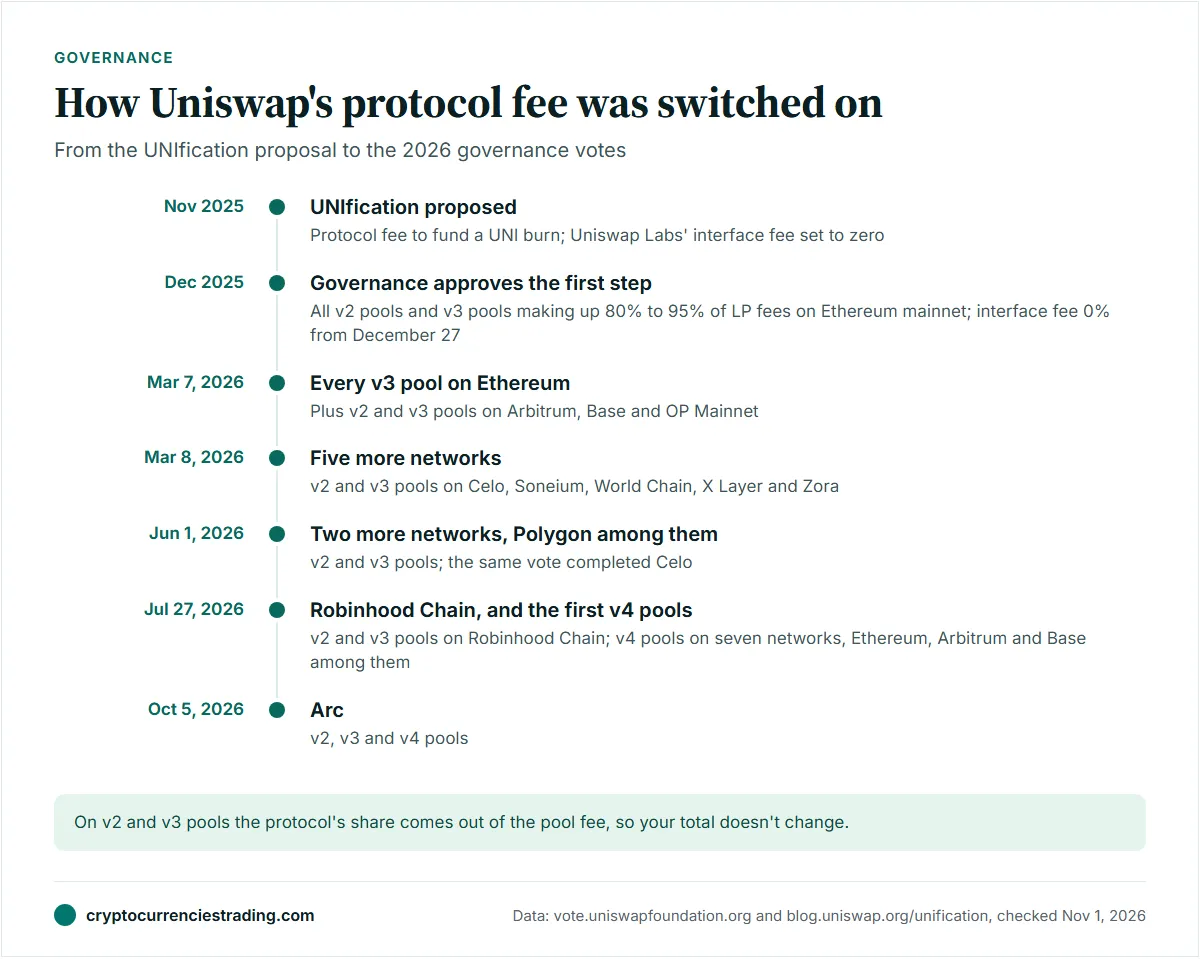
Uniswap governance has switched on a protocol fee that sends part of the pool fee to a UNI burn mechanism. The UNIfication proposal of November 10, 2025, which governance approved in December 2025, set the first step: all v2 pools and a set of v3 pools that make up 80% to 95% of LP fees on Ethereum mainnet. On v2 and v3 pools the protocol’s share comes out of the pool fee, so your total doesn’t change:
| Pool | You pay | To liquidity providers | Protocol fee |
|---|---|---|---|
| v2, all pools | 0.3% | 0.25% | 0.05% |
| v3, 0.01% tier | 0.01% | 0.0075% | 0.0025% |
| v3, 0.05% tier | 0.05% | 0.0375% | 0.0125% |
| v3, 0.3% tier | 0.3% | 0.25% | 0.05% |
| v3, 1% tier | 1% | 0.8334% | 0.1666% |
Split from Uniswap’s help center, checked November 1, 2026. That page was last updated before most of the 2026 votes below, and it still says only some v3 pools carry the protocol fee.
Governance has since gone further. Votes executed on the Uniswap Foundation’s governance portal in 2026 turned the fee on for:
- every v3 pool on Ethereum, and v2 and v3 pools on Arbitrum, Base and OP Mainnet (March 7);
- v2 and v3 pools on Celo, Soneium, World Chain, X Layer and Zora (March 8), and on BNB Chain and Polygon in a June 1 vote that also completed Celo;
- v2 and v3 pools on Robinhood Chain (July 27), and v4 pools on Ethereum, Arbitrum, Base, BNB Chain, Polygon, Optimism and Robinhood Chain (July 27);
- v2, v3 and v4 pools on Arc (October 5).
The v4 vote left Celo, Soneium, World Chain, X Layer and Zora for a later proposal, which had not appeared on the portal by November 1, 2026. The v4 proposals set the protocol fee as a share of each pool’s LP fee, but they don’t say whether it comes out of that fee or is added to what you pay.
Uniswap interface fee: 0% since December 27, 2025
Uniswap Labs’ fees page lists the interface fee for its web app and wallet as 0% and says it has charged none since December 27, 2025. The UNIfication post set out that change, along with zero fees on Labs’ API.
Before that date, Uniswap Labs charged an interface fee in its apps, so older swaps in your history may show one. Its current pages don’t give the old rates. If a fee is ever charged again, the help center says it is paid in the output token and shown on the Fee line.
The 0% covers only Uniswap Labs’ own apps. Other wallets and aggregators that route to Uniswap pools set their own fees; MetaMask, for example, includes 0.875% in every swap quote.
Uniswap gas fees by network
The network cost goes to the blockchain’s validators, not to Uniswap Labs, and each network takes its own token. Uniswap’s network cost page says it is non-refundable even when a transaction fails.
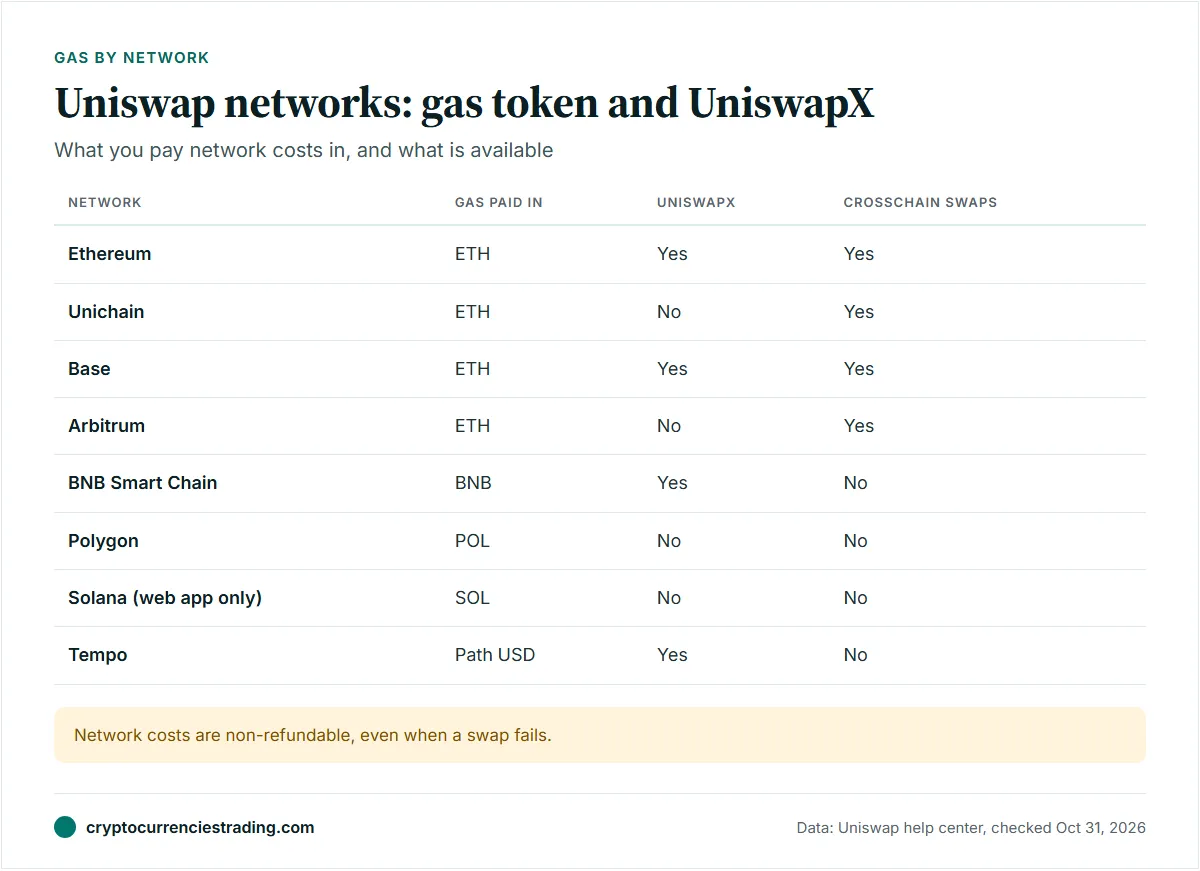
On Ethereum mainnet, gas rises and falls with traffic, and Uniswap’s network cost guide points to Etherscan’s gas tracker for live prices and averages by time of day. Its Layer 2 explainer says users of Layer 2 networks, such as Base, Arbitrum and Unichain, can typically expect lower network fees. Uniswap publishes no typical amounts, so read the Network cost line before you confirm.
Extra gas comes from:
- Token approvals, a separate transaction the first time you trade a token.
- Failed swaps, which still pay their network cost.
- Keeping gas back: you may not be able to swap your whole ETH, BNB or POL balance.
On Unichain, the network cost page, updated in October 2026, says Uniswap Labs receives a portion of network costs. The UNIfication proposal, which governance approved in December 2025, says all Unichain sequencer fees, after L1 data costs and 15% to Optimism, go to the UNI burn. The two official sources don’t match, and neither changes what you pay.
The Uniswap Wallet, its embedded wallet and the extension let you set custom network costs: too low and the swap may stall or fail, too high and you overpay. Our guide to network fees explains gas in more depth.
UniswapX: swaps where the filler pays the gas
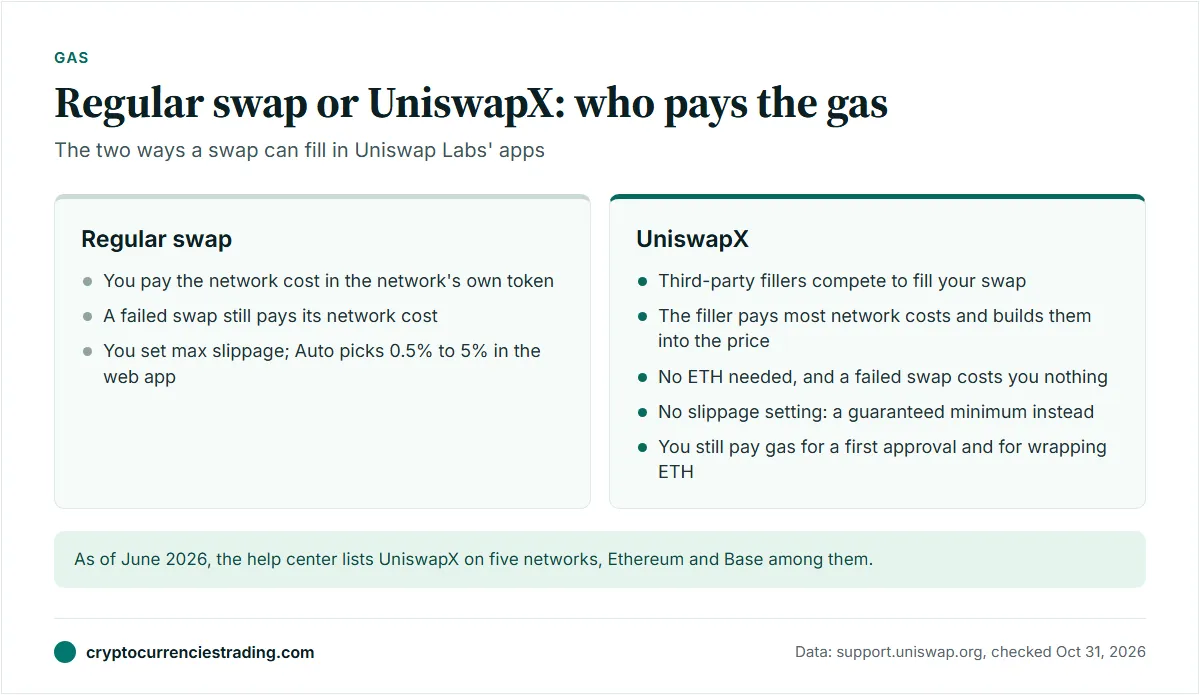
UniswapX auctions your swap to third-party fillers. As of June 2026, the help center lists it on Ethereum, Avalanche, Base, BNB Smart Chain and Tempo. The filler pays most network costs and factors them into the swap price, so you don’t need ETH to swap and a failed swap costs you nothing. You still pay gas for a token’s first approval and for wrapping a native token such as ETH.
Slippage can’t be adjusted on UniswapX; the screen shows a guaranteed minimum instead. Limit orders, on Ethereum mainnet only, also use UniswapX fillers and have no slippage: they fill at your price or stay open until cancelled or expired.
Price impact and slippage settings
Uniswap’s glossary separates two things. Price impact is the price change caused by your own trade, larger when your swap is big next to the pool. Slippage is the gap between the price you expect and what you get, because the market moved in between.
Max slippage is the limit you accept. The web app’s Auto setting picks 0.5% to 5% based on network cost and swap size, and the wallet’s picks 0.5% to 5.5%, with custom slippage capped at 20%. Too low and the swap may fail, still paying gas. Too high and you may get fewer tokens: up to 25% fewer at a 25% setting, the help center warns. On Ethereum mainnet, the wallet’s swap protection, on by default, sends swaps to a private transaction pool to reduce sandwich attacks.
Worked examples
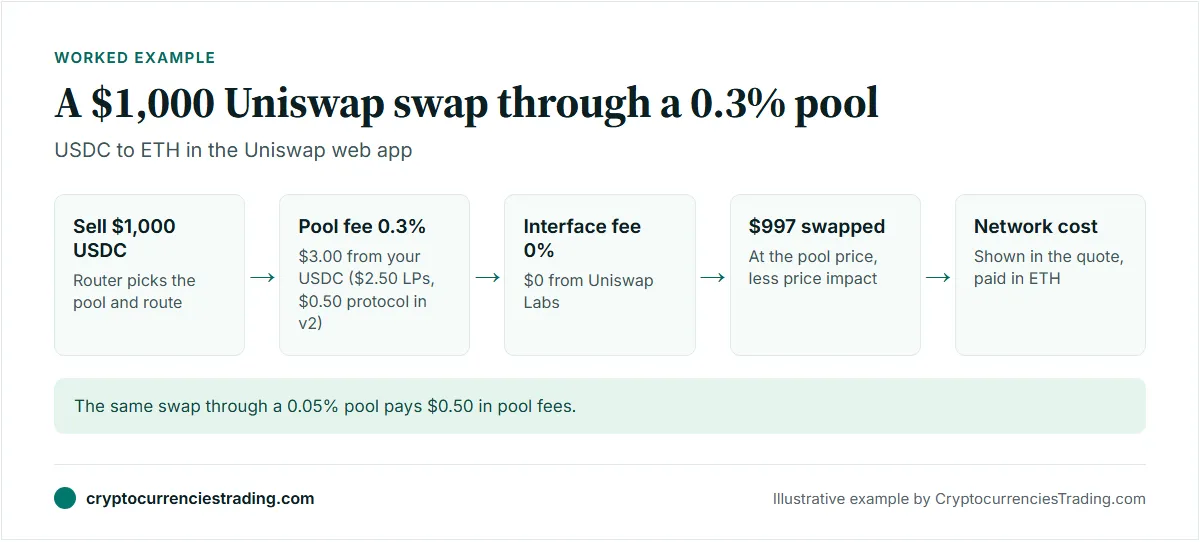
A $1,000 swap: 0.3% pool vs 0.05% pool
You swap $1,000 of USDC for ETH.
- Pool fee in a 0.3% pool: $1,000 × 0.3% = $3.00, taken from your USDC. In a v2 pool, $2.50 goes to liquidity providers and $0.50 to the protocol fee; you pay $3.00 either way.
- Interface fee: $0.
- What gets swapped: $997 of USDC at the pool price, less any price impact.
- Network cost: shown in the quote and paid in ETH on Ethereum or Base, unless a UniswapX filler covers it.
Through a 0.05% pool, the pool fee is $0.50; through a 1% pool, $10.00.
A $10,000 swap: what max slippage allows
You sell $10,000 of USDC for ETH through a 0.05% pool, and the quote shows 2.5 ETH.
- Pool fee: $10,000 × 0.05% = $5.00.
- At 0.5% max slippage, the minimum you accept is 2.5 × 99.5% = 2.4875 ETH. If the price moves further first, the swap fails and still pays its network cost.
- At 5% max slippage, the minimum drops to 2.375 ETH: up to 0.125 ETH less, about $500 at the quoted price.
- Through UniswapX on Ethereum, you get a guaranteed minimum instead of a slippage setting, and the filler pays most of the gas.
Crosschain swaps and card purchases
A crosschain swap bridges and swaps in one step, such as ETH on Ethereum to USDC on Base. It adds a bridging fee paid to Across on top of network costs, and all fees are in the quote before you confirm. The help center lists 14 networks for crosschain swaps, Ethereum, Base and Arbitrum among them, but not BNB Smart Chain, Polygon or Solana. Our guide to bridging USDC covers bridges in general.
Card and bank purchases are completed on an outside provider’s site, such as MoonPay, Coinbase, Robinhood, Transak or Stripe. Uniswap’s buy guide lists no fee schedule for them, so read the provider’s quote. Our card vs bank transfer guide compares the two.
How to pay less on Uniswap
- Swap on a Layer 2 such as Base, Arbitrum or Unichain when your tokens are already there.
- Use UniswapX where it runs, so you don’t pay gas directly.
- Check the pool fee: a 0.05% pool costs a sixth of a 0.3% pool.
- Keep max slippage tight, and watch price impact on large swaps.
- Swap when Ethereum is quiet; gas rises with traffic.
- Use Uniswap Labs’ own apps for the 0% interface fee.
How Uniswap fees compare
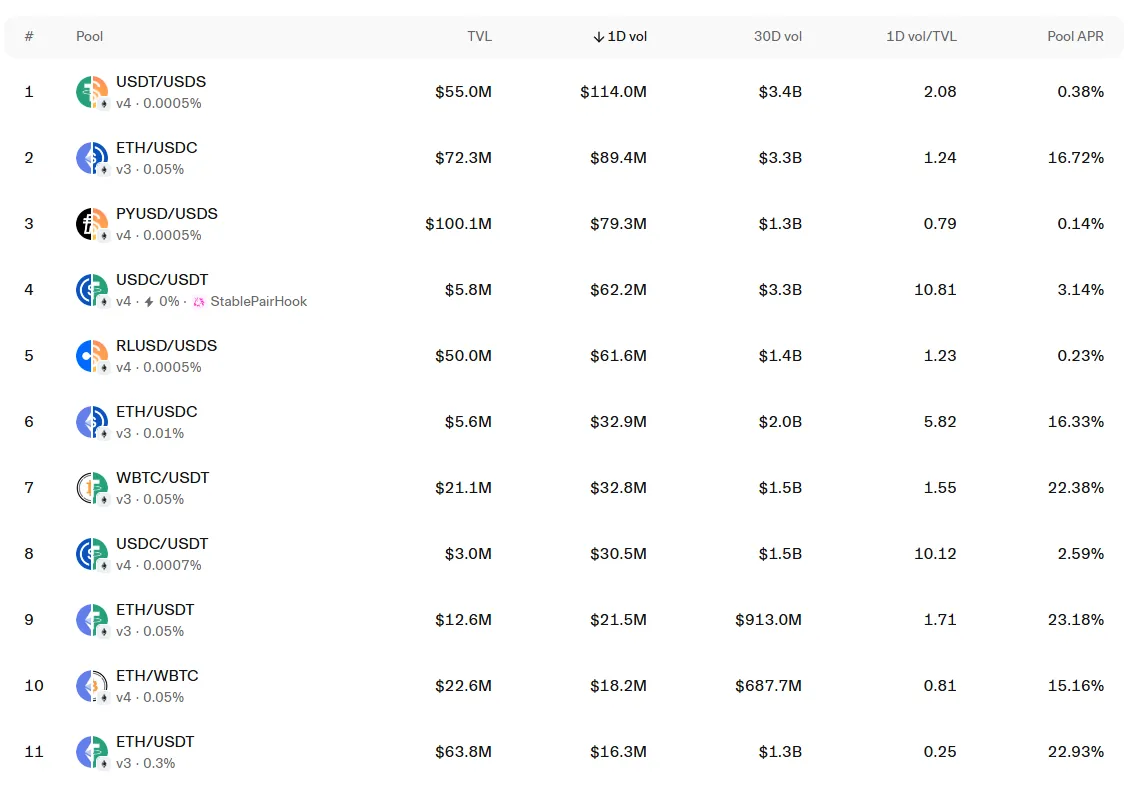
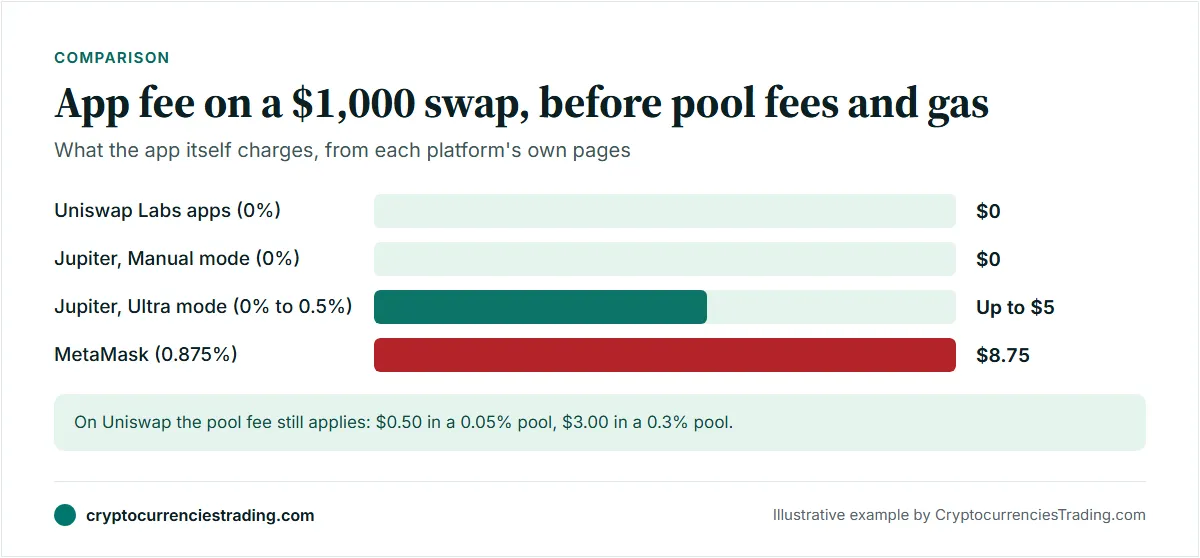
On a $1,000 swap, Uniswap Labs adds nothing, so you pay the pool fee ($0.50 in a 0.05% pool, $3.00 in a 0.3% pool) plus gas. Jupiter, the Solana swap router, charges a commission of 0% to 0.5% in its default Ultra mode depending on the pair, up to $5 on $1,000, and 0% in Manual mode, with Solana network fees on top. MetaMask includes a 0.875% fee in every swap quote, $8.75 on $1,000, plus the network fee. Our decentralized exchange ranking compares more venues, and CEX vs DEX explains the difference.
Frequently asked questions
How much does Uniswap charge per swap?
Uniswap Labs charges 0% in its web app and wallet. You pay the pool fee, 0.3% on v2 and 0.01% to 1% on v3 (v4 pools can set any rate), plus the network cost. On $1,000 through a v3 pool, that is $0.10 to $10 before gas.
What is the Uniswap interface fee?
A fee Uniswap Labs used to charge in its own apps. It has been 0% since December 27, 2025.
Why are Uniswap gas fees so high?
Ethereum mainnet gas rises with traffic and goes to validators, not Uniswap Labs. Layer 2 networks typically cost less, and on UniswapX the filler pays most of the gas.
Do I pay gas if my Uniswap swap fails?
On a regular swap, yes: the network cost is non-refundable. On a UniswapX swap, a failed swap costs you nothing.
Does the Uniswap Wallet charge fees?
Uniswap Labs lists 0% for its wallet. You still pay pool fees and network costs, and outside providers price card purchases.
