Moving crypto off an exchange can involve three separate costs: the blockchain’s network fee (gas), the exchange’s withdrawal fee, and the spread or deposit fee you paid when you bought. The costliest mistake is none of these. It is sending on a network the other side doesn’t support, which some exchanges will fix for a fee and others cannot fix at all.
This guide covers each cost, why fees differ by network, how to choose one, and what the big exchanges can recover.
This is not financial advice. Crypto transfers can’t be reversed, so a wrong network or address can mean a permanent loss.
Three costs people mix up
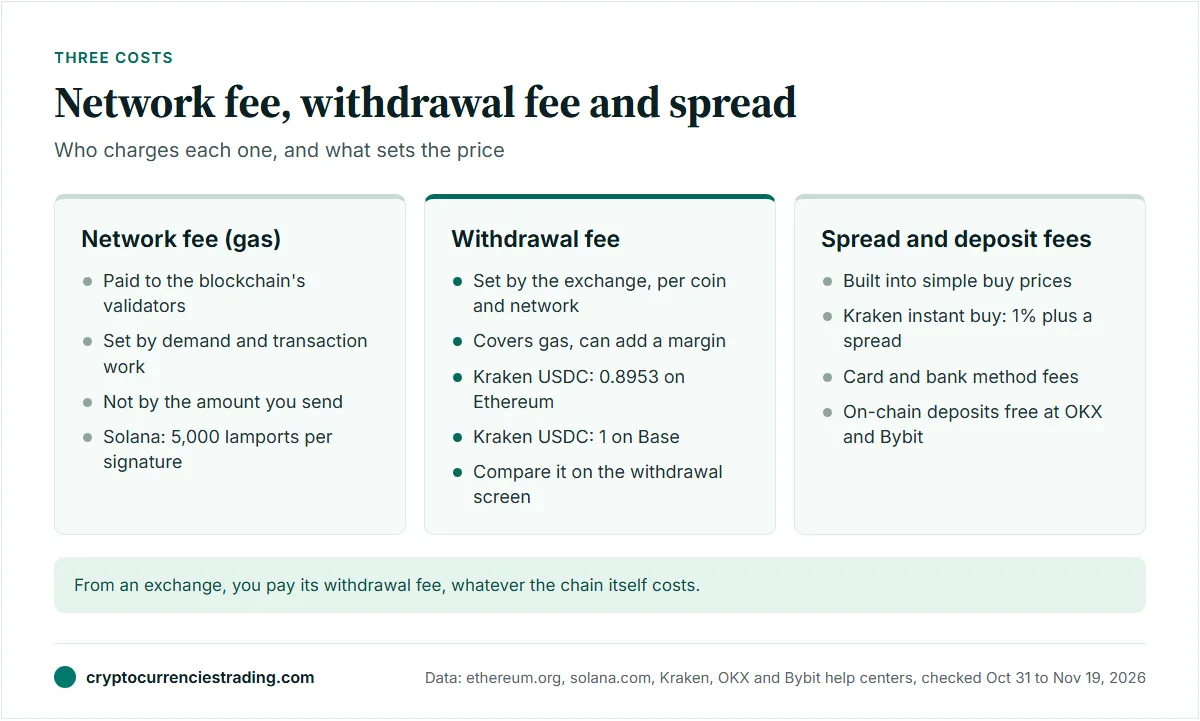
The network fee (gas) is what the blockchain charges to process a transaction. It goes to the validators who run the network, not to your exchange or wallet. It depends on how busy the network is and how much work the transaction needs, not on the amount. Sending $50 or $50,000 of the same token costs about the same.
The withdrawal fee is what an exchange charges to send your crypto out. It usually covers the network fee the exchange pays, but the exchange sets it:
- OKX says its fee includes a share for operating costs and can differ from the live on-chain cost. It is charged once per withdrawal, whatever the amount.
- Bybit charges a fixed fee per coin and network for any amount, and nothing for internal transfers to another Bybit account.
- Coinbase charges its estimate of the network fee. USDT withdrawals add a 0.01% processing fee capped at 20 USDT.
- Kraken publishes a fee table per asset and network. On November 19, 2026 it listed USDC withdrawals at 0.8953 USDC on Ethereum, 1 USDC on Base and 0.7526 USDC on Solana.
Ethereum mainnet is usually the priciest of those networks to use directly, yet a Kraken USDC withdrawal cost less there than on Base. These fees also move: on October 31 the same table listed 0.598 USDC on Ethereum and 0.9722 USDC on Solana. Compare fees on the withdrawal screen, network by network.
Spreads and deposit fees come before the money reaches a blockchain. Coinbase builds a spread into simple buys, but not into Coinbase Advanced. Kraken’s instant buy charges a 1% fee plus a spread. Card and bank deposits can add a payment-method fee, while on-chain crypto deposits are free at OKX and Bybit. See card vs bank transfer and maker vs taker fees for more.
Why network fees differ: Ethereum, layer 2s and Solana
Each blockchain prices its block space differently. Dollar costs move with token prices and demand, so check the fee your wallet or exchange shows before you confirm.
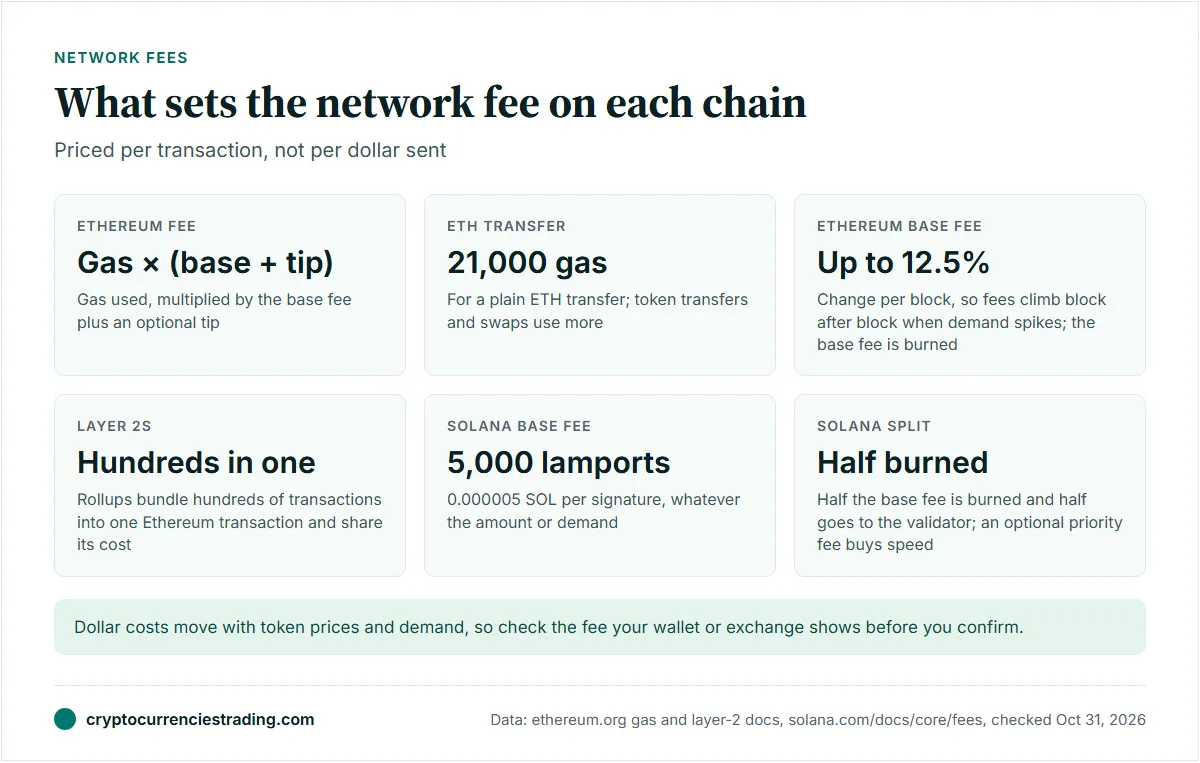
Ethereum mainnet charges in gas. Per ethereum.org, the fee is the gas used multiplied by the base fee plus an optional tip. A plain ETH transfer uses 21,000 gas; token transfers and swaps use more. The base fee is burned and can rise or fall by up to 12.5% per block, so when demand spikes, fees climb block after block.
Layer-2 networks such as Arbitrum, Base and Optimism are separate blockchains that settle on Ethereum. Rollups bundle hundreds of transactions into one Ethereum transaction and share its cost, which is why a layer-2 transfer usually costs a fraction of the same transfer on mainnet. Most use ETH for gas, so you need a little ETH on that specific network.
Solana charges a base fee of 5,000 lamports (0.000005 SOL) per signature, according to its documentation. An optional priority fee helps a transaction get scheduled sooner when the network is busy. Half the base fee is burned and half goes to the validator. The base fee doesn’t change with the amount or with demand; only the priority fee does.
Because network fees are roughly flat per transaction, they hurt most on small transfers.
How to choose a network when withdrawing
- Start at the receiving end. Open the deposit or receive screen where the money is going, pick the asset and note which networks it accepts. Coinbase says the same network must be used on both ends, with an exception for some assets on Polygon and Ethereum.
- Pick a network both sides list, even if it isn’t the cheapest.
- Compare the fee and the minimum for each shared network. Kraken’s withdrawal minimums include the fee, and OKX does not credit deposits below its stated minimum.
- Check the token version. Kraken, for example, supports both native USDC and bridged USDC.e on Polygon and Arbitrum. Send the version the receiving side lists.
- Plan the next step. To move the funds again you need gas on that network: ETH on Arbitrum or Base, SOL on Solana. Funding a perp DEX? Check its deposit chain in how to fund a perp DEX, and remember that leveraged positions can be liquidated.
Our exchange-to-wallet guide walks through a full withdrawal, and how to bridge USDC covers moving funds between networks afterwards.
Memos and destination tags
Some coins need a second field next to the address. Exchanges often use one shared deposit address for these coins and tell customers apart by a memo or tag. Coinbase’s memo list includes XRP (a destination tag), Stellar (XLM), Cosmos (ATOM), EOS and Hedera (HBAR), among others.
- Sending to an exchange: copy both the address and the memo from its deposit screen. Coinbase warns that a missing or wrong memo can delay the deposit or lose it.
- Sending to your own wallet: Coinbase says a memo generally isn’t needed, because a self-custody address belongs only to you.
If you forget it, a large exchange can often help, for a fee:
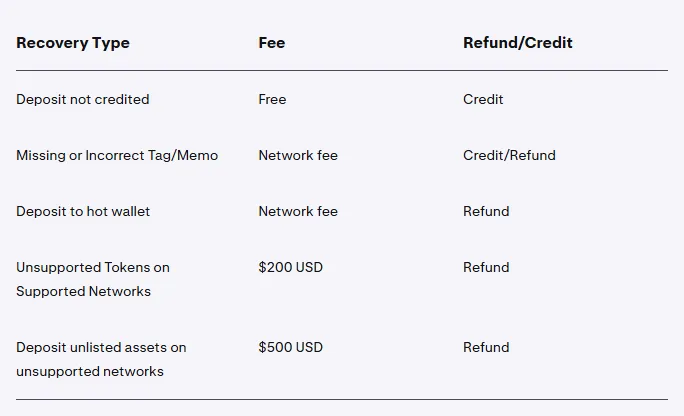
- Kraken charges the network fee to recover a deposit with a missing or incorrect memo.
- Bybit has a self-service appeal for missing memos. The handling fee is five times its standard withdrawal fee for that coin, transactions older than 180 days are not processed, and the refund goes back to the sending address.
- OKX asks you to contact support through its chatbot with the coin, amount, correct and incorrect tag, and transaction hash.
- Coinbase says to contact its support with the transaction hash if you sent a wrong tag to Coinbase.
What happens after you send on the wrong network
A blockchain doesn’t check whether the recipient can use what you send. Coinbase puts it plainly: it can’t reject deposits of unsupported crypto, and blockchains don’t require recipients to accept them. Whether you get the money back depends on who controls the receiving address on the chain where the funds landed.
Same address, different EVM chain
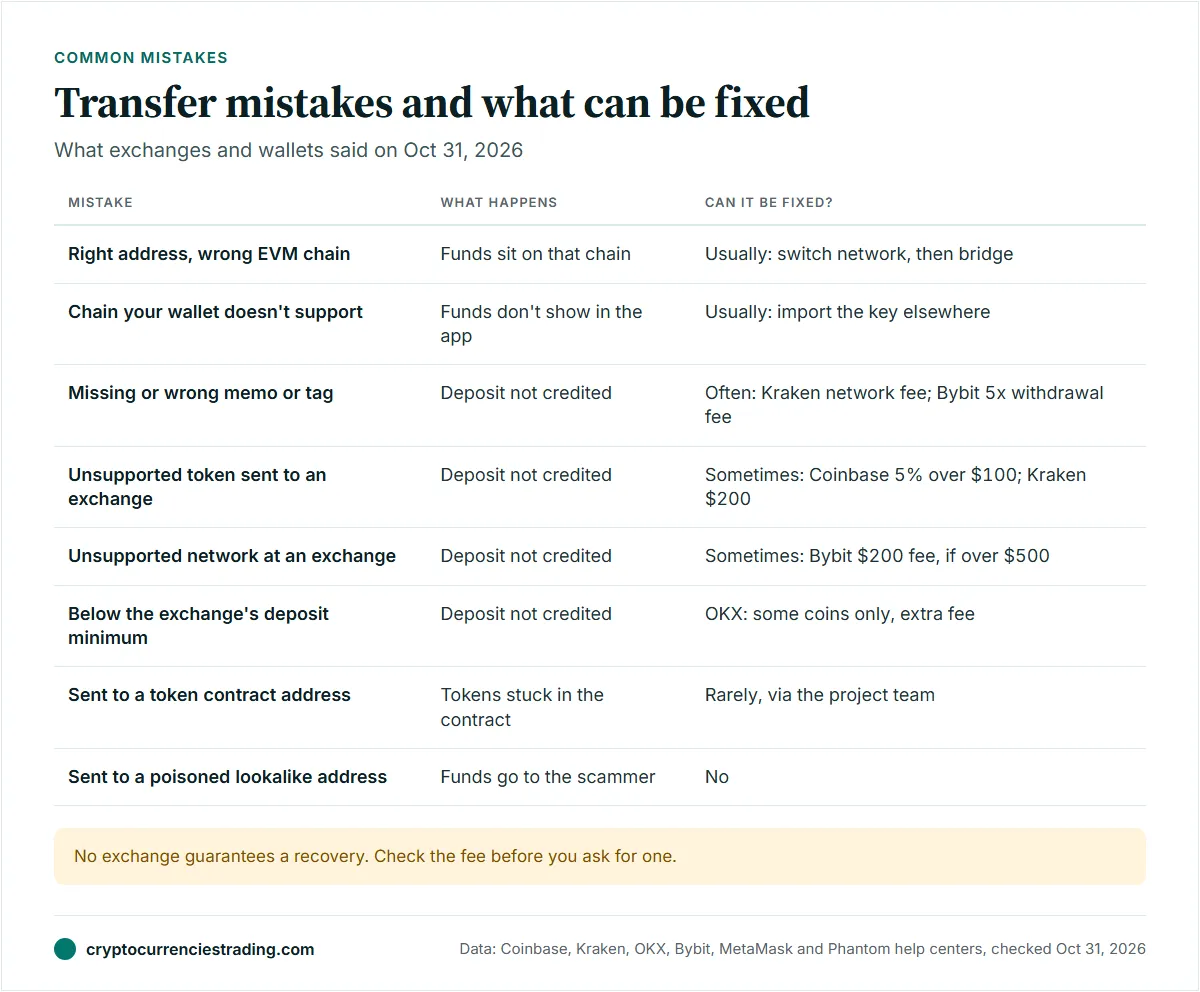
On Ethereum-compatible (EVM) chains, your recovery phrase gives you the same address everywhere. MetaMask’s help center says tokens sent to your address on the wrong EVM network are not lost: switch the wallet to that network, then bridge them where you wanted them. You will need a little of that chain’s gas token.
If your wallet doesn’t support that chain, you can still reach the funds. Phantom does not support Arbitrum, Optimism, Avalanche, Unichain or Linea, among others, and its help center describes the fix: export the receiving account’s private key, import it into an EVM wallet that supports the network, then move the tokens through an exchange to a network Phantom supports. Phantom then suggests moving them to a new account, since the key was exposed to another app.
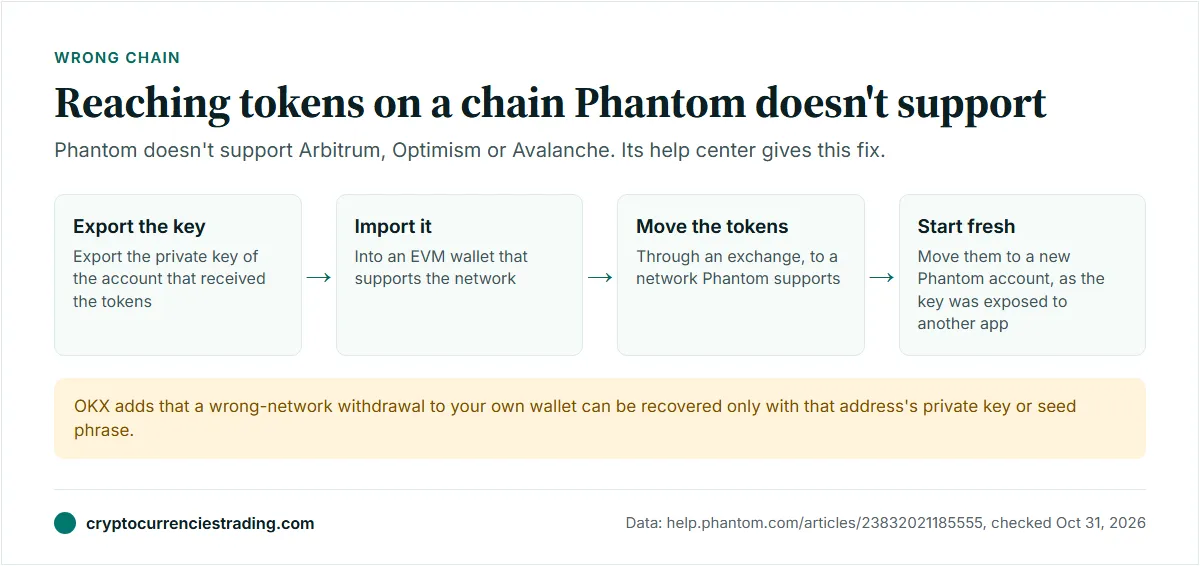
OKX adds that a wrong-network withdrawal to your own wallet can be recovered only with that address’s private key or seed phrase. If the funds went to an address on a non-EVM network, MetaMask says they are likely gone for good.
Unsupported network or token sent to an exchange
Policies differ most here. What each help center said on October 31, 2026:
- Coinbase says it can’t recover funds sent on an incorrect network. For unsupported assets sent to a Coinbase address, its asset recovery service can return certain assets on certain networks to a self-custody wallet. It works only in a web browser and charges a network fee, paid from your ETH balance, plus 5% of any amount over $100.
- Kraken lists recovery fees of $200 for unsupported tokens on supported networks and $500 for unlisted assets on unsupported networks. It confirms the fee before starting and says not every case can be recovered.
- OKX may show an unsupported token under Untradable assets. If a Withdraw button appears, you can send it to a wallet that supports the same coin, network and token contract. Its help page lists only the network fee for this, with no recovery fee. If not, file a feedback form; OKX says recovery isn’t guaranteed.
- Bybit lets you withdraw the deposit yourself if it shows on your Pending Asset page, for a USDT handling fee that varies by asset. Otherwise a manual request is accepted only for deposits worth more than $500, costs a fixed $200 and takes 3 to 5 working days to review. Deposits on KCC, OEC, Ronin and Cronos are not eligible.
Do the arithmetic first. A $300 mistake is too small for Bybit’s manual route, and a $200 or $500 fee at Kraken would take most of a small deposit.
Tokens sent to a token contract address
A common slip is pasting a token’s own contract address, such as the USDC contract, as the recipient. The transaction succeeds, but the tokens sit inside a contract that usually can’t send them back. MetaMask says there is no guarantee of recovery, and the project team can help only in some cases. Treat it as lost unless the project says otherwise.
Address poisoning
Address poisoning targets copy and paste. A scammer creates an address that starts and ends with the same characters as one you use, then sends you a tiny or zero-value transfer so it appears in your history. Next time you copy “your” address from recent activity, you copy theirs. MetaMask says funds lost this way are irretrievable.
To avoid it:
- Copy addresses from the source, such as the exchange’s deposit screen, never from transaction history.
- Check the middle characters, not only the first and last few.
- Use an address book or allowlist. Coinbase, OKX and Bybit offer withdrawal allowlists, and Kraken asks for email confirmation of new withdrawal addresses.
- Take wallet warnings seriously. MetaMask shows a blocking warning when you send to an address that closely resembles one you have used before.
Our self-custody wallet guide covers this and other wallet scams.
A pre-send checklist
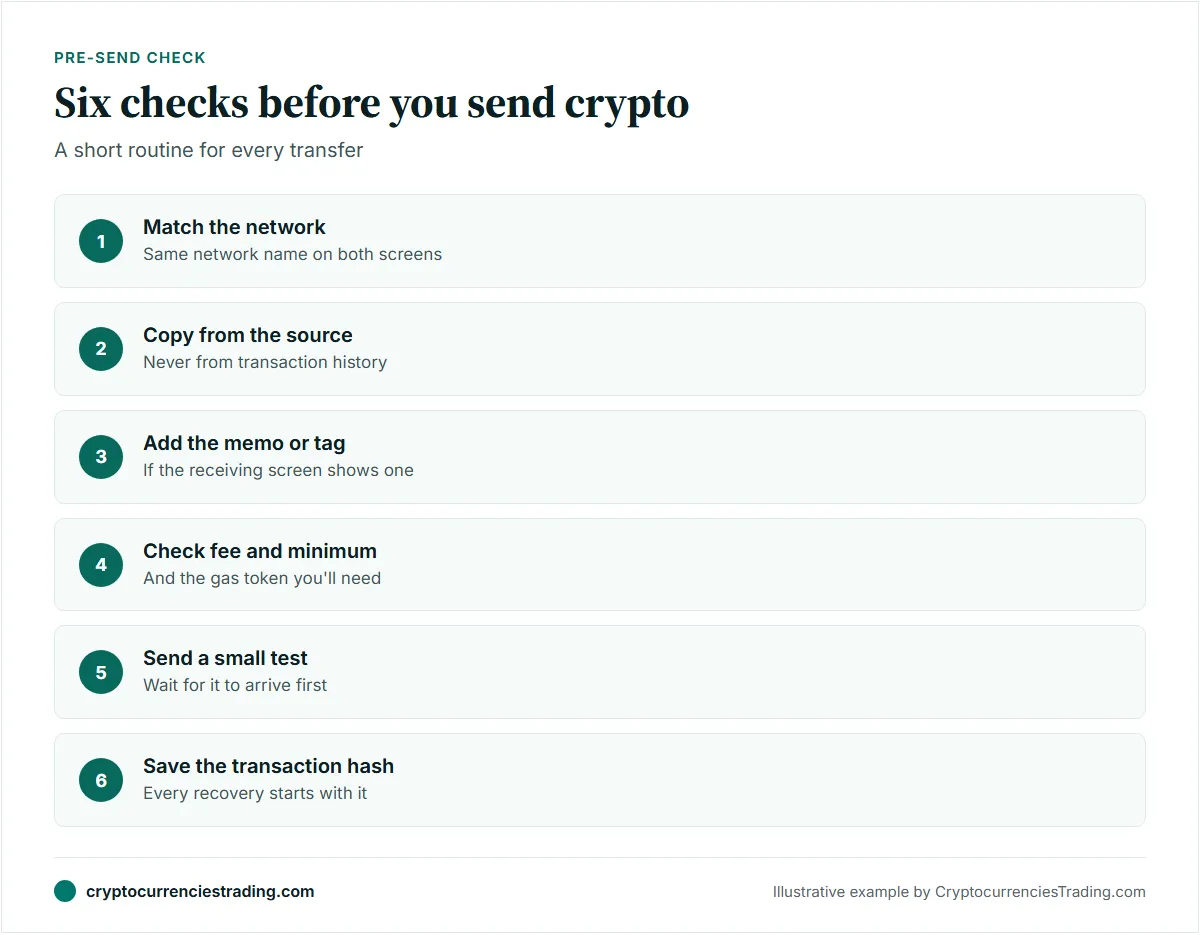
- Match the network by name on both screens.
- Copy the address from the receiving app and check its first, middle and last characters.
- Add the memo or tag if the receiving screen shows one.
- Check the fee, the minimum and the gas token you will need on arrival.
- Send a small test and wait for it to arrive. A second withdrawal fee is cheap insurance on a large amount.
- Save the transaction hash. Every recovery process above starts with it.
For the wider picture, see how to move money in and out of crypto and how to cash out crypto. Our best crypto exchanges ranking compares the exchanges mentioned here.
Frequently asked questions
Why is my exchange’s withdrawal fee higher than the gas on a block explorer?
Because they are different fees. The exchange sets its own withdrawal fee, which can include a margin for its costs and is updated periodically rather than block by block. Compare networks on the withdrawal screen to find the cheapest route.
Can I get crypto back if I sent it on the wrong network?
Often, if you control the receiving address: switch networks, or import your key into a wallet that supports that chain. If you sent it to an exchange, Coinbase, Kraken and Bybit have paid recovery routes for some cases, and none of them guarantees success.
Is withdrawing on Solana or a layer 2 always cheaper?
Not from an exchange. On-chain, Solana and layer 2s usually cost far less than Ethereum mainnet, but you pay the exchange’s withdrawal fee. On November 19, 2026, Kraken charged more to withdraw USDC on Base, a layer 2, than on Ethereum, though Solana was the cheapest of the three.
Sources
The figures in this guide come from these pages, checked on October 31, 2026.
- ethereum.org/en/developers/docs/gas
- ethereum.org/en/layer-2/learn
- solana.com/docs/core/fees
- help.coinbase.com/en/coinbase/trading-and-funding/pricing-and-fees/fees
- help.coinbase.com/en/coinbase/trading-and-funding/sending-or-receiving-cryptocurrency/assets-on-multiple-networks
- help.coinbase.com/en/coinbase/trading-and-funding/sending-or-receiving-cryptocurrency/recover-unsupported-crypto
- help.coinbase.com/en/coinbase/trading-and-funding/sending-or-receiving-cryptocurrency/unsupported-crypto-deposits
- help.coinbase.com/en/coinbase/trading-and-funding/sending-or-receiving-cryptocurrency/destination-tag-memo-faq
- support.kraken.com/articles/crypto-assets-deposit-recovery
- support.kraken.com/articles/360000767986-cryptocurrency-withdrawal-fees-and-minimums
- okx.com/help/do-i-need-to-pay-fees-for-deposit-and-withdrawal
- okx.com/help/why-has-not-my-deposit-been-credited
- okx.com/help/what-should-i-do-if-i-forget-to-fill-in-tag-memo
- okx.com/help/what-should-i-do-if-i-mistakenly-withdraw-crypto-via-the-wrong-network
- okx.com/help/what-should-i-do-if-i-accidentally-deposit-crypto-that-okx-does-not-support
- bybit.com/en/help-center/article/Bybit-Fees-You-Need-to-Know
- bybit.com/en/help-center/article/How-Recover-Missing-Deposit-Self-Service
- bybit.com/en/help-center/article/Unsupported-Deposit-Recovery-Procedure-Rules
- support.metamask.io/manage-crypto/move-crypto/send/funds-sent-on-wrong-network
- support.metamask.io/stay-safe/protect-yourself/wallet-and-hardware/address-poisoning-scams
- help.phantom.com/articles/23832021185555
- help.phantom.com/articles/supported-networks-chains-in-phantom-41372840389651
