To cash out crypto, sell it for your local currency on a centralized exchange, then withdraw the cash to a bank account in your own name by SEPA, ACH, wire, Faster Payments or Pix, depending on where you live. If the crypto sits in a self-custody wallet, first send it to that exchange on a network the exchange supports.
At the exchanges we checked, a SEPA or ACH withdrawal costs between nothing and 1 euro, wires cost $4 to $30, and most transfers arrive within minutes to five business days. The bigger risks are sending on the wrong network, failing an identity check at the last step, and the scammers who target people with money to move.
This is not financial advice. Prices can move while you cash out, and crypto sent to the wrong network or address is often lost for good.
Our guide to moving money in and out of crypto covers the full picture.
The main route: sell on an exchange, then withdraw
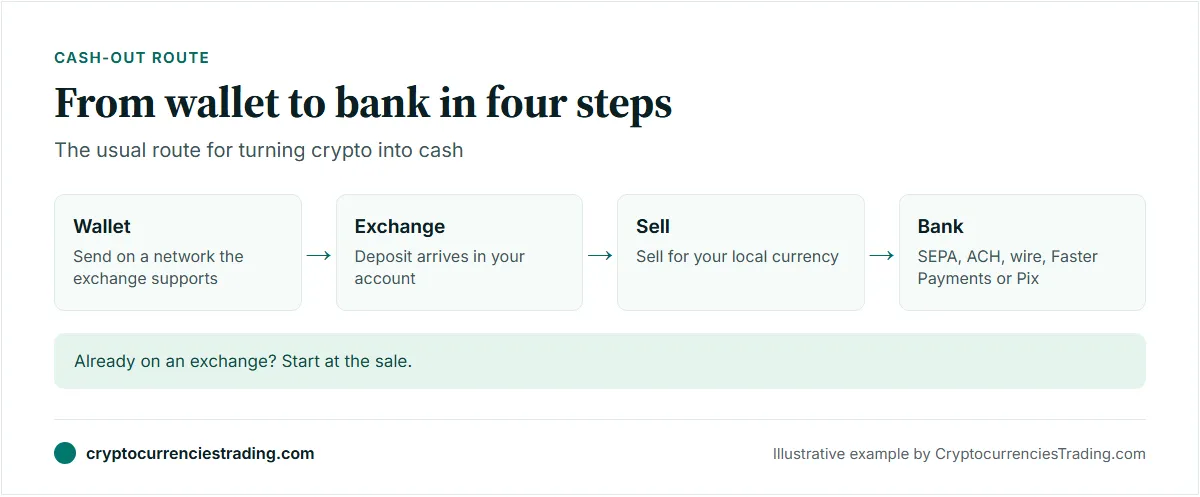
- Use a verified exchange account that offers bank withdrawals in your currency. Our country guides for the US, UK and Europe show which exchanges serve you.
- Get the crypto onto the exchange, if it isn’t there already. The wallet section below shows how.
- Sell it for cash. The simple sell screen usually builds a spread into the price. Kraken’s instant sell in its app costs 1% plus a spread, while the Kraken Pro order book starts at 0.40% maker and 0.80% taker. See maker vs taker fees.
- Withdraw to your bank. Open Withdraw, pick the currency and method, check the fee and arrival estimate on the preview screen, and confirm with two-factor authentication.
- Check the money arrived and save the confirmation for your records.
Bank withdrawal methods and fees
Which method you get depends on your country and currency:
- SEPA for euros. Instant SEPA is near-instant where both sides support it.
- ACH for US dollars to US banks.
- Wires: FedWire inside the US, SWIFT internationally.
- Faster Payments (FPS) for UK pounds.
- Pix for Brazilian reais.
- Coinbase. US customers cash out by ACH (1 to 5 business days) or wire (1 to 3 business days, usually same day if sent before 1:00 pm PT), and PayPal, debit card and instant bank cashouts are listed as instant. SEPA in the EU and Faster Payments in the UK take 1 to 3 business days, and Pix in Brazil is instant. An outgoing US wire costs $25 and SEPA transfers in euros are free. For ACH, PayPal, Faster Payments and instant cashouts, Coinbase publishes no rate, and the preview shows the fee before you confirm. Our Coinbase withdrawal guide has the steps.
- Kraken. Its withdrawal fee table lists ACH as free (0 to 2 business days), FedWire at $4 (0 to 1 business day) and SEPA at 1 EUR (0 to 5 business days). Instant SEPA costs 0.90 to 1 EUR depending on the provider, Faster Payments 1.95 GBP and Pix 0.50%, and all three are near-instant. In the US, RTP is near-instant too, if your bank supports it, and costs 1.50% with a 50 USD maximum.
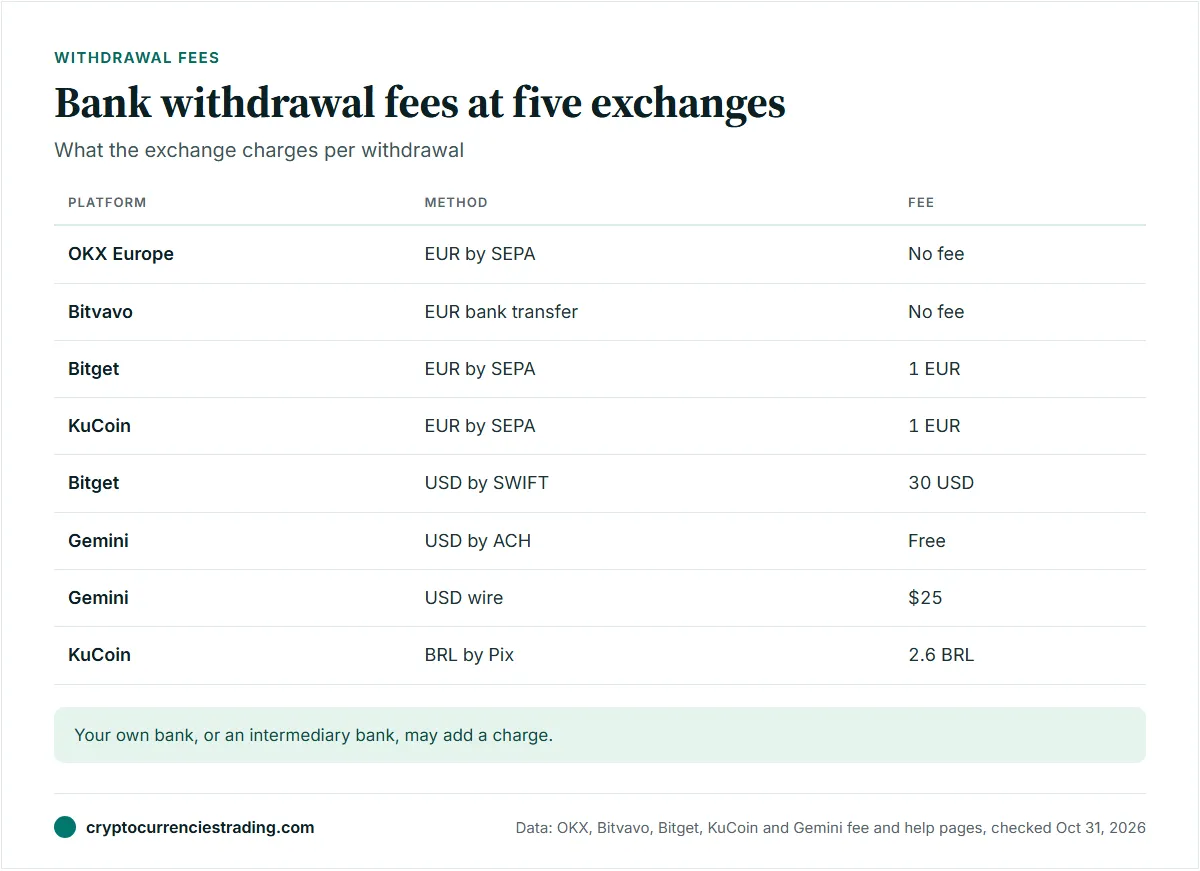
- OKX. OKX Europe offers euro withdrawals by SEPA to EEA residents and charges no fee for them. It says funds generally arrive instantly or within 2 business days, depending on your bank.
- Bybit. Fiat withdrawals go by SEPA and Zen.com for euros, Faster Payments and Zen.com for pounds, Pix for reais, SWIFT to non-US banks for dollars, Zen.com for several other European currencies, and local bank transfer in a few more. Bybit publishes no fee table: its fiat withdrawal FAQ says the fee for each currency and method shows on the Fiat Withdrawal page and in the app.
- Bitget. Bank transfers cover 15 fiat currencies. A SEPA euro withdrawal costs 1 EUR, a SWIFT dollar withdrawal costs 30 USD, and Pix is available for reais.
- Bitvavo (EEA residents only) pays euros out only to a linked bank account, with no fee. It takes one business day to a Dutch bank and two to others.
- Gemini (mainly US): ACH withdrawals are free and a USD wire costs $25.
- KuCoin: a SEPA withdrawal costs 1 EUR and a Pix withdrawal 2.6 BRL.
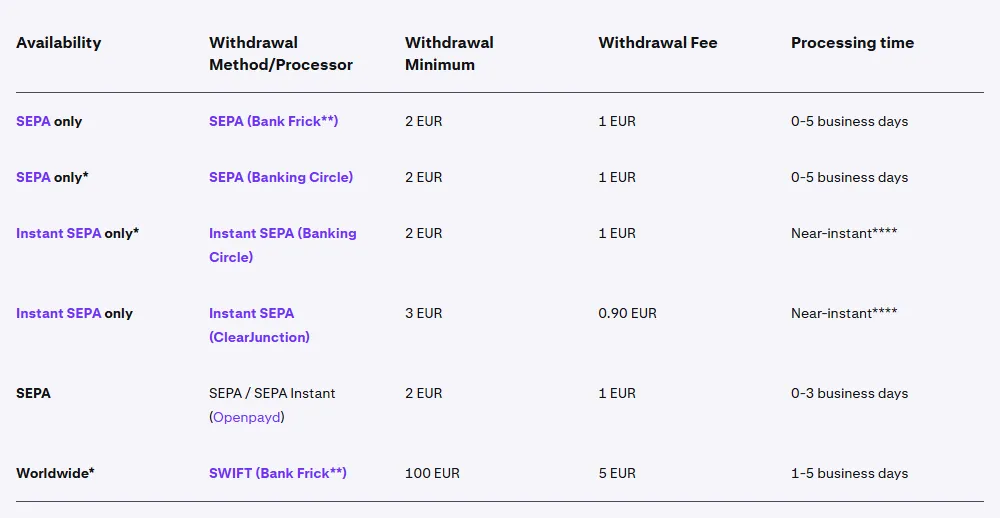
Your own bank may add a charge, and on a SWIFT transfer an intermediary bank can take a fee or convert the currency, as Kraken warns.
Cashing out from a self-custody wallet or DEX
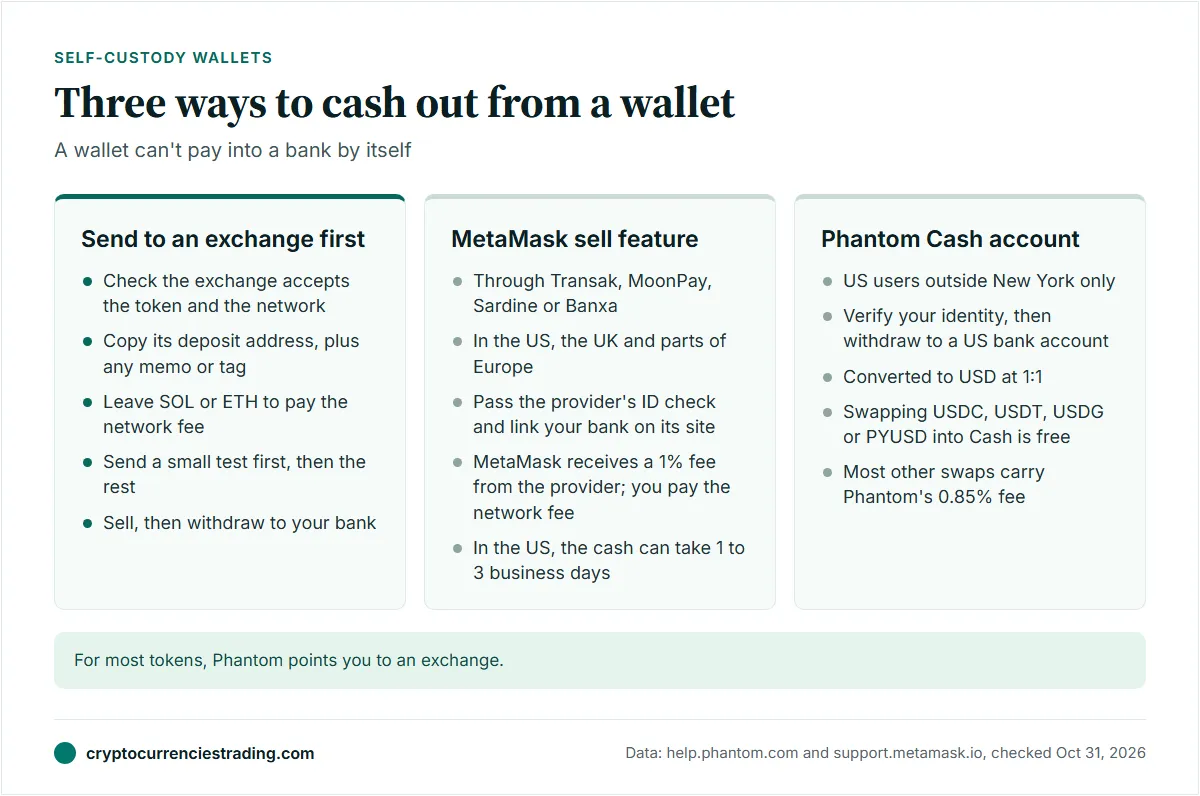
A wallet such as MetaMask or Phantom can’t pay into a bank by itself. You either move the crypto to an exchange, or use a sell feature run by a third-party provider.
Route 1: send to an exchange first
This is the route Phantom’s help center describes.
- Check support. The exchange must accept both the token and the network you send on. An unsupported token or the wrong network can mean lost funds.
- Copy the deposit address for that token and network from the exchange, plus any memo or tag it asks for.
- Keep gas. Leave enough of the network’s native token, such as SOL or ETH, to pay the network fee.
- Send a small test first, then the rest once it shows up.
- Sell and withdraw as in the main route.
Our guides to wrong-network mistakes and to sending crypto from an exchange to a wallet cover the same checks. If your exchange doesn’t accept the chain your tokens are on, you may need to bridge them first. Phantom also warns against sending CASH, the token in its Cash account, to an exchange that doesn’t support it; swap it for SOL first.
Money on a perp DEX has to come back to your wallet first; see how to fund a perp DEX. Close positions before withdrawing margin: less margin moves the liquidation price closer, and a liquidated position can lose all of its margin. See leverage and liquidation explained.
Route 2: a sell feature inside the wallet
- MetaMask. Its help center describes selling in MetaMask Portfolio or the mobile app through Transak, MoonPay, Sardine or Banxa, in the US, the UK and parts of Europe. You pass the provider’s identity check, link your bank on its site, then send the crypto. MetaMask receives a 1% fee from the provider, and you pay the network fee. By SEPA or Faster Payments the cash can arrive once the provider finishes the order; in the US it can take 1 to 3 business days.
- Phantom. For most tokens Phantom points you to an exchange. The exception is its Cash account: US users outside New York can withdraw it to a US bank account after verifying their identity, converted to USD at 1:1. Swapping USDC, USDT, USDG or PYUSD into Cash is free; most other swaps carry Phantom’s 0.85% fee.
P2P markets: useful, but risky for sellers
On a peer-to-peer (P2P) market you sell crypto directly to another user, who pays you by bank transfer or a local payment app. Bybit’s App Store listing says its P2P market has over 100 local payment methods and zero platform fees. It can help where no exchange offers a bank withdrawal in your currency.
As the seller you carry the risk: you release crypto, and the payment may be fake or later reversed. Bybit’s P2P scam guide sets out the rules that matter:
- Release only when the money is in your account. Log in to your bank and check. Screenshots and SMS alerts can be forged.
- The payer’s name must match the buyer’s verified name. Never accept payments from third parties.
- Stay in the order chat. Bybit says it never emails users to complete transactions or release funds.
- Don’t cancel under pressure. If something goes wrong, file an appeal from the order page.
How long a cash-out takes
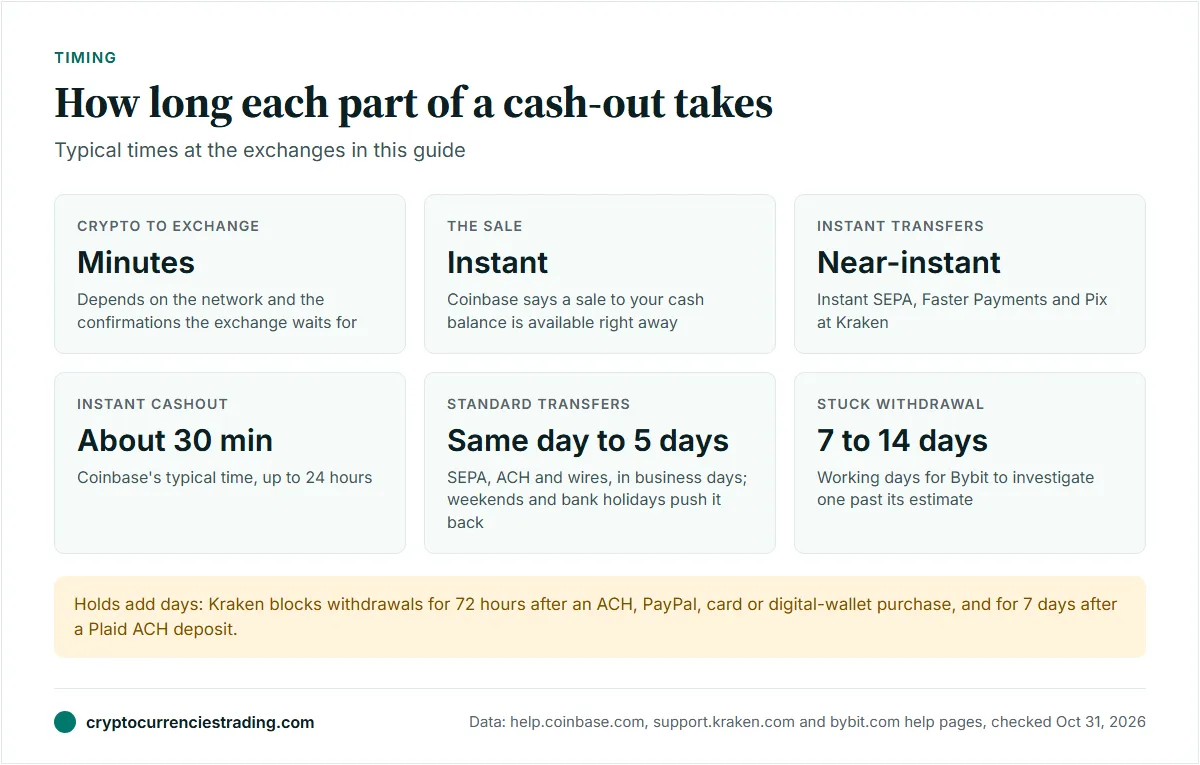
Sending crypto to the exchange usually takes minutes, depending on the network and how many confirmations the exchange waits for. The sale is instant; Coinbase says a sale to your cash balance is available right away.
The bank leg is the slow one. Instant SEPA, Faster Payments and Pix at Kraken are near-instant, and Coinbase’s instant cashouts typically take about 30 minutes, up to 24 hours. Standard SEPA, ACH and wire transfers take from same day to five business days, as listed above.
Weekends, bank holidays and late-day requests push things back; Coinbase says a late-day transaction usually starts the next business day. Holds matter too. Kraken blocks withdrawals for 72 hours after an ACH, PayPal, card or digital-wallet purchase, and for 7 days after a Plaid ACH deposit; our card vs bank transfer guide compares the two funding routes. Bybit says a withdrawal stuck past its estimate may take 7 to 14 working days to investigate.
Limits and identity checks
Every exchange in this guide requires identity verification, and a cash-out is where it gets enforced.
- Verification sets the limits. Bybit requires it for fiat withdrawals and raises limits at higher levels. Kraken says withdrawal limits depend on your verification level.
- The bank account must be yours. Coinbase requires the name on a payment method to match your account and reviews mismatches by hand in 1 to 3 business days. Bitget requires a matching name and doesn’t accept joint accounts.
- Deposit before you withdraw. OKX Europe asks you to prove you own the receiving account by depositing from it first. Some Bybit methods pay out only to an account you’ve deposited from.
- Caps. Coinbase limits instant bank cashouts to $100,000 per transaction.
- Banks, plus cash pickup at Kraken. Kraken’s USD withdrawal table, updated November 4, 2026, lists MoneyGram cash pickup in select countries: free, paid out in your local currency, typically within 10 minutes of an accepted quote. A bullet on the same page still says cash, check, card and third-party payment processor withdrawals are not possible.
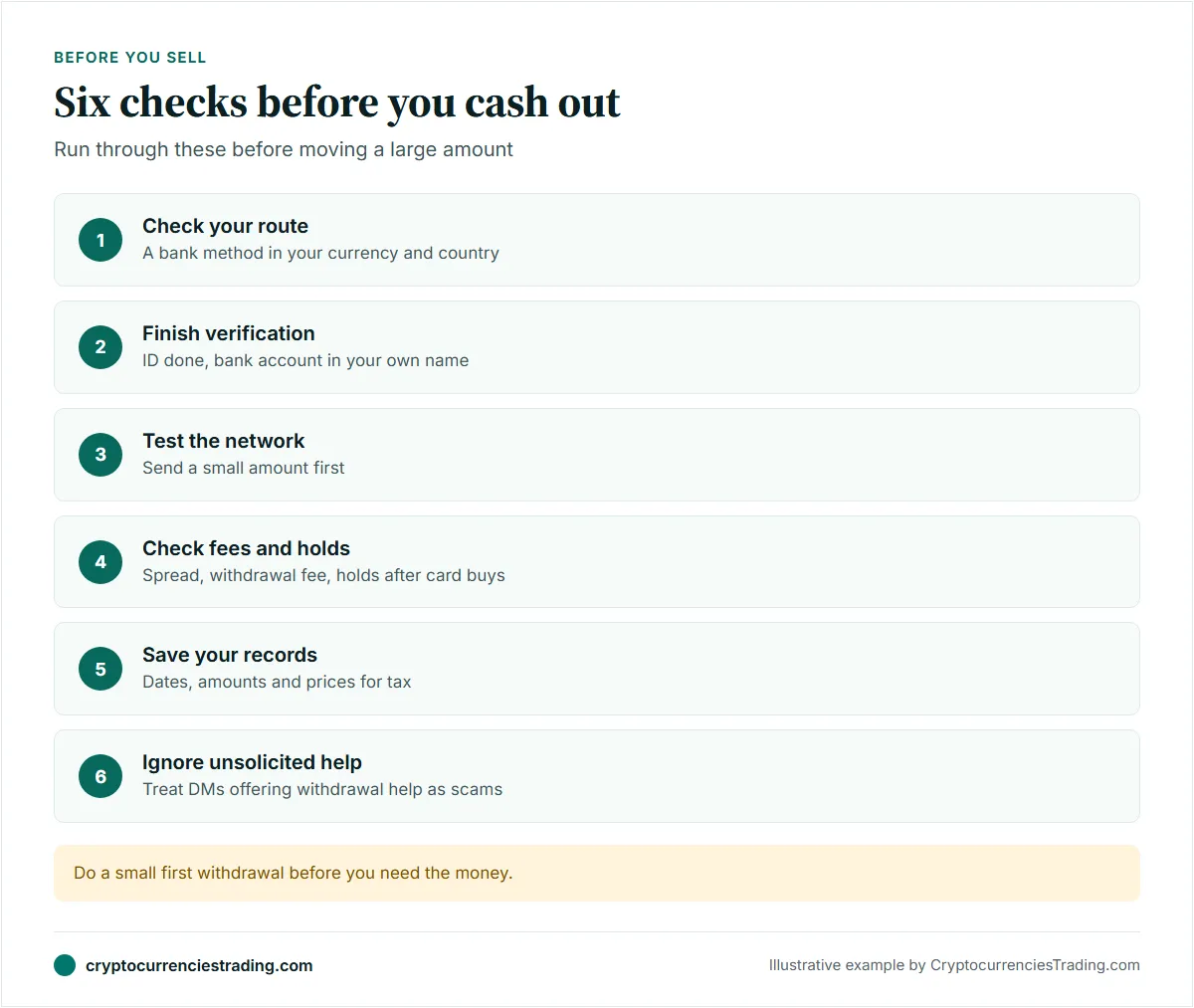
Make a small first withdrawal well before you need the money.
Taxes: keep records
In many countries, selling crypto for cash can create a taxable gain or loss, and some also tax swaps from one coin to another. The rules depend on where you live, so ask a local tax adviser. This is not tax advice.
Whatever the rules, keep:
- A record of each sale: date, amount, price in your currency and fees.
- A record of each transfer between your own wallets and exchanges, so it isn’t mistaken for a sale.
- Exchange statements, downloaded before you close any account.
Cash-out scams to watch for
People with crypto to sell are a target. The common scripts:
- Fake OTC desks. A stranger offers to buy a large amount above the market price and asks you to send the crypto first, or to an “escrow” address they control. For a large sale, ask your exchange about an OTC service through its own site or app.
- Pay to withdraw. A trading site shows a large balance but wants a “tax” or “fee” before it releases your money. The FBI lists demands for bank fees to verify your identity before a withdrawal as a warning sign.
- “Recovery” services. After a loss, someone posing as a lawyer, a recovery firm or a government partner offers to get your money back for a fee, often in crypto or gift cards. The FBI warned about these fake law firms in August 2025 and says the US government does not charge for law enforcement services.
- Fake support. Treat anyone who contacts you first offering withdrawal help as a scammer, and never share your seed phrase. Our self-custody wallet guide covers the usual scripts.
- Cashing out for someone else. Passing a stranger’s money through your bank account can make you a money mule, which can get the account closed and can be a crime.
A checklist before you cash out
If you’re still choosing where to sell, our ranking of crypto exchanges compares fees and availability.
Frequently asked questions
What is the cheapest way to cash out crypto?
Usually selling on an order book in your own currency and withdrawing by a domestic method. At the exchanges we checked, OKX Europe and Bitvavo charge nothing for euro withdrawals, and Kraken and Gemini charge nothing for ACH. Wires cost more, from $4 at Kraken to 30 USD at Bitget.
Can I send crypto straight to my bank account?
No. A bank only accepts money in your currency, so someone has to sell the crypto first: an exchange, or a provider such as those behind MetaMask’s sell feature.
How long does it take to cash out?
From minutes with Faster Payments, Instant SEPA or Pix, to about five business days for a standard SEPA or ACH transfer. Holds after a recent card or ACH purchase can add days.
Sources
The figures in this guide come from these pages, checked on October 31, 2026.
- help.coinbase.com/en/coinbase/getting-started/add-a-payment-method/add-and-verify-pm-namerica-latam
- help.coinbase.com/en/coinbase/getting-started/add-a-payment-method/add-and-verify-pm-emea
- help.coinbase.com/en/coinbase/trading-and-funding/buying-selling-or-converting-crypto/how-long-does-a-sell-or-withdrawal-take-to-complete
- help.coinbase.com/en/coinbase/trading-and-funding/buying-selling-or-converting-crypto/cash-out-funds
- help.coinbase.com/en/coinbase/getting-started/add-a-payment-method/instant-cashout
- help.coinbase.com/en/coinbase/trading-and-funding/pricing-and-fees/fees
- help.coinbase.com/en/coinbase/trading-and-funding/depositing-or-withdrawing-fiat-money/funding-your-account-namerica-latam
- help.coinbase.com/en/coinbase/trading-and-funding/depositing-or-withdrawing-fiat-money/funding-your-account-emea
- support.kraken.com/articles/360000423043-cash-withdrawal-options-fees-minimums-and-processing-times-
- kraken.com/features/fee-schedule
- okx.com/en-eu/help/how-do-i-withdraw-eur-with-sepa-bank-transfer
- bybit.com/en/help-center/article/How-to-Withdraw-Fiat-Currencies-on-Bybit
- bybit.com/en/help-center/article/FAQ-Fiat-Withdrawal
- apps.apple.com/us/app/bybit-new-financial-platform/id1488296980
- bybit.com/en/help-center/article/How-to-Avoid-Crypto-P2P-Scams
- bitget.com/support/articles/12560603785944
- support.bitvavo.com/hc/en-us/articles/4405188690065-How-do-I-withdraw-euros-to-my-bank-account
- bitvavo.com/en/terms
- gemini.com/fees/transfer-fee-schedule
- support.gemini.com/hc/en-us/articles/46255474469275-Gemini-closing-accounts-in-the-UK-EU-and-Australia-Everything-you-need-to-know
- kucoin.com/support/47497300093820
- help.phantom.com/articles/cash-out-crypto-from-phantom-using-an-exchange-28469415977491
- help.phantom.com/articles/withdraw-cash-to-your-bank-account-us-only-44800172520467
- help.phantom.com/articles/swap-crypto-in-phantom-5985106844435
- support.metamask.io/manage-crypto/move-crypto/sell/how-to-sell-your-crypto-assets-for-fiat-currency-in-metamask
- ic3.gov/PSA/2025/PSA250813
