To fund a perp DEX, you send a supported asset, usually USDC, from your own wallet on a network the venue accepts, and it becomes your trading balance. Hyperliquid takes USDC on Arbitrum with a 5 USDC minimum, Lighter accepts deposits from Ethereum and 11 other chains, Extended takes USDC, cirBTC, wETH and EURC from seven chains, and Aster funds accounts from BNB Chain, Ethereum, Arbitrum and Solana.
Withdrawals go back to your wallet, usually within minutes. Below: each venue’s assets, minimums, timings, signing and withdrawals, then a checklist for any perp DEX.
This is not financial advice. A deposit sent on the wrong network can be lost for good, and leveraged positions can be liquidated.
The four venues at a glance
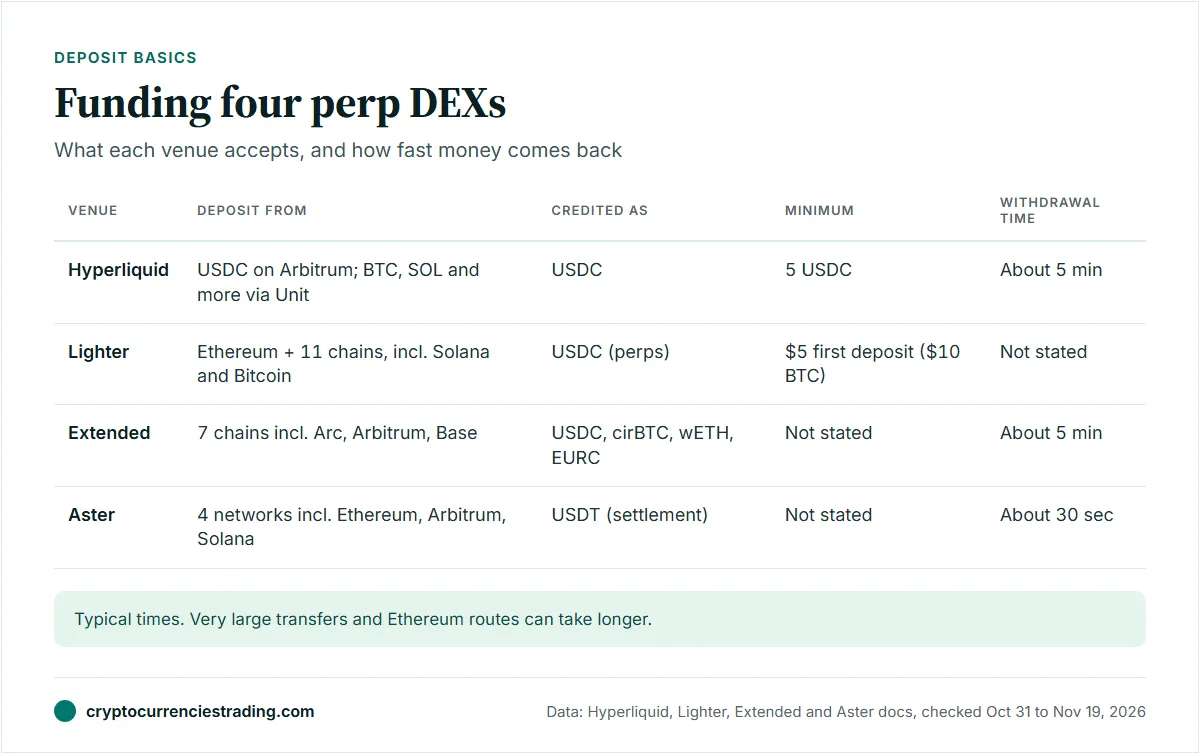
All four are self-custody, with no ID check in their documented sign-ups. The flip side: nobody can reverse a deposit sent to the wrong place.
What you need before you deposit
- A self-custody wallet. The docs name EVM wallets such as MetaMask or Rabby for Hyperliquid, Extended and Aster, and a Lighter account belongs to an Ethereum address. Our self-custody wallet guide covers setup.
- The right asset on the right network. If you buy USDC on an exchange, withdraw it straight to a network the venue accepts. See sending crypto from an exchange to a wallet, or how to bridge USDC if it is on the wrong chain. Starting from bank money? Read card vs bank transfer first.
- A little gas. The deposit transaction is paid in the source chain’s own token, such as ETH on Arbitrum. Hyperliquid’s docs note that the gas is only for depositing; trading itself is gas-free.
- An eligible country. All four venues bar the United States, and three of them also bar the UK and Canada.
For the wider picture of getting money into and out of crypto, start with how to move money in and out of crypto.
Hyperliquid
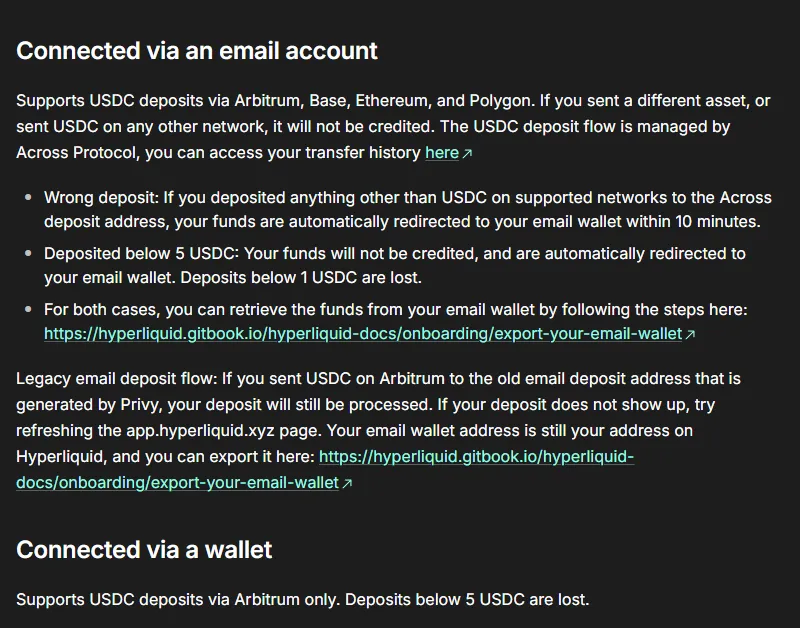
What you can deposit. With a wallet, the standard deposit is USDC on Arbitrum: click Deposit, enter the amount and confirm in your wallet. If you log in with an email address instead, the app shows a deposit address that takes USDC on Arbitrum, Ethereum, Base or Polygon. Either way, it arrives as USDC on HyperCore, Hyperliquid’s trading layer. The onboarding guide adds that many exchanges and bridges can withdraw USDC to Hyperliquid directly, and that you can bring USDC from other chains through Circle’s CCTP.
You can also send BTC, ETH, SOL and several other coins to a deposit address in the app. Unit, an independent team, handles these. They arrive as spot tokens, which you sell for USDC before using them as perps margin.
Minimum. 5 USDC for a wallet deposit. Hyperliquid’s deposit FAQ says wallet-connected accounts deposit USDC from Arbitrum only and that a deposit under 5 USDC is lost. With an email login, the same FAQ says deposits under 5 USDC go to your email wallet instead, and deposits under 1 USDC are lost. Circle’s CCTP docs say CCTP deposits to Hyperliquid have no minimum, but staying above 5 USDC is safe on any route. Other coins have their own minimums: Hyperliquid’s FAQ gives 0.0003 BTC for Bitcoin and says smaller BTC deposits are lost too.
Time. Hyperliquid’s onboarding guide and deposit FAQ give no time for a USDC deposit. Its USDC developer docs say the legacy Arbitrum bridge credits a deposit in under a minute, but they now mark that bridge deprecated and name Circle’s CCTP as the preferred way to bring USDC onto Hyperliquid. Bitcoin deposits take about 30 minutes.
Signing. The first time you connect a wallet, you click Enable Trading and sign a gas-free message. Withdrawals need your own wallet’s signature.
Withdrawals. Click Withdraw. You sign on Hyperliquid only, and validators send the withdrawal to Arbitrum, so you need no ETH to withdraw. Hyperliquid’s API docs say withdrawals take about 5 minutes to finalize. The fee is 1 USDC: Hyperliquid’s support FAQ says a withdrawal needs 1 USDC, and the API docs put it at $1.
Lighter
What you can deposit. Your first credited deposit creates your Lighter account. You can deposit on Ethereum directly, or send funds from another chain to a deposit address. Lighter’s deposit docs list Arbitrum, Base, Optimism, Polygon, BNB Chain, HyperEVM, Monad, Robinhood Chain, Solana, Tron and Bitcoin for that route. Assets vary by chain: USDC, USDT and ETH on several EVM chains, USDT only on Tron, BTC only on Bitcoin. Only USDC can be credited to the perps balance.
Minimum. Through a deposit address, $5 for a new account, or $10 from Bitcoin. The docs warn that bridging and swaps can cause slippage, so send a little more than the minimum.
Time. The docs say deposits typically complete within a few minutes.
Signing. Lighter uses API keys: a key pair, separate from your Ethereum key, that signs Lighter transactions once you register it with a wallet signature. The docs reserve the first key slots (0 to 3) for Lighter’s own desktop and mobile apps. An API key can trade and request a secure withdrawal to your own address. Transfers to someone else and fast withdrawals need your wallet’s signature.
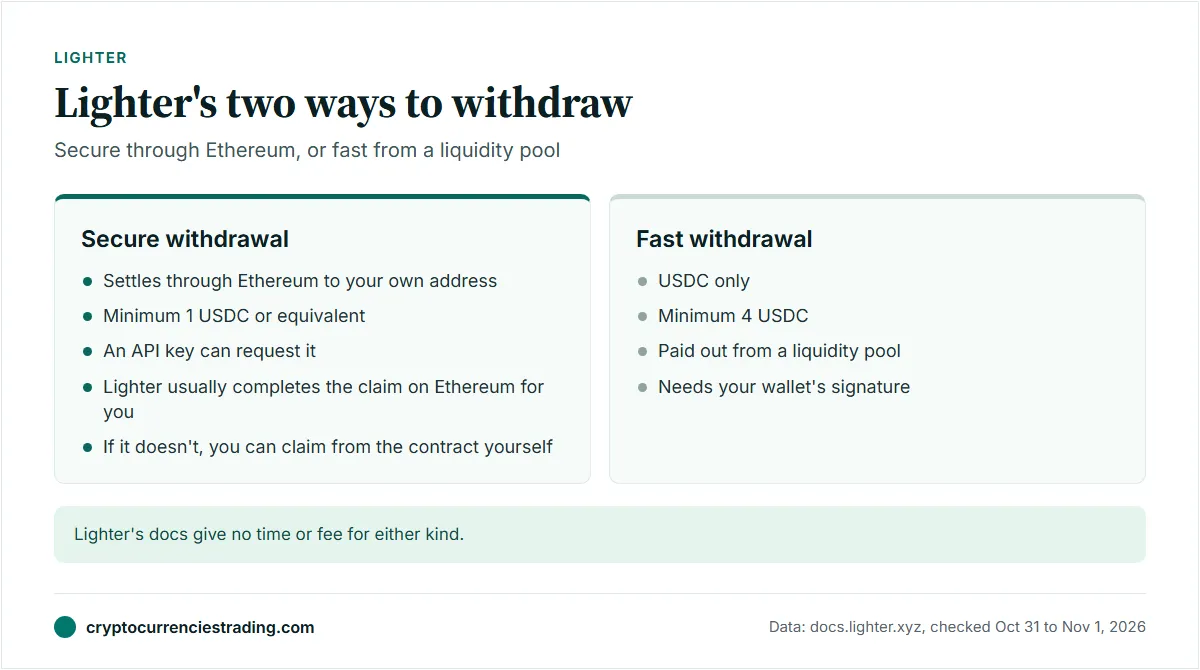
Withdrawals. There are two kinds:
- Secure withdrawal. Settles through Ethereum to your own address, minimum 1 USDC or equivalent. Lighter usually completes the claim on Ethereum for you; if it doesn’t, you can claim from the contract yourself.
- Fast withdrawal. USDC only, minimum 4 USDC, paid out from a liquidity pool.
The docs give no time or fee for either.
Extended
Extended moved settlement from Starknet to Circle’s Arc chain on October 22, 2026. Accounts, positions and history moved over automatically, and you log in with the same wallet as before.
What you can deposit. For EVM wallets, Extended’s deposits page lists four assets:
- USDC from Ethereum, Arbitrum, Base, Arc, BNB Chain, Polygon or Avalanche.
- wETH from every one of those chains except Avalanche. ETH you send from an EVM chain is converted to wETH on Arc by Rhino.fi, the bridge Extended uses.
- cirBTC, Circle’s Bitcoin-backed token, from Ethereum or Arc.
- EURC, Circle’s euro-backed stablecoin, from Ethereum, Base or Arc.
USDT and wBTC deposits have been switched off on all chains since October 8, 2026, and existing balances were converted to USDC and cirBTC at 1:1. If your account uses a Starknet wallet, you can only deposit from and withdraw to Starknet. Transfers from other chains go through the Rhino.fi bridge.
Minimum. The deposits page lists per-transaction maximums (up to $10 million for USDC) but no minimum.
Time. Most deposits arrive in about 1 minute. Very large ones take longer: about 22 minutes for USDC over $4 million from Ethereum, Arbitrum or Base, about 15 minutes for wETH or cirBTC over $200,000 from any EVM chain except Arc, and about 20 minutes for EURC over $500,000 from Ethereum or Base.
Signing. Creating an account takes two signatures. The first generates your Extended account and a signing key pair that is stored locally in your browser. The second registers it and enables trading. So Extended gives you a trading key: treat that browser like your wallet.
Withdrawals. You withdraw to the same chains, and most routes take about 5 minutes. wETH withdrawals over $200,000 take about 20 minutes to any EVM chain except Ethereum and Arc. The deposits page lists no bridge fee for any route.
Aster
What you can deposit. Click Deposit, choose the network, token and amount, and confirm in your wallet. The Aster Chain docs list BNB Chain, Ethereum, Arbitrum and Solana as supported networks. Aster’s settlement asset is USDT. Its multi-asset mode page lists the collateral it accepts on each network: USDT on all four, USDC on Ethereum, Arbitrum and Solana, and a longer list on BNB Chain that includes BNB, USD1 and ASTER. If you log in with email, Aster generates a wallet for you that accepts only USDT on Arbitrum, and the docs say Aster won’t refund deposits of the wrong asset or on the wrong network.
Minimum. We found no minimum deposit in Aster’s docs. To connect on BNB Chain, your wallet must hold at least 0.001 BNB.
Time. Deposits to Aster Chain are free and take 1 to 5 minutes, longer from Ethereum. They are credited once 3 of 4 validator nodes verify them.
Signing. You connect a wallet and approve a signature request, and you confirm each deposit and withdrawal in your wallet.
Withdrawals. Click Withdraw and choose the network, token and amount. The docs estimate about 30 seconds, longer to Ethereum. The fee covers gas on the destination chain and can be as low as 1 USDT. If any token balance is negative, from losses, funding or fees, you must clear it first with Rebalance.
Once your funds are back in your wallet, how to cash out crypto covers the route to your bank.
Wallet signatures vs trading keys
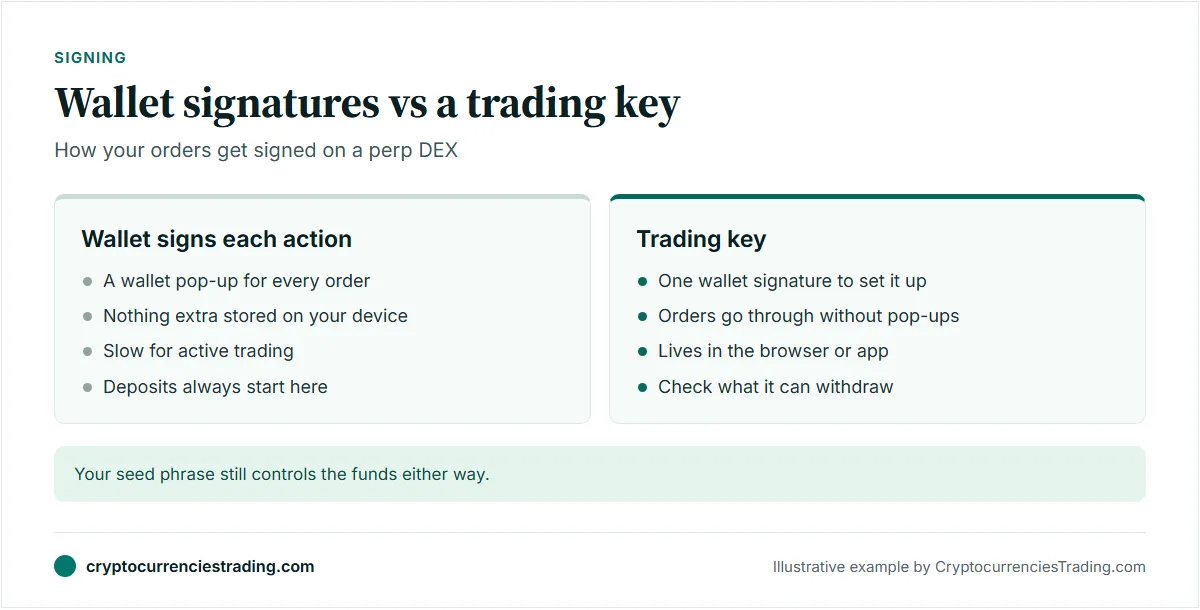
Order-book trading means many signatures: every order, cancel and leverage change. A wallet pop-up for each would be slow, so perp DEXs such as Lighter and Extended have you approve a separate trading key once. That key then signs your trades.
What to check on any venue:
- What the key can do. On Lighter, an API key can withdraw only to your own address; sending funds anywhere else needs your wallet. On Hyperliquid, withdrawals need your wallet’s signature.
- Where it lives. Extended stores its key in your browser. Malware on that device could misuse it, so trade from a clean, updated device.
- What to do if a device is compromised. Withdraw with your wallet and start again on a clean device.
A deposit checklist for any perp DEX
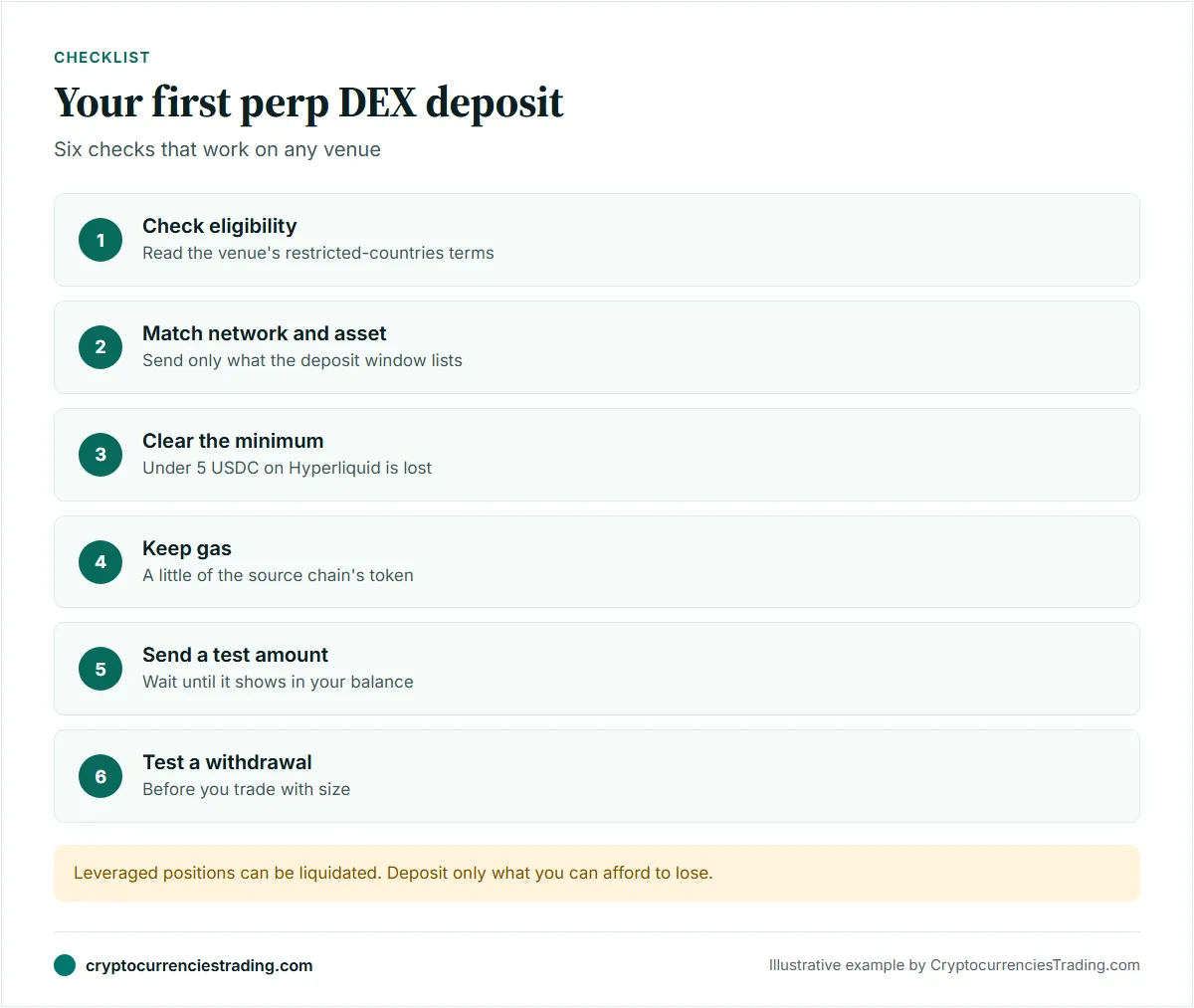
- Check you are eligible. Read the restricted-countries section of the venue’s current terms.
- Match the network and asset. Send only what the deposit window lists, on the network it names. A token on the wrong chain may never arrive; see network fees and wrong-network mistakes.
- Clear the minimum. On Hyperliquid, a deposit below 5 USDC is lost, not returned. Allow for slippage where a bridge or swap is involved.
- Keep gas in the source chain’s token so the transaction can go through.
- Use a bookmark for the venue’s site. Fake front-ends are a common way to lose a deposit.
- Send a test amount above the minimum and wait until it shows in your balance.
- Test a withdrawal before you trade with size, so you know the way out works.
- Keep records of deposits and withdrawals. Whether any of this is taxable depends on your country, so ask a local tax adviser.
Where these venues are available
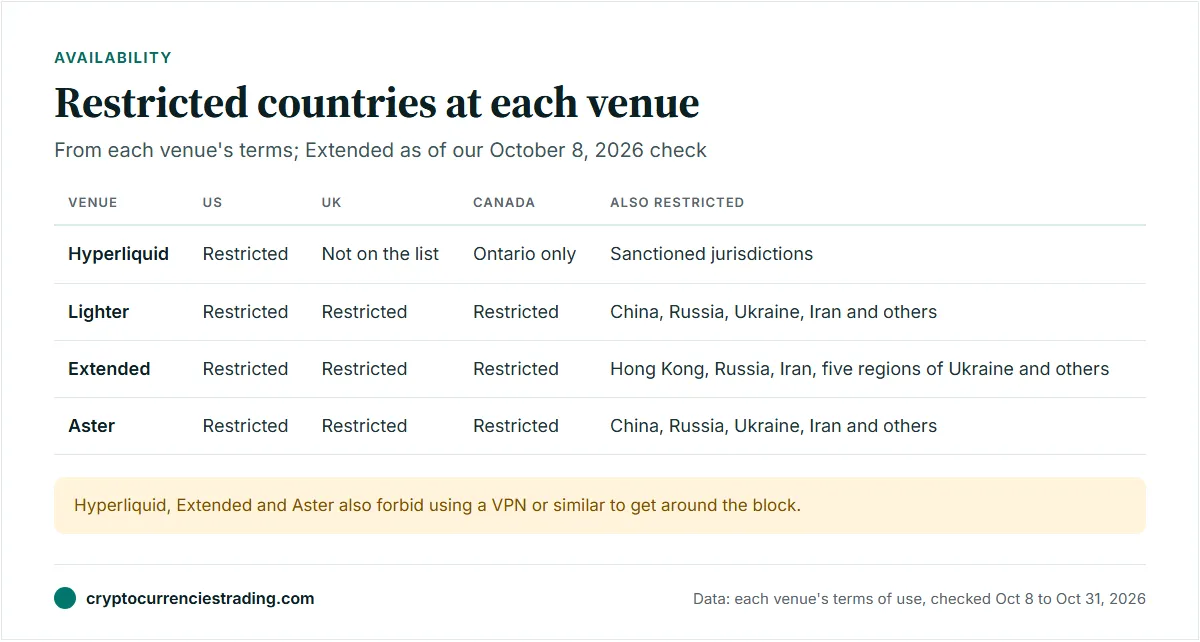
All four venues restrict some countries in their terms. Hyperliquid, Extended and Aster also forbid using a VPN or similar to get around the block.
- Hyperliquid: the United States, Ontario (Canada) and sanctioned jurisdictions.
- Lighter: the United States, Canada, the UK, China, North Korea, Russia, Ukraine, Cuba, Iran, Venezuela, Sudan, Belarus, Myanmar and Syria.
- Extended: as of our October 8, 2026 check, Afghanistan, Canada, Hong Kong, Cuba, Iran, North Korea, Russia, Syria, the Seychelles, the UK and the US, plus five regions of Ukraine. Its page now points to each service’s terms instead of listing countries.
- Aster: the United States, Canada, the UK, China, North Korea, Russia, Ukraine, Cuba, Iran, Venezuela and Syria.
If you are in the US, our guide to perp DEXs and US availability covers the regulated alternatives.
Leverage and liquidation
Funding the account is the easy part. Once your USDC is in, any leveraged position can be liquidated if the price moves far enough against you, and you can lose all the margin behind it. Start with low leverage and a stop-loss, and read leverage and liquidation explained before your first trade. Compare venues in our perp DEX ranking.
Frequently asked questions
What is the minimum deposit on Hyperliquid?
5 USDC. Smaller wallet deposits are not credited and are lost. With an email login, deposits under 5 USDC go to your email wallet instead, and under 1 USDC they are lost. Other coins have their own minimums, such as 0.0003 BTC for Bitcoin.
Can I deposit USDT on a perp DEX?
On Aster, yes: its settlement asset is USDT, and email accounts take USDT on Arbitrum. Lighter accepts USDT on several chains through its deposit addresses, but only USDC is credited to the perps balance. Extended stopped accepting USDT deposits on October 8, 2026.
How long does a withdrawal take?
About 30 seconds on Aster, and about 5 minutes on Hyperliquid and on most Extended routes. Lighter’s docs don’t give a time.
Do I need ETH to withdraw from Hyperliquid?
No. You sign the withdrawal on Hyperliquid and validators handle the Arbitrum side. You do need a little ETH on Arbitrum to deposit.
Is my money safe once it’s deposited?
Self-custody removes the risk of a company holding your funds, but smart contracts, bridges and the venue’s operations still carry risk, and leveraged positions can be liquidated. Keep only what you are actively trading on a perp DEX.
Sources
The figures in this guide come from these pages, checked on October 31, 2026.
- hyperliquid.gitbook.io/hyperliquid-docs/onboarding/how-to-start-trading
- hyperliquid.gitbook.io/hyperliquid-docs/for-developers/api/usdc
- hyperliquid.gitbook.io/hyperliquid-docs/support/faq/deposit-or-transfer-issues-missing-lost/deposited-usdc
- developers.circle.com/cctp/concepts/cctp-on-hypercore
- hyperliquid.gitbook.io/hyperliquid-docs/for-developers/api/exchange-endpoint
- hyperliquid.gitbook.io/hyperliquid-docs/support/faq/deposit-or-transfer-issues-missing-lost/deposited-via-bitcoin-network
- docs.hyperunit.xyz/unit/about-unit/supported-assets
- docs.lighter.xyz/developers/integration-guides/deposits-transfers-and-withdrawals
- docs.lighter.xyz/developers/integration-guides/api-keys
- docs.lighter.xyz/developers/getting-started/core-concepts
- docs.extended.exchange/extended-resources/account-operations/deposits-and-withdrawals
- developers.circle.com/stablecoins/what-is-eurc
- docs.extended.exchange/about-extended/migration-from-starknet-to-arc
- docs.extended.exchange/extended-resources/account-operations/account-creation
- docs.asterdex.com/aster-chain/overview
- docs.asterdex.com/getting-started/deposit-and-withdrawal-guide.md
- docs.asterdex.com/getting-started/login-via-email-address.md
- docs.asterdex.com/getting-started/login-via-web3-wallet.md
- docs.asterdex.com/trading/perpetuals/single-asset-mode-and-multi-asset-mode
