| Market | Maker | Taker | Notes |
|---|---|---|---|
| Spot | 0% | 0.025% | Flat rate with no volume tiers, the same as for perpetual markets. Spot trading is temporarily paused; the crypto markets page lists cirBTC and wETH spot markets. After the October 22, 2026 move to Arc, USDT and wBTC are no longer accepted as collateral. |
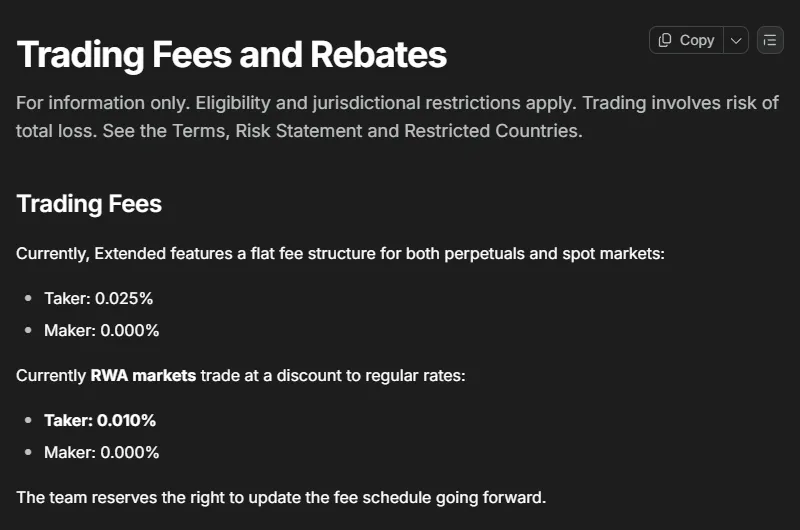
| Perpetuals | 0% | 0.025% | Flat rate with no volume tiers. RWA markets currently pay 0.010% taker and 0% maker. Makers with 0.5% or more of 30-day maker volume earn rebates of 0.002% to 0.010%. |
Extended exchange fees are flat: every trader pays 0% maker and 0.025% taker on crypto perps, so a $1,000 market order costs $0.25 and a limit order that rests on the order book costs nothing. The costs to watch are hourly funding on open positions and any bridge fee on deposits and withdrawals from EVM chains, which Extended does not publish.
Stocks, FX, indices and commodities, which Extended calls RWA markets, are cheaper still at 0.010% taker. There are no volume tiers and no fee token.
This is not financial advice. Perps are leveraged, and a leveraged position can be liquidated, losing the collateral behind it.
Extended is not open to restricted persons, and its terms forbid using a VPN to get around that. See where Extended is available.
Extended trading fees: 0% maker, 0.025% taker
Extended’s trading fees page lists one schedule for everyone:
- Crypto perps and spot: 0% maker, 0.025% taker. Spot trading is temporarily paused.
- RWA perps (stocks, indices, FX, metals and energy): 0% maker, 0.010% taker.
A new account pays the same rate as a large one, and Extended says it may update the schedule.
Fees are charged on the full position size, not your margin. $500 of margin at 20x opens a $10,000 position, and a market order on it costs $2.50.
Order book or RFQ changes what you pay. The main crypto markets, such as BTC, ETH, SOL and HYPE, trade on an order book, where a limit order that rests on the book pays the 0% maker rate. Many smaller markets use RFQ, where market makers quote your order. Extended’s API docs say orders you place on an RFQ market always pay the taker fee, even a limit order that waits for a market maker to pick it up. Our Extended perps section explains both models.
Spot trades pay the same 0% maker and 0.025% taker, with no funding, but spot trading is paused for now. The crypto markets page lists two spot markets, cirBTC and wETH, says “Spot trading is temporarily paused” and gives no restart date. Spot balances still count as collateral. See spot trading on Extended.
Maker rebates
The largest market makers earn a rebate instead of paying nothing. It depends on your share of all maker volume on Extended, perps and spot combined, over the past 30 days:
| Share of 30-day maker volume | Rebate, crypto markets | Rebate, RWA markets |
|---|---|---|
| 0.5% or more | 0.002% | 0.0008% |
| 1% or more | 0.004% | 0.0016% |
| 2.5% or more | 0.006% | 0.0024% |
| 5% or more | 0.010% | 0.0040% |
Maker rebates from Extended’s trading fees and rebates page, checked October 31, 2026.
There is nothing to sign up for. Rebates accrue automatically and are paid daily at 00:00 UTC for the previous 24 hours, but only when that day’s rebate reaches $10. Few retail traders will qualify. Our maker vs taker fees guide explains how an order is classified.
Funding on Extended perps
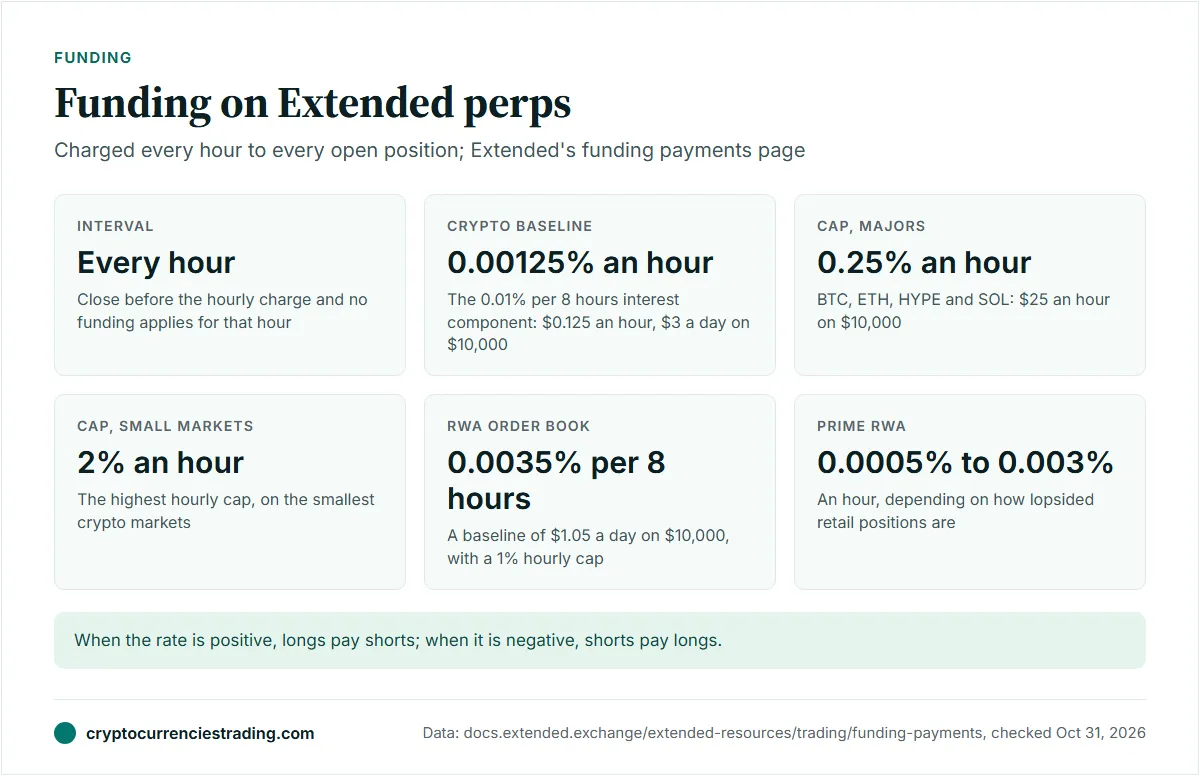
Funding is the main cost of holding a position. Extended charges it every hour to everyone with an open position at that moment, according to its funding payments page. When the rate is positive, longs pay shorts; when it is negative, shorts pay longs. If you close before the hourly charge, no funding applies for that hour.
Each hourly rate is one eighth of an 8-hour rate built from two parts: the perp’s premium over the index price, and a fixed interest component. On order-book crypto markets the interest component is 0.01% per 8 hours. When the perp trades close to the index, longs pay 0.00125% an hour: $0.125 an hour on a $10,000 position, or $3 a day.
Rates can move far from that baseline. The hourly cap is 0.25% for the group 1 and 2 markets (BTC, ETH, HYPE and SOL), rising to 2% for the smallest markets. At the 0.25% cap, a $10,000 position pays $25 an hour.
- RWA order-book markets use an interest component of 0.0035% per 8 hours, a baseline of $1.05 a day on $10,000, with a 1% hourly cap.
- RFQ markets take funding from an outside price source or a separate formula, so check each market’s rate.
- Prime RWA markets charge 0.0005% to 0.003% an hour, depending on how lopsided retail positions are.
Our funding rates guide explains the mechanics.
Worked examples
A $1,000 trade. A market order on BTC pays the taker fee: $1,000 × 0.025% = $0.25. A post-only limit order that rests on the order book pays $0. On a stock or FX perp, the same market order costs $1,000 × 0.010% = $0.10.
A $10,000 perp held for a day. You post $1,000 of margin at 10x, open a $10,000 BTC long with a market order, hold it for 24 hours while funding sits at the baseline, then close with a market order.
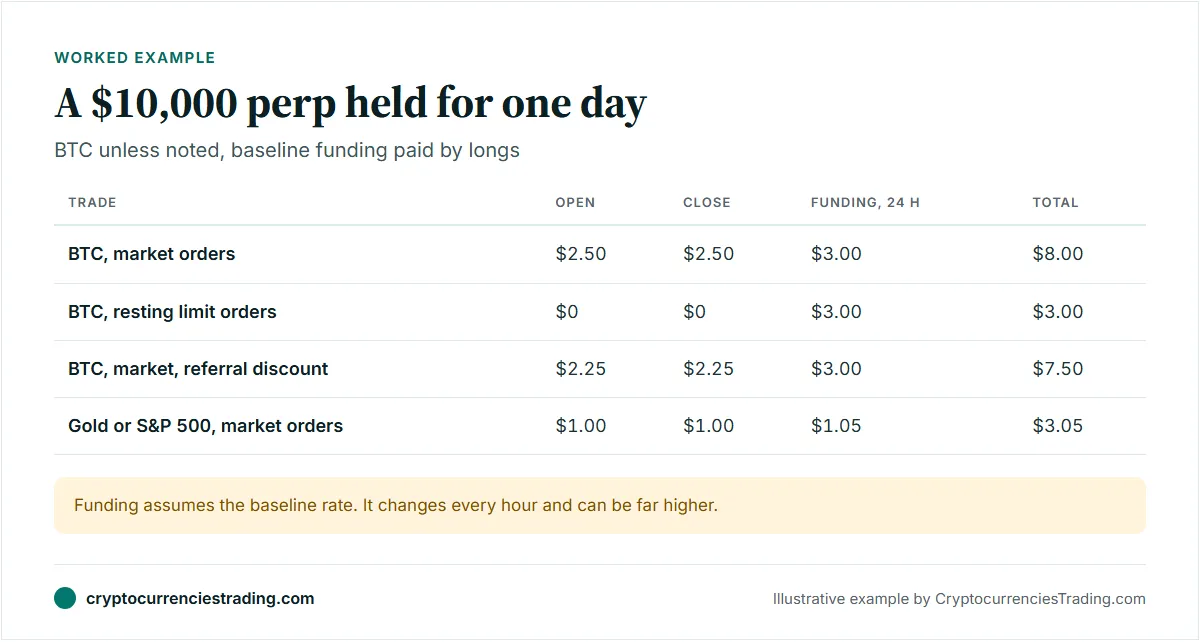
- Market orders: $2.50 to open + $2.50 to close + $3.00 of funding = $8.00.
- Limit orders that rest on the book: $0 + $0 + $3.00 = $3.00.
- Market orders with the referral discount: $2.25 + $2.25 + $3.00 = $7.50.
- The same trade on gold or the S&P 500, both RWA order-book markets: $1.00 + $1.00 + $1.05 = $3.05.
If you hold the side being paid, funding is income instead. At 10x, a move of less than 10% against you can trigger liquidation, which costs far more than any fee. See leverage and liquidation explained.
Extended exchange fees for deposits and withdrawals
Extended charges nothing itself to move money. Its API docs say Extended doesn’t charge fees on deposits or withdrawals, but bridge fees may apply on EVM chains, and all deposits and withdrawals are subject to gas fees.
EVM chains. EVM wallets deposit from Ethereum, Arbitrum, Base, Arc, BNB Chain, Polygon or Avalanche, per the deposits and withdrawals page. That page lists no fee for any route. The API docs send six of them through the Rhino.fi bridge: Arbitrum, Ethereum, Base, BNB Chain, Avalanche and Polygon. For API users, each of those transfers starts with a quote that includes the bridge fee, and the transfer goes ahead only once the quote is accepted. Extended publishes no bridge fee amounts, and the docs don’t say whether Arc transfers use the bridge.
Starknet. Accounts created with a Starknet wallet deposit from and withdraw to Starknet only, in USDC or wETH.
Assets. Four assets are accepted: USDC, cirBTC, wETH and EURC. USDC comes from all seven of those EVM-wallet chains, wETH from all of them but Avalanche, cirBTC from Ethereum and Arc, and EURC from Ethereum, Base and Arc. ETH sent from an EVM chain is converted to wETH on Arc by Rhino.fi. USDT and wBTC deposits have been switched off on all chains since October 8, 2026, per the migration page.
Minimum. The docs list per-transaction maximums, up to $10 million for USDC, but no minimum deposit.
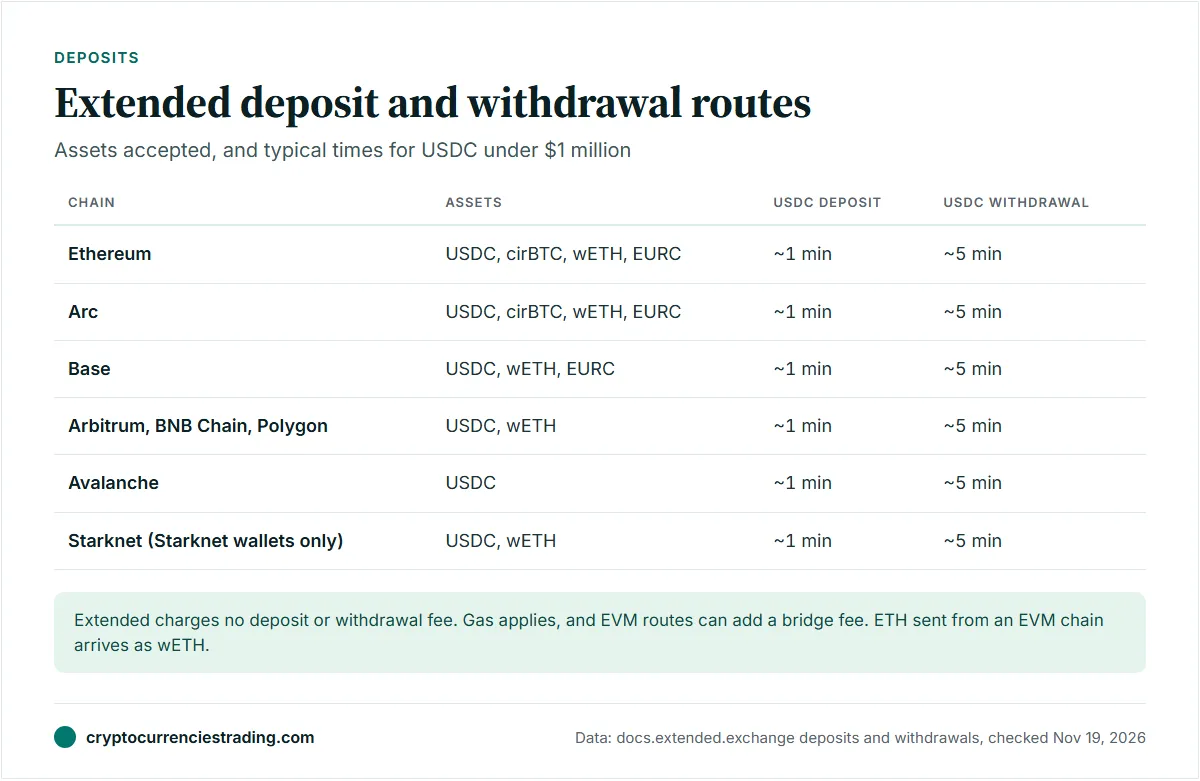
Times. USDC under $1 million arrives in about 1 minute and withdraws in about 5 minutes on every route. wETH and cirBTC deposits over $200,000 take about 15 minutes from any EVM chain except Arc, EURC deposits over $500,000 from Ethereum or Base about 20 minutes, and large Starknet deposits up to about 4 hours. wETH withdrawals over $200,000 take about 20 minutes to any EVM chain except Ethereum and Arc.
What you can withdraw. USDC and spot assets such as wETH, only to the wallet linked to your account; vault shares (XVS) can’t be withdrawn directly. Moving funds between your own Extended trading accounts is free, per the trading accounts page. Our guide to funding a perp DEX walks through a first deposit.
Other costs
- Builder fees. Third-party front ends built on Extended can add their own fee to each order. The builder codes page publishes no cap, so check the fee before you trade through another app.
- Liquidation. If a position is liquidated at a better price than its bankruptcy price, a 1% liquidation fee goes to the Extended Vault, per the liquidation logic page. On a $10,000 position that is $100.
- Borrow interest. If losses push your USDC balance below zero while cirBTC or wETH backs your account, Extended treats it as a USDC loan and charges interest about every 15 minutes, at a floating rate set by its money market. No interest is charged when XVS covers the gap.
- Collateral discount. USDC counts at 100% toward your trading balance, EURC at 95%, and cirBTC, wETH and XVS at 90%, per the unified margin page. It is not a fee, but $1,000 of wETH backs only $900 of margin.
- Vault. The vault docs list no deposit, withdrawal or performance fee. Deposits have a $5 minimum and a 24-hour lock, and when you withdraw, any price impact from closing your share of the vault’s positions is yours. You can lose what you deposit. See the Extended Vault.
- Points. The points page lists no cost, and points can’t be bought or sold. Points don’t guarantee a token or its value.
How Extended’s perp DEX fees compare
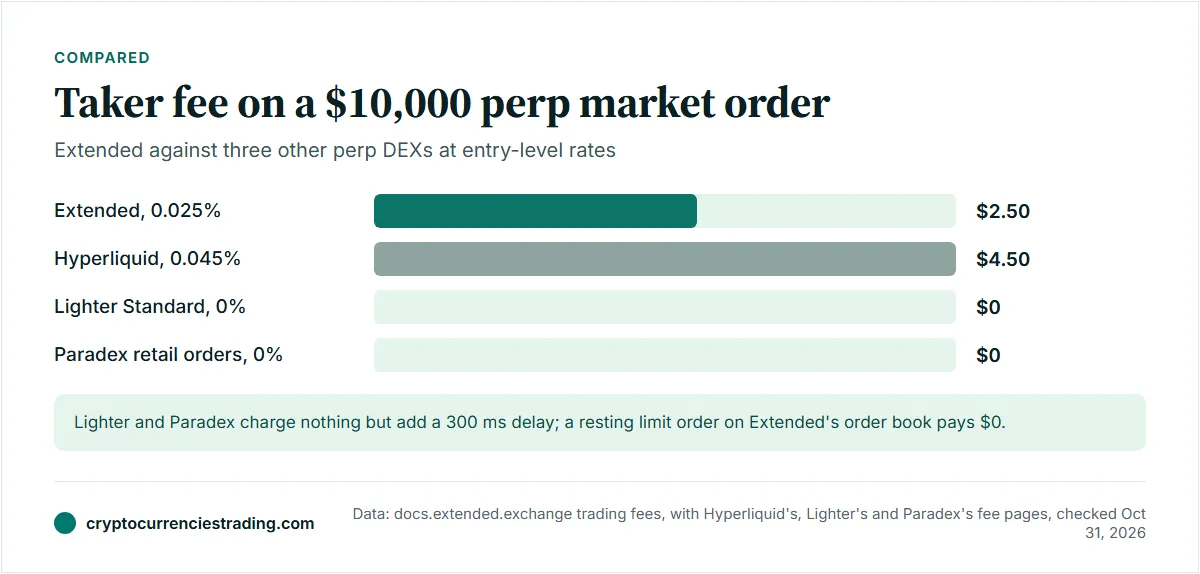
On a $10,000 market order, Extended charges $2.50. Hyperliquid charges $4.50 at its base perps rate of 0.045% taker (0.015% maker). Lighter’s default Standard account and Paradex’s retail orders charge nothing, but both add a 300 ms delay: Lighter on taker orders and cancels, Paradex on retail orders. Hyperliquid publishes a 1 USDC withdrawal fee and a 5 USDC minimum deposit, and Lighter lists deposit minimums of $3 to $10 by chain; Extended publishes neither a minimum deposit nor a bridge fee amount. So Extended perp DEX fees sit between the zero-fee venues and Hyperliquid for market orders, and match the zero-fee venues for limit orders on its order-book markets. See our perp DEX ranking.
How to pay less on Extended
- Use post-only limit orders on order-book markets, so you pay the 0% maker rate.
- Know when a market is RFQ. Your orders there pay the taker fee whatever the order type.
- Check funding before holding for days. It is the only cost that grows with time.
- Deposit from the chain your funds already sit on, and move money in fewer, larger transfers, since each pays gas and possibly a bridge fee.
- Referral. Invited users receive a 10% discount on trading fees for their first $50M in total trading volume. See Extended’s referral program.
- Keep leverage low. A liquidation costs 1% of the position on top of the loss.
Frequently asked questions
What are Extended’s trading fees?
0% maker and 0.025% taker on crypto perps and spot, and 0% maker and 0.010% taker on RWA perps such as stocks, FX and indices. Every account pays the same rate. Spot trading is temporarily paused.
Does Extended charge deposit or withdrawal fees?
Extended charges none itself. You pay gas, and transfers on EVM chains can include a bridge fee. Extended’s deposits page lists no fee amounts for any route.
How often is funding paid on Extended?
Every hour. On crypto order-book markets at the baseline rate, longs pay 0.00125% an hour, about $3 a day on a $10,000 position.
Do limit orders on Extended always pay 0%?
No. Only a limit order that rests on an order-book market pays the 0% maker rate. On RFQ markets, orders you place pay the taker fee.
Does Extended have VIP tiers or a fee token?
No. The only reductions are maker rebates for traders with at least 0.5% of 30-day maker volume and the 10% referral discount.
