| Market | Maker | Taker | Notes |
|---|---|---|---|
| Spot | 0.005% | 0.04% | VIP 1 base tier. Higher VIP tiers (rolling 14-day volume plus an ASTER balance) pay down to 0% maker and 0.023% taker. Paying fees in ASTER gives a 5% discount. |
| Perpetuals | 0% | 0.04% | Order-book perps on Crypto General pairs at VIP 1. Taker falls to 0.016% at VIP 6. Group B pairs start at 0.1% taker and RWA pairs pay a flat 0.0125% taker. 1001x and Shield Mode use different fee models. |
Aster DEX trading fees on its order-book perpetuals are 0% for maker orders and 0.04% for taker orders at the base tier, so a $1,000 market order costs $0.40 and a limit order that rests on the book costs nothing. The costs to watch are the 0.1% taker rate on a group of smaller pairs, funding on positions you hold, and the separate fee models in the 1001x and Shield modes.
This is not financial advice. Leveraged positions can be liquidated, and you can lose all the margin you put up.
Aster is closed to residents of the United States, Canada, the United Kingdom and other listed countries; see where Aster is available. For how the exchange works, see our Aster guide.
Aster DEX trading fees on perps: maker, taker and VIP tiers
Aster’s perps run on an order book, still called Pro mode in parts of the docs. A maker order rests on the book; a taker order fills at once. See maker vs taker fees if the terms are new.
The perps fee page splits markets into groups:
- Crypto General pairs (BTC, ETH and other established coins): 0% maker, 0.04% taker at VIP 1.
- Crypto Group B pairs, a listed set of smaller pairs such as AEONUSDT and MEMEUSDT: 0% maker, 0.1% taker at VIP 1.
- RWA pairs (real-world assets): 0% maker and a flat 0.0125% taker at every tier, effective September 7, 2026.
- USD1-quoted pairs: BTC, ETH and SOL follow the General schedule, and RWA pairs pay 0.0125%.
Aster’s two fee pages don’t list the same Group B pairs. On November 1, 2026, the perps fee page named 21 and the VIP Program page named 17, so check both lists before you trade a small pair at market.
Maker fees have been 0% at every tier since February 2, 2026. Fees are charged on position size, not margin: $1,000 of margin at 10x opens a $10,000 position, and its taker fee is $4.
How Aster sets your VIP tier
Your tier is set daily at 23:59 UTC by two tests, and you must pass both: rolling 14-day spot and perps volume, and your average daily ASTER balance across spot, perps and Aster staking. Maker volume on RWA pairs counts 10 times toward the volume test.
| Tier | 14-day volume | ASTER held | Perps taker (General) | Spot maker / taker |
|---|---|---|---|---|
| VIP 1 | Under $5M | Any | 0.04% | 0.005% / 0.04% |
| VIP 2 | $5M | 500 | 0.035% | 0.0045% / 0.035% |
| VIP 3 | $25M | 2,500 | 0.033% | 0.004% / 0.033% |
| VIP 4 | $100M | 25,000 | 0.023% | 0% / 0.03% |
| VIP 5 | $500M | 250,000 | 0.02% | 0% / 0.027% |
| VIP 6 | $1B | 2,500,000 | 0.016% | 0% / 0.023% |
From the fee tables on Aster’s VIP Program and spot fee pages, checked October 31, 2026. Volume and ASTER figures are minimums. Perps maker is 0% at every tier.
Group B taker drops from 0.1% at VIP 1 to 0.05% at VIP 2, then matches the General rates from VIP 3. Most retail traders stay at VIP 1, so plan on 0.04% for market orders.
Spot fees and the ASTER discount
Spot is an order book too. At VIP 1 it costs 0.005% maker and 0.04% taker.
The spot fee page gives 5% off if you pay spot fees in ASTER: deposit ASTER to your spot wallet and turn on “Pay fee in ASTER”. We found this discount for spot only. Buying ASTER just for it rarely pays, since a fall in the token’s price can cost more than you save.
1001x and Shield Mode fees
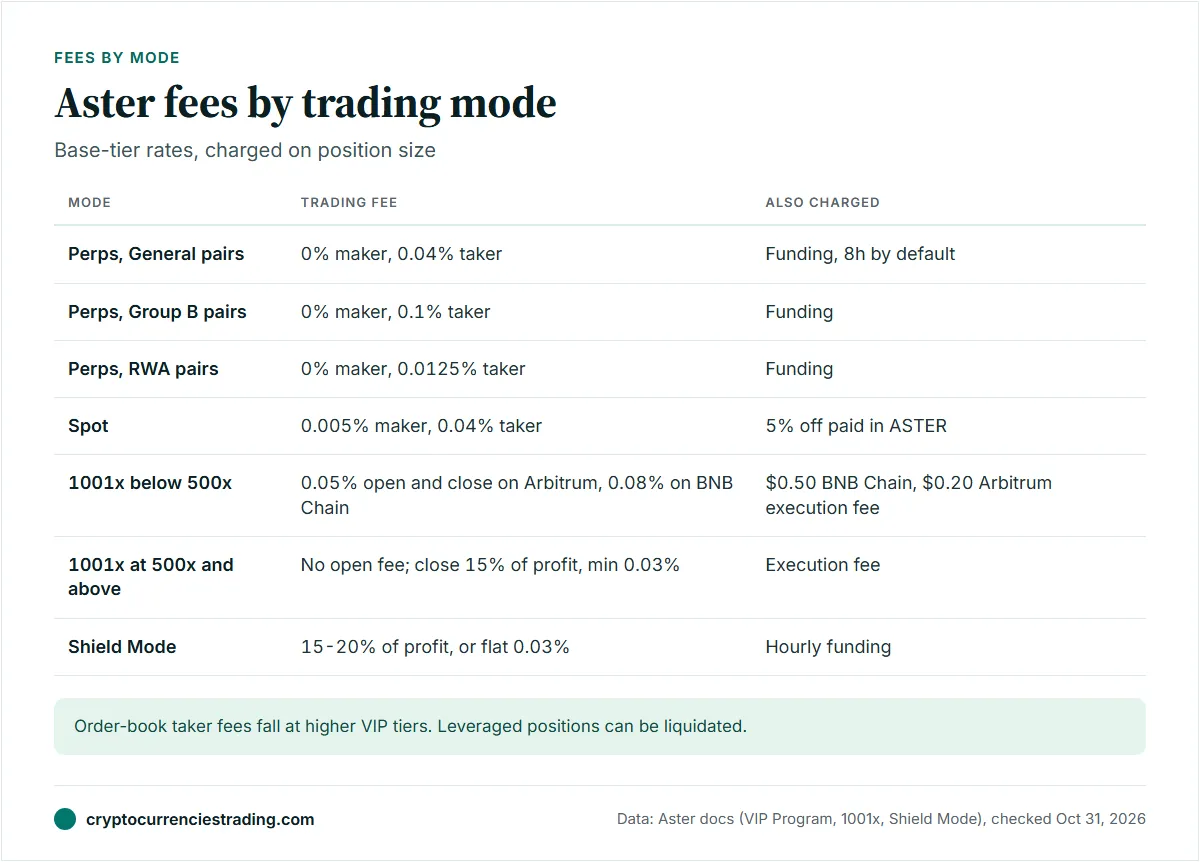
Aster’s two simplified perps modes do not use the maker-taker schedule.
1001x
1001x trades on-chain against a liquidity pool on BNB Chain and Arbitrum, straight from your wallet. Per its fees page and leverage page:
- Below 500x leverage: 0.05% to open and 0.05% to close crypto positions on Arbitrum, and 0.08% each way on BNB Chain, per the fee table on the fees page. The text of the same page and the leverage page still give 0.08% without naming a chain. Forex pairs, on BNB Chain only, pay 0.02% each way.
- At 500x, 750x or 1001x: no opening fee. The closing fee is 15% of your profit, with a floor of 0.03% of position size that losing trades pay too.
- Execution fee: $0.50 per opened position on BNB Chain and $0.20 on Arbitrum, to cover network costs.
- Funding and borrow costs: charged every block and added to unrealized PnL, so they move your liquidation price.
Shield Mode
Shield Mode lets you pick a fee model when you open a position:
- Profit share: 15% to 20% of the profit on a winning trade, and nothing on a losing one. The docs give 15% for BTCUSDT and ETHUSDT.
- Flat fee: 0.03% of the position’s notional value. The fees page says this rate applies to opening and closing positions, but not whether you pay it once or on both.
With the 1001x minimum closing fee, this is the “Aster 0.03% fee”. The Shield docs still mention a launch promotion with no opening or closing fees, so check the order panel before you confirm. Funding is charged hourly, based on the gap between long and short open interest.
Funding on Aster perps
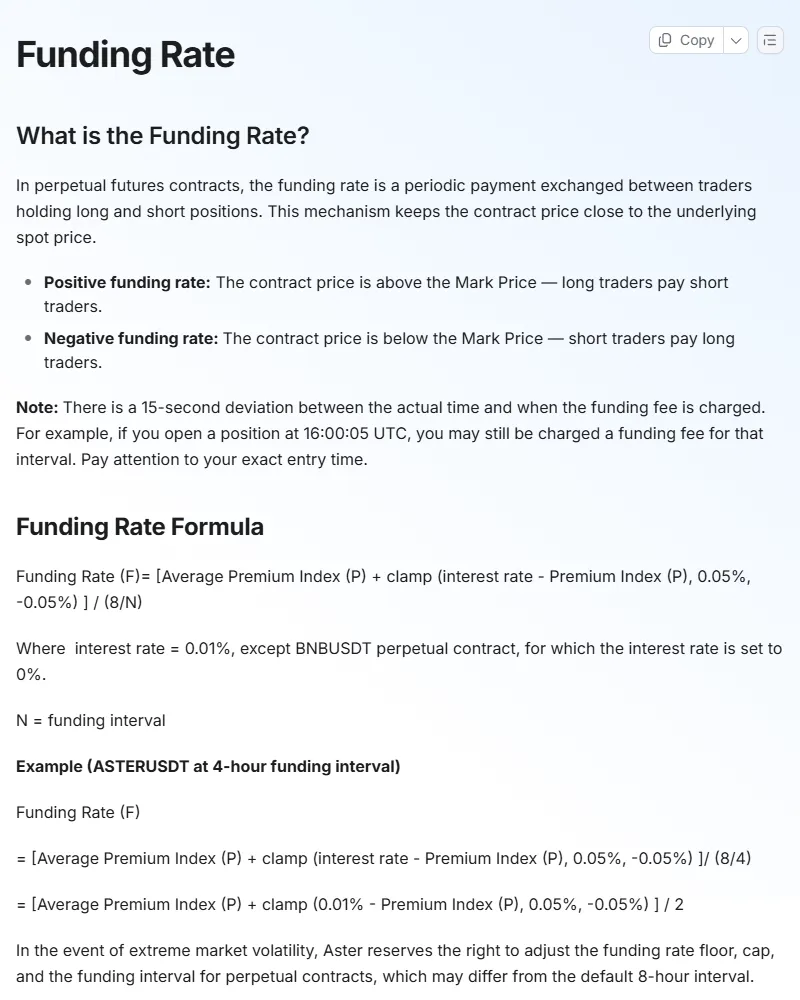
Funding passes between longs and shorts, and Aster’s funding page says Aster takes no cut. When the rate is positive, longs pay shorts.
The default interval is 8 hours, but it varies by market. On October 31, 2026, Aster’s public market data listed 8-hour funding on BTCUSDT and ETHUSDT, 4-hour funding on ASTERUSDT and 1-hour funding on some others. BTCUSDT’s last rate was 0.01%, the interest-rate part of Aster’s formula, capped at 0.3% per interval.
The payment is position size times the rate: $1 per interval on a $10,000 position at 0.01%. A position opened up to 15 seconds after a funding time may still pay for that interval. See our funding rates guide.
Liquidation costs
On the order book, a position is liquidated when your margin falls below the maintenance requirement. Per the liquidations page, Aster cancels your open orders, closes as much of the position as it can, and charges a liquidation fee on the liquidated notional, part of which goes to the insurance fund as an “Insurance Clearance Fee”.
Aster’s public market data listed a liquidation fee rate of 2.5% for BTCUSDT and nearly all other perps on November 1, 2026. The liquidations page points to Aster’s Trading Rules page for current rates.
The high-leverage modes leave very little room. In Shield Mode, BTC and ETH positions at 501x to 1001x are liquidated once losses reach 65% of margin, which at 1001x is a price move of well under 0.1%. Read leverage and liquidation explained first, and close positions yourself before the threshold to avoid the fee.
Deposit, withdrawal and gas costs
The Aster Chain docs list no deposit fee and no gas on Aster Chain itself. You pay the network fee of the chain you send from, so keep a little BNB or ETH for gas. Deposits arrive in 1 to 5 minutes, and Ethereum can take longer.
Withdrawals pay a gas fee set by the destination chain. On November 1, 2026, Aster’s public withdrawal-fee estimate returned:
| Withdraw to | Estimated fee (USDT or USDC) | Typical time |
|---|---|---|
| BNB Chain | About $0.10 | About 30 seconds |
| Arbitrum | About $0.50 | About 30 seconds |
| Solana | About $0.50 | About 30 seconds |
| Ethereum | About $0.50 | Longer, depends on the network |
From Aster’s withdrawal-fee API and the Aster Chain docs, checked November 1, 2026. Gas prices change, and the withdrawal window shows the current fee.
Clear any negative balance first: with several collateral tokens, losses, funding or fees can leave one, and the withdrawal guide says you must rebalance before withdrawing. Spot withdrawals go out on BNB Chain.
If your stablecoins sit on a chain Aster doesn’t take, moving them adds a bridge or exchange withdrawal fee. See how to fund a perp DEX and wrong-network mistakes.
Builder fees, vaults and other discounts
- Builder fees. Third-party sites built on Aster Code can add their own fee, up to a maximum rate you approve on your first trade there. Aster’s builder docs cap it at 0.1%.
- Vaults. A vault manager takes 0% to 100% of realized investor profits, shown before you invest, and nothing on losses.
- Referral discount. A referrer can pass part of their default 10% fee commission back to you as a fee discount, and the referrer sets the split.
Worked examples
A $1,000 spot buy. A market order at VIP 1 costs $1,000 × 0.04% = $0.40, or $0.38 paid in ASTER. A limit order that rests on the book costs $1,000 × 0.005% = $0.05.
A $10,000 BTC perp held for a day. You put up $1,000 at 10x and open with a market order.
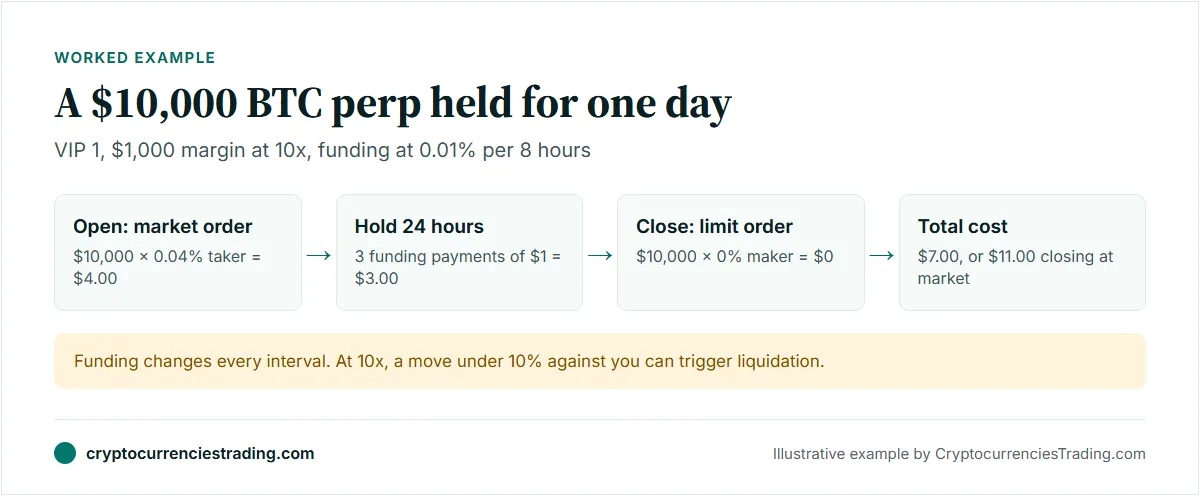
Opening costs $10,000 × 0.04% = $4.00. Three 8-hour funding payments at 0.01% cost $1 each, $3.00 if you are long and the rate stays positive. Closing with a resting limit order costs $10,000 × 0% = $0. The total is $7.00, or $11.00 if you close at market.
Funding changes every interval. At 10x, a move of less than 10% against you can trigger liquidation, because maintenance margin is reached before the $1,000 is gone.
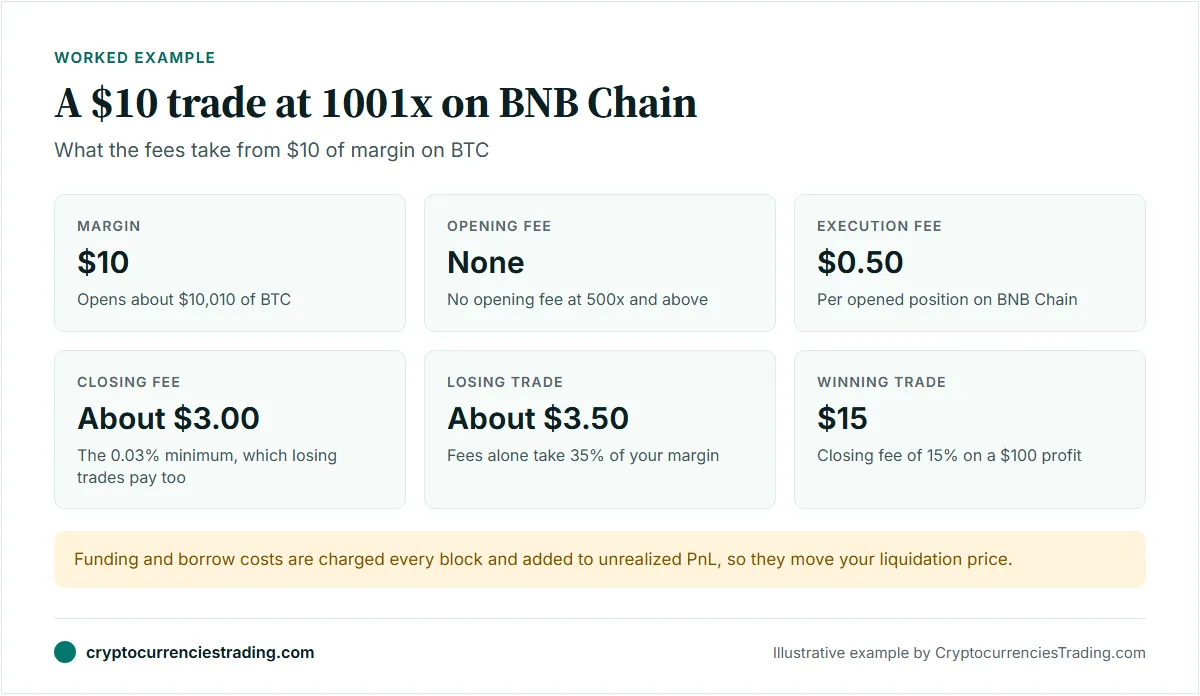
A $10 trade at 1001x. $10 of margin opens about $10,010 of BTC. There is no opening fee, but you pay the $0.50 execution fee on BNB Chain and at least 0.03% to close, about $3.00. If the trade loses, fees alone take about $3.50, or 35% of your margin. If it makes $100, the closing fee is 15% of the profit, $15.
How Aster fees compare
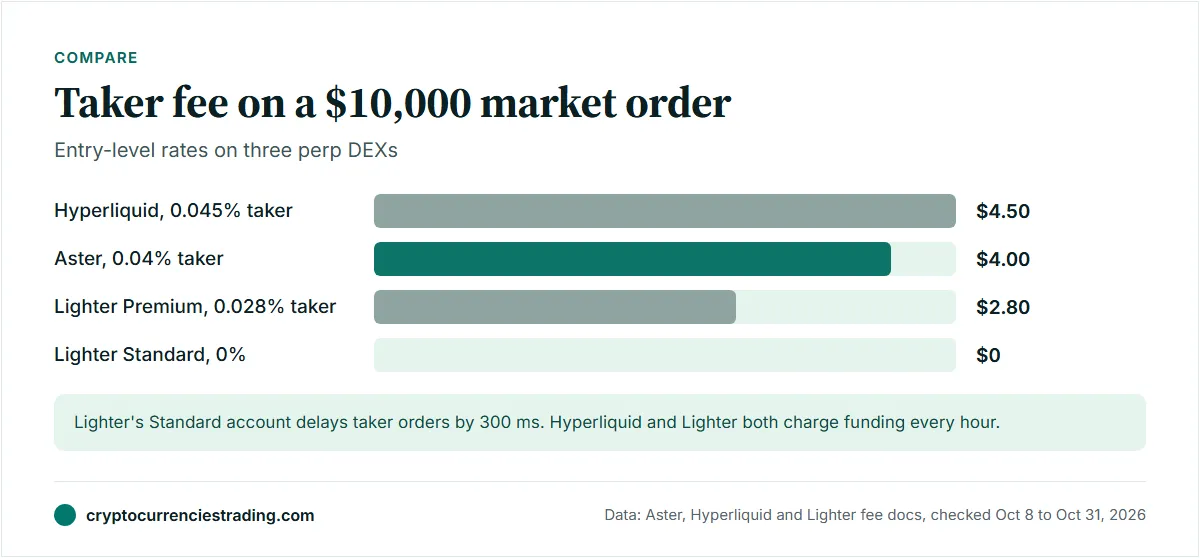
On a $10,000 market order at entry-level rates, Aster’s 0.04% taker fee costs $4.00. Hyperliquid charges 0.045% taker and 0.015% maker, so $4.50 at market and $1.50 with a resting limit order, where Aster charges $0; its USDC withdrawal to Arbitrum costs 1 USDC. Lighter’s default Standard account charges 0% on both sides but delays taker orders by 300 ms, and its Premium account charges 0.028% taker, $2.80 on the same order. Hyperliquid and Lighter both charge funding every hour. See the best perp DEXs for more.
How to pay less on Aster
- Use limit orders that rest on the book: perps maker fees are 0%.
- Check whether a pair is in Group B before trading it at market.
- Below 500x, the order book costs less than 1001x: 0.04% taker against 0.05% each way on Arbitrum or 0.08% on BNB Chain.
- Withdraw to BNB Chain when your destination accepts it.
- Watch funding on longer holds, and use lower leverage to keep liquidation further away.
Frequently asked questions
What are Aster DEX’s maker and taker fees?
On order-book perps, 0% maker and 0.04% taker on General pairs at VIP 1, falling to 0.016% taker at VIP 6. Group B pairs start at 0.1% taker, and RWA pairs pay 0.0125%. Spot costs 0.005% maker and 0.04% taker at VIP 1.
What is Aster’s 0.03% fee?
It is the flat-fee option in Shield Mode, charged on the position’s notional value instead of a share of profit. 1001x also charges a minimum closing fee of 0.03% at 500x and above.
How much does it cost to withdraw from Aster?
Deposits carry no Aster fee, only gas on the chain you send from. Withdrawals pay a gas fee set by the destination chain: Aster’s estimate on November 1, 2026 was about $0.10 to BNB Chain and about $0.50 to Arbitrum, Solana or Ethereum.
Is Aster cheaper than Hyperliquid?
At base rates, yes: 0.04% against 0.045% taker, and 0% against 0.015% maker. Funding, spreads and withdrawal costs can change the total.
