| Market | Maker | Taker | Notes |
|---|---|---|---|
| Spot | n/a | n/a | Each Stock Token quote lists a protocol fee and the settlement gas cost, both charged in the token you trade; Arcus publishes no rate. A token-to-token swap needs no ETH, and you pay gas in ETH yourself only when you pay with ETH. The help center says the quote can also include fees or spreads kept by the settlement network, routers or aggregators; other help center pages still say spot Stock Token trading carries no Arcus fee and that you need a little ETH for gas. |
| Perpetuals | 0.015% | 0.045% | These are the crypto perps rates at the base tier (under $2.5M in 30-day volume), Arcus's standard schedule since October 23, 2026. Stock, commodity and index perps keep the beta rates of 0% maker and 0.0225% taker at the base tier; Arcus calls these discounted rates and has set no end date. Higher tiers pay less on both schedules, with maker rebates from $500M in 30-day volume. Liquidations closed on the order book pay a per-market fee of about 10% of the market's initial margin fraction, capped at 1%. |
Arcus trading fees depend on what you trade. Each Stock Token quote lists a protocol fee and gas, and Arcus publishes no rate for the protocol fee. Since October 23, 2026, crypto perps cost 0.015% maker and 0.045% taker at the base tier, so a $10,000 crypto perp market order costs $4.50. Stock, commodity and index perps keep the beta rates of 0% maker and 0.0225% taker, or $2.25 on the same order. The costs to watch are the spread built into every Stock Token quote, hourly funding on perps, and a liquidation fee of up to 1%.
Arcus adds no deposit or withdrawal fee of its own. What you pay on the way in and out goes to card processors, bridges and the network, and the app shows it before you confirm.
This is not financial advice. Perpetuals use leverage, and a leveraged position can be liquidated.
Arcus is not available in the US, UK or Canada, and perps need an invite code; see where Arcus is available. For how the exchange works, see our Arcus review.
Arcus trading fees on Stock Token swaps
Every quote to swap USDG for a Stock Token, or back, lists its fees: a protocol fee and the settlement gas cost, both charged in the token you trade, per Arcus’s docs. The docs publish no rate for the protocol fee and say to read the fee lines on each quote rather than assume a fixed rate. The quote is the estimated all-in price: the help center says it can include network costs and fees or spreads kept by the settlement network, routers or aggregators, and the fill can differ from the quote within your slippage setting. Two other help center pages, an RFQ answer and the perps fee-tier page, still say spot Stock Token trading carries no Arcus fee.
What that means in practice:
- Spread. Quotes come from market makers and on-chain pools. The help center says spreads widen overnight, at weekends and on US market holidays, most on less-traded names and on sell quotes.
- Gas. The docs say a token-to-token swap needs no ETH: Arcus’s router submits the transaction, and gas is charged in the token you trade and shown as a line on the quote. You pay gas in ETH yourself only when you pay with ETH. The help center still says you need a small amount of ETH on Robinhood Chain for network fees, so keep a little ETH in your wallet, and read every fee line on the quote before you sign.
- Builder fees in other apps. Wallets and apps that route trades through Arcus can add their own builder fee, which the docs say appears as a line on the quote.
- No FX fee. Prices are in US dollars, and Arcus charges no separate FX fee on Stock Token trades.
- pTokens. We found no Arcus fee for trading pTokens on its official pages. The pTokens launch post says the cost of rebalancing trades and hourly funding comes out of each token’s value.
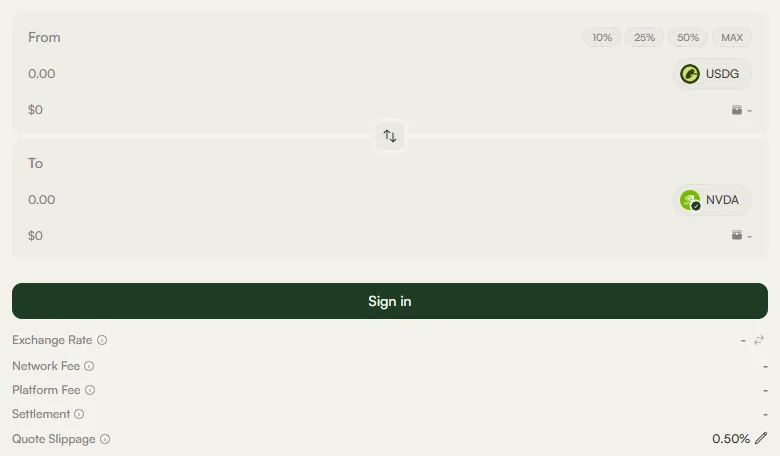
To pay less, compare the quote with the stock’s last price, trade thin names during US market hours, and split large orders on less-traded names, as the help center suggests. Stock Tokens are not shares; see what tokenized stocks are.
Arcus perps fees: maker, taker and volume tiers
Perps use maker/taker fees, tiered by your rolling 30-day volume across all perp markets, crypto and real-world assets combined. Each fill is charged at the schedule for its market type. A market order pays the taker fee. A limit order that rests on the book pays the maker fee. See maker vs taker fees.
- Crypto perps moved to Arcus’s standard schedule on October 23, 2026, when their beta discount ended, per Arcus’s October 20 announcement. The base tier, where every new account starts, pays 0.015% maker and 0.045% taker, so a $10,000 market order costs $4.50. That is double the beta taker rate.
- Stock, commodity and index perps keep the beta rates: 0% maker and 0.0225% taker at the base tier, or $2.25 on the same order. A resting limit order pays nothing at this tier.
The same update halved every tier threshold. The fee-tier page lists these rates:
| Tier | 30-day volume | Crypto perps (maker / taker) | Stock, commodity and index perps (maker / taker) |
|---|---|---|---|
| 0 | Under $2.5M | 0.015% / 0.045% | 0% / 0.0225% |
| 1 | $2.5M | 0.012% / 0.038% | 0% / 0.019% |
| 2 | $10M | 0.008% / 0.032% | 0% / 0.016% |
| 3 | $50M | 0.004% / 0.027% | 0% / 0.0135% |
| 4 | $200M | 0% / 0.023% | 0% / 0.0115% |
| 5 | $500M | -0.002% / 0.020% | -0.002% / 0.010% |
| 6 | $1.5B | -0.003% / 0.019% | -0.003% / 0.0095% |
A negative maker fee is a rebate paid to you.
Arcus has not said how long the stock, commodity and index rates will last. The fee-tier page calls them discounted rates and gives no end date. Arcus’s beta fee post says standard fees resume when beta ends, with notice in advance on X and Arcus’s website. The crypto perps change was announced three days ahead.
- Higher tiers. Tiers advance automatically with volume, and higher tiers pay less. Tiers 5 and 6 earn a maker rebate on both schedules, which the help center says is credited to your collateral balance on each fill.
- Referral discount. A trader registered under a referral code gets 5% off positive maker and taker fees, per the fee docs. It does not apply to zero fees or rebates. On a $10,000 crypto perp market order at the base tier, it cuts the fee from $4.50 to about $4.28.
- Sub-accounts. Volume across the sub-accounts of one wallet counts toward a single tier.
- No gas on orders. Placing, modifying and cancelling orders costs no gas.
- Live rates. Your current tier and rates are on the Portfolio dashboard in the app.
Funding on Arcus perps
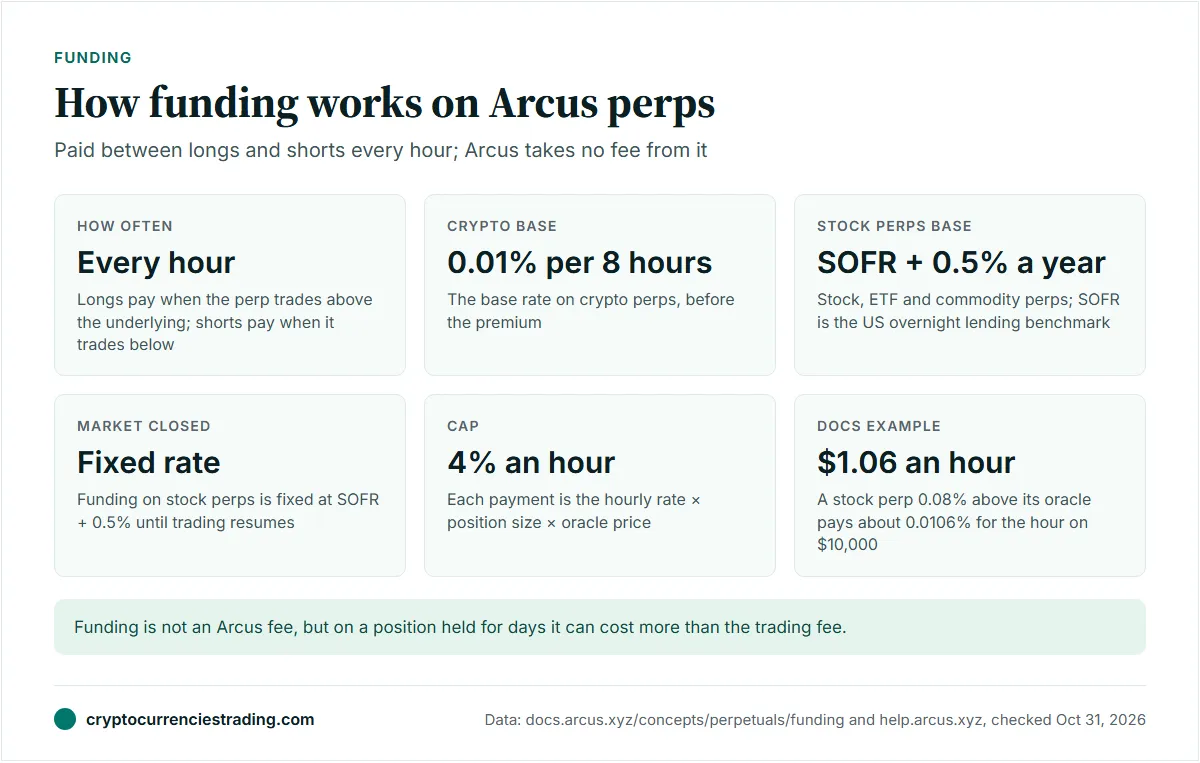
Funding is paid every hour between longs and shorts, and Arcus takes no fee from it. When the perp trades above the underlying, longs pay; below it, shorts pay. Each payment is the hourly rate × position size × oracle price, and the rate is capped at 4% an hour, per the funding docs.
The rate is a base plus a premium:
- Crypto perps: a base of 0.01% every 8 hours.
- Stock, ETF and commodity perps: a base of SOFR + 0.5% a year. SOFR is the US overnight lending benchmark.
- While the stock market is closed, funding on those markets is fixed at SOFR + 0.5% until trading resumes, so weekend holds don’t face shifting funding.
The premium can outweigh the base. In the docs’ example, a stock perp trading 0.08% above its oracle pays about 0.0106% for the hour, or $1.06 on a $10,000 position. See funding rates explained.
Worked example: a $10,000 stock perp held for a day
Say you open a $10,000 long on a stock perp with $1,000 of margin (10x) and hold it for 24 hours over a weekend, when the stock market is closed. Fees are charged on the position, not your margin.
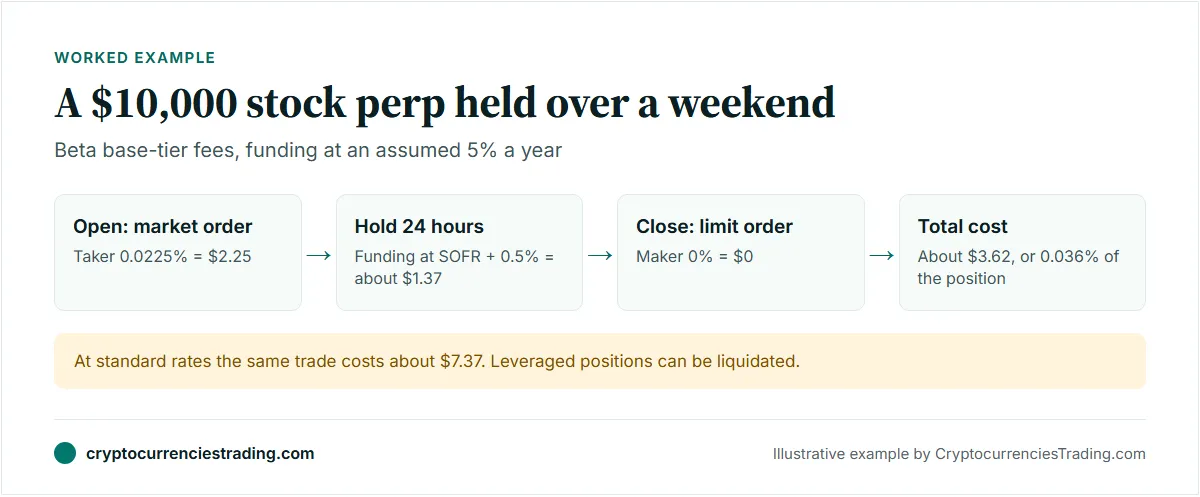
- Open with a market order: $10,000 × 0.0225% = $2.25.
- Hold for 24 hours. Funding is fixed at SOFR + 0.5% while the market is closed. Assuming that comes to 5% a year (an illustrative rate): $10,000 × 5% ÷ 8,760 hours × 24 = about $1.37, paid by longs.
- Close with a resting limit order: $10,000 × 0% = $0.
The total is about $3.62, or 0.036% of the position and 0.36% of your margin. At the standard 0.045% taker and 0.015% maker rates, which crypto perps have paid since October 23, 2026, the same trade would cost about $7.37.
Opening a position while the market is closed currently needs 1.5 times the usual initial margin, per the margin docs. At 10x, a move of less than 10% against you can get the position liquidated, you can lose the collateral behind it, and a liquidation closed on the order book also pays a fee of up to 1%; see leverage and liquidation explained.
Arcus deposit and withdrawal fees
Arcus charges no deposit or withdrawal fee of its own, and the onboarding docs say USDG deposits and withdrawals carry zero fees. Whatever you deposit is converted to USDG on Robinhood Chain by Fun, a third-party onboarding provider, and the route, fees and estimated time are shown before you confirm.
Arcus deposit and withdrawal costs
Arcus adds no fee; third parties set their own
| Route | Arcus fee | Third-party cost | Minimum or limit |
|---|---|---|---|
| Crypto from another chain | None | Bridge fee and gas, shown first | About $3; higher on Ethereum, Bitcoin |
| Coinbase account | None | Shown before you confirm | No set minimum |
| Card, Apple Pay, Google Pay | None | About 2.1% | About $3 |
| SEPA bank transfer | None | About 0.5% | About $3 |
| Revolut Pay | None | About 1.1% | About $3 |
| Perps to Spot balance | None | No bridge needed | $2M a transaction, $8M a day |
| Spot to another chain | None | Bridge fee and gas, shown first | Set by the bridge route |
Keep a little ETH on Robinhood Chain for gas.
- Crypto from another chain. Send from Ethereum, Arbitrum, Base, Solana, Bitcoin and others. The routes use bridges such as Circle CCTP, Relay, Across and LayerZero, which charge their own fees. The minimum is about $3 on most chains and higher on Ethereum and Bitcoin.
- Coinbase. Connect a Coinbase account to pull funds across in about two minutes, with no set minimum.
- Cash. The help center lists typical processor fees of about 2.1% for cards, Apple Pay and Google Pay, about 0.5% for SEPA bank transfers and about 1.1% for Revolut Pay, with other wallets and vouchers higher. The minimum is about $3.
- Currency conversion. Local currency converts to USDG with no spread for most currencies. The exceptions are KES, RWF, ZMW, ZAR, NGN and INR.
Withdrawing takes two steps. Withdrawing from Perps moves USDG to your Spot balance in the same wallet on Robinhood Chain, with no bridge. From Spot you can bridge out to other chains, and the screen shows the bridge fee, gas estimate and total received first. There is no minimum for withdrawals to your Robinhood Chain wallet, and perps withdrawals are capped at $2 million a transaction and $8 million a day.
Our guides to funding a perp DEX and bridging USDC walk through the routes.
Other costs
- Liquidation. A liquidation closed on the order book pays a per-market fee of about 10% of the market’s initial margin fraction, for example 1% on a 10x market, capped at 1% and paid to the insurance fund, per the help center. The liquidation docs say takeovers and auto-deleveraging charge no fee. Either way, a liquidated position can cost you all the collateral behind it.
- Borrowing. Multi-Asset Collateral, in early access, lets you margin perps with Stock Tokens or ETH. Arcus then lends you USDG when your account needs it, and the docs say you pay variable interest at SOFR plus a spread that rises with lending utilization.
How Arcus DEX fees compare
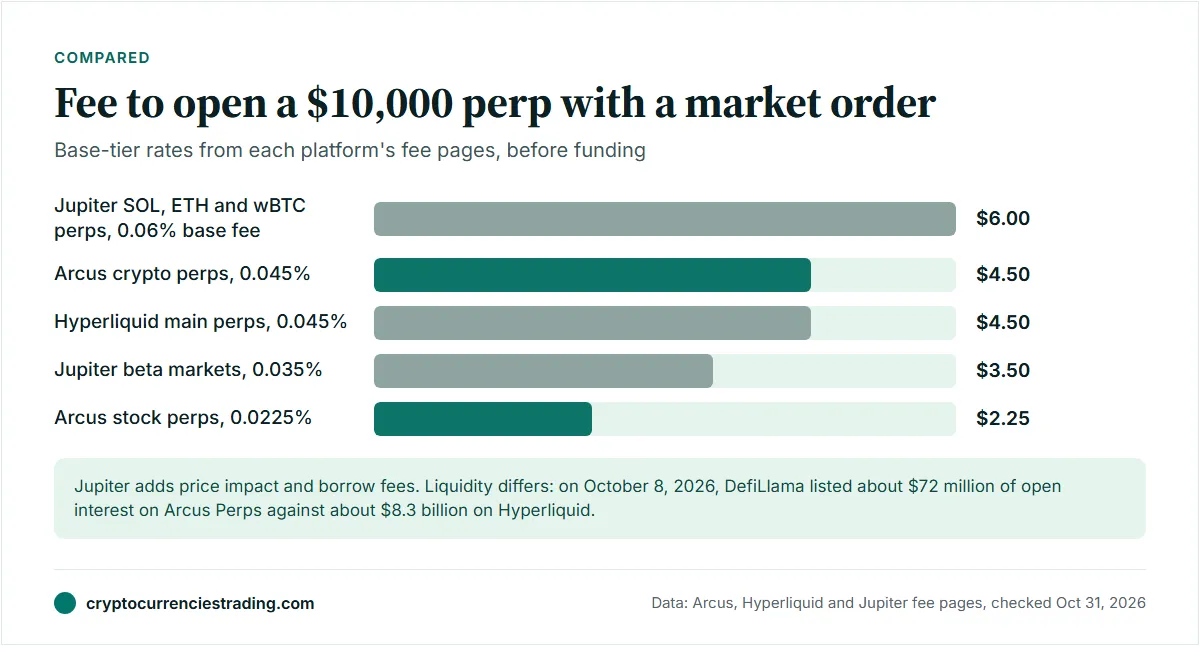
Next to two alternatives from our perp DEX ranking, Arcus now matches on crypto perps and costs less on stock perps. On a $10,000 crypto perp market order, its 0.045% taker fee is $4.50, the same as Hyperliquid at its 0.045% base taker rate on its main perps, where builder-deployed markets can differ. On a stock perp, Arcus’s 0.0225% taker fee is $2.25. Jupiter charges $3.50 (0.035% taker) on its beta markets, which include stock perps, and a 0.06% base fee ($6.00) to open SOL, ETH and wBTC positions, plus price impact and borrow fees. For tokenized stocks, Arcus lists a protocol fee on each quote but publishes no rate, while Jupiter’s default Ultra mode takes 0% to 0.5% per swap. Liquidity is the trade-off: DefiLlama listed about $72 million of open interest on Arcus Perps on October 8, 2026, against about $8.3 billion on Hyperliquid. More options are in our tokenized stock platform ranking.
Frequently asked questions
What are Arcus trading fees?
Each Stock Token quote lists a protocol fee and gas, both charged in the token you trade, and the quoted price includes any spread. Arcus publishes no rate for the protocol fee. Since October 23, 2026, crypto perps cost 0.015% maker and 0.045% taker at the base tier. Stock, commodity and index perps cost 0% maker and 0.0225% taker. Higher tiers pay less, and traders registered under a referral code get 5% off positive fees.
Does Arcus charge deposit or withdrawal fees?
Arcus adds none. You pay third-party costs such as about 2.1% on card deposits, bridge fees and gas, all shown before you confirm.
Do I need ETH to trade on Arcus?
Arcus’s docs say no for token-to-token Stock Token swaps: gas is charged in the token you trade, and you pay it in ETH only when you pay with ETH. The help center still says you need a small amount of ETH on Robinhood Chain for gas, so keeping a little ETH covers both cases. Placing, modifying and cancelling perps orders costs no gas.
Is funding a fee on Arcus?
No. It passes between longs and shorts every hour, and Arcus takes no cut. On a position held for days, it can still cost more than the trading fee.
